Silkwood (1983)

Superb drama about true-life events. 

Karen Silkwood (Meryl Streep) works at the Kerr-McGee Cimarron Fuel Fabrication Site in Oklahoma with her lover Drew (Kurt Russell) and their friend Dolly (Cher). Making fuel rods for nuclear reactors, she is exposed to radiation owing to the company cutting corners on safety standards. She alerts the Atomic Energy Commission and helps them investigate, with significant consequences. 

Although it’s a biographical story with political elements, it works especially well as a domestic narrative. I really like the scenes between Karen, Drew and Dolly, who all live together. The human drama of their developing relationships seems very real and I’d have been happy to watch an entire film focusing on that. The fact that there’s a whole additional narrative is just a bonus. 

I could finally see what all the fuss was about regarding Streep. She’s riveting and hugely charismatic. Kurt Russell is also strong, once again taking on a somewhat sulky role. Cher is terrific too: in her role as a downbeat, almost monosyllabic lesbian she’s the opposite of what you’d expect based on her glitzy showbiz profule.

Directed by Mike Nichols and with a screenplay by Nora Ephron, this could hardly fail to be enthralling. Sure enough, it ends up being one of the best films I’ve ever seen.

The Whistle Blower (1986)

Spy thriller. Michael Caine stars as a retired naval officer and Korean War veteran. Nigel Havers is his son, a linguist working for GCHQ who is compromised after finding out too much about the true workings of the British establishment. 

The plot can be complex and difficult to follow. Still not sure why the Russian spy was held in a fake hotel constructed in an aircraft hangar, but all of this probably makes more sense in the original novel by John Hale. 

Caine is absolutely excellent, showing more diversity and range in his acting than he’s often credited for. Havers is likeable, too, despite his years of TV overexposure. There are also parts for James Fox and John Gielgud. 

It’s a consistently engrossing low-budget English drama that’s worth seeing if only for the scene in which Michael Caine gets his friend (Barry Foster) drunk on vodka while concealing his own sobriety.

Kes (1969)

This drama directed by Ken Loach (adapted from Barry Hines’ novel A Kestrel for a Knave) is the saddest film I’ve ever seen. 

Billy is growing up in Barnsley, Yorkshire, where he lives with his unkind brother and distant mother. His school is a seemingly barbaric, uncaring place, and he appears to have little future beyond a job in the local coal mine. His life changes when he finds a kestrel. He starts to feed and train the bird, which gives his life purpose and meaning and soon becomes the focal point of his existence. His love of Kes offers him a form of freedom and hope, but this hope is tragically short-lived. 

David Bradley is absolutely remarkable in the lead role as Billy. He has you absolutely rooting for him from the very beginning. He’s gentle but tough. And his wise, sad, hugely expressive face is heartbreaking to watch. Amazingly, he had never acted before. 

The soundtrack by John Cameron is beautiful – a sort of pastoral English folk music. 

The ending is absolutely devastating. But before this, there are moments of humour and shrewd social observation. 

A masterpiece.

Senna (2010)

Brilliant documentary about Brazilian Formula One driver Ayrton Senna. It’s assembled entirely from footage of the time, so there are no retrospective talking heads or other such elements. As such, it’s pretty intense. We see his rise to prominence, his rivalry with McLaren teammate Alain Prost and his becoming a national hero for Brazil. Unfortunately, we also get to see the 1994 crash that killed him. 

If there’s a criticism, it’s that we learn very little of his personal life. The focus is entirely on his career, but that’s still more than enough of a story to make this a dynamic experience.

Backdraft (1991)

Chicago in 1971. Two brothers lose their fireman father when he is killed on duty. Twenty years later they are both firemen too and find themselves working within the same division, as resentful older brother Stephen (Kurt Russell) starts to train younger brother Brian (William Baldwin). 

Robert De Niro plays the Inspector of Fire Investigation. Donald Sutherland is a serial arsonist who wants to burn down the entire world. Jennifer Jason Leigh plays Brian’s former girlfriend (it seems inappropriate to write “old flame”). And Rebecca De Mornay is Stephen’s estranged wife. 

Ron Howard’s film has plenty of drama, and the fire scenes are scary. It’s a tale of two brothers that sometimes suffers from the fact that neither is especially likeable. In fact – with the possible exception of De Niro – that goes for everyone in it.

When a Man Loves a Woman (1994)

Meg Ryan plays a mother of two who descends into the horror of alcohol addiction. Andy Garcia plays the loving airline-pilot husband who wants to save her but ends up stifling her in the process.

It’s an extremely well-written drama that avoids cliché. Cleverly, it evolves from a film about a drink problem into a film about a marital problem. And it presents the couple’s situation from multiple angles so that it’s difficult to “take sides”.

The two child roles are brilliantly acted by Tina Majorino and Mae Whitman, revealing real sensitivity in their restrained but heartbreaking performances. Philip Seymour Hoffman plays a friend from Alcoholics Anonymous, who oddly drops out of the narrative without explanation – the only real flaw.

The songs on the soundtrack can be a little intrusive, but they don’t spoil the film. I was fearing a simplistic “happy” or “sad” ending, but it wisely avoids that and finds its way to a more satisfying conclusion. It’s emotional and powerful.

Waterworld (1995)

A very strange epic. With a budget of $172–175 million, was the most expensive film ever at the time it was made.

It’s the future. The ice caps have melted and the old civilisations are now underwater graveyards. A few humans survive as nomads and warriors in battered boats and makeshift floating villages. 

The Deacon (Dennis Hopper) is a crazed leader seeking to capture a little girl named Enola (Tina Majorino), who has a map of the mythical “Dryland” tattooed on her back. Jeanne Tripplehorn is Enola’s guardian. And Kevin Costner is the monosyllabic “mariner” who reluctantly becomes their protector.

It’s a technically impressive film that’s also quite daft in many ways. The slight pantomime quality actually works: the world has become more extreme and absurd, and people have degenerated as a result. I was frequently reminded of recent American political rallies, and the villain at the centre of them – an orange, deranged monster – is very reminiscent of someone else in US politics.

It’s such an unusual film. There are hints of Apocalypse Now, Flash Gordon, Mad Max, Raiders of the Lost Ark and Return of the Jedi, but it has a peculiar tone and feel of its own. A few things keep greatness at bay:
• Why has Costner evolved to have gills and webbed feet so quickly? It’s described as a “mutation”, but no more detail is given.
• Cheery “adventure” music undercuts the drama – what I think of as the “Spielberg Syndrome”.
• The lighting is all over the place. Bright studio lights come and go with little relation to the weather or environment.

Hugely enjoyable, though.

Desperately Seeking Susan (1985)

I had wanted to see this film for 35 years, but unfortunately it turned out to be a bit of a disappointment. 

Roberta (Rosanna Arquette) is a bored housewife who becomes obsessed with the personal ads in her newspaper – particularly those between a couple called Susan and Jim. Her life changes when she starts stalking Susan (played by Madonna) around the streets of New York and becomes accidentally involved in a crime involving a pair of stolen Egyptian earrings. Then Roberta has a bump on the head and can’t even remember her own name. She’s forced to begin a new life with a new identity, while simultaneously being pursued by a killer.

Not funny enough to work as a comedy nor exciting enough to work as a drama, the story often falls flat. It tries to become a sort of farce but then misses opportunities to squeeze comedy out of absurd situations. Compare it to What’s Up, Doc? to see how it could have been done so much better. 

Arquette is fairly sweet as the lead character. Madonna is pretty good, too, largely because she barely speaks. Roberta’s husband (Mark Blum), sister-in-law (Laurie Metcalf) and new boyfriend (Aidan Quinn) are merely so-so, largely because of the average script. Deadpan comedian Steven Wright is also present, but criminally underused. 

The soundtrack is bizarrely inappropriate, with clanking synths and drums almost drowning out everything else. Only Madonna’s “Into the Groove” and a burst of Iggy Pop’s “Lust for Life” redeem it. 

As it lumbers towards a laboured conclusion, you realise that the “Egyptian earrings” plot is one thread too many. It could have been ditched entirely to keep the focus on the various relationships, as there’s enough going on already with the strands about memory loss and mistaken identity. It’s far from a terrible film – just a bit of a mess.

Gorillas in the Mist (1988)

Sigourney Weaver plays naturalist Dian Fossey, who worked to monitor and protect the mountain gorillas of Rwanda from 1966 until her murder in 1985. 

Directed by Michael Apted and adapted from Fossey’s own memoir, this (sort-of) biopic is remarkable for its close-ups of the gorillas seeming to interact directly with Weaver. It’s not clear how that was achieved, and I’m not sure I want to know, but the effect of seeing her living so closely with the animals is powerful indeed.

There’s a strong empathy for these critically endangered creatures and there are heartbreaking scenes showing the impact of the poachers. 

Weaver gives the performance of a lifetime, expressing great tenderness with the gorillas (and briefly with Bob Campbell, her photographer lover played by Bryan Brown) alongside her increasingly fierce determination to protect the species (going so far as to mimic a witch to scare the locals) – whatever the cost. 

It’s both tragic and uplifting. Fossey paid the ultimate price for her commitment, but was able to raise enough awareness to ensure that the gorillas remain protected to this day.

Memoirs of an Invisible Man (1992)

John Carpenter's clever, funny adaptation of the excellent novel by H.F. Saint is a real treat. Chevy Chase plays a man accidentally turned invisible by an accident in a scientific research institute. Instead of wanting to help him, the people responsible attempt to capture and exploit him for his unusual condition.

Some of the “invisible” scenes are ingenious, such as when the invisible man holds a gun against the head of the villain (played by Sam Neill). You see Neill dragged across a room with the weapon apparently stuck to his head.

Daryl Hannah offers an above-par performance as the girlfriend, seeming more engaged than she usually does. 

The film received generally poor reviews but I can’t understand why. It’s hugely entertaining. Maybe people didn’t like the fact that it so effortlessly crosses and combines genres (crime thriller, romance, sci-fi, comedy). That sort of freedom doesn’t seem to be encouraged: maybe films can’t be marketed as easily if they evade a simplistic genre categorisation. But it makes for something very refreshing to watch.

The Sting (1973)

Classic caper set in Chicago in 1936. 

Johnny Hooker (Robert Redford) is a petty criminal whose conman partner is murdered by Doyle Lonnegan (Robert Shaw), a much more powerful criminal. Hooker seeks his revenge and teams up with Henry Gondorff (Paul Newman) to trick Lonnegan out of his money. 

The twists and turns of the plot are complex, so you really need to pay attention. In a couple of places I found it too far-fetched, but wasn’t going to let that spoil it.

The chemistry of the two leads is clearly evident, with Redford in particular exuding magnetism, but I still preferred seeing their interplay in Butch Cassidy and the Sundance Kid (1969).

Robert Shaw is brilliant as the brooding villain who walks with a slight limp.

Scott Joplin’s ragtime piano music adds a playful, colourful quality to the action, neatly framing this somewhere between crime film and comedy-drama.

Ender’s Game (2013)

A sci-fi saga presumably aimed at 12-year-old boys, this version of Orson Scott Card's 1985 novel is entertaining and races along in an exciting way.

Ender Wiggin (Asa Butterfield) is an unusually talented child selected to join an orbiting military academy. He is one of many young people being trained to lead Earth’s defence against invading aliens named the Formic. Harrison Ford plays his mentor, Colonel Hyrum Graff, while Ben Kingsley is Mazer Rackham, a war hero from the aliens’ first attack.

For some reason the training segments of the film – complete with drill instructor – seem to deliberately pay homage to those in Full Metal Jacket, a film that the young audience won’t even be aware of.

The visuals are often remarkable, with seamless zero-gravity CGI and impressive videogame-like effects. 

In places it can all seem a little silly – a bunch of kids taking everything very seriously indeed – and although it attempts to introduce moral issues, these aren’t explored in great depth.

But ultimately it’s a well-paced romp, and the double twist of the ending certainly wasn’t predictable.

Heat and Dust (1983)

Strangely tepid Merchant Ivory adaptation of Ruth Prawer Jhabvala’s Booker Prize-winning novel of 1975. 

In the 1980s, Anne (Julie Christie) travels from England to India to find out what happened to her great-aunt Olivia (Greta Scacchi) in the 1920s. The story splits so that we switch between both timelines. Olivia, we learn via extensive flashbacks, was married to a civil servant in the British Raj, Douglas Rivers (Christopher Cazenove), but caused scandal when she became involved with an Indian prince. 

The material is potentially interesting, but the treatment is leaden and stilted, despite the best efforts of Scacchi and Christie – who are the best thing about the film by some distance. The thread about civil unrest is not satisfactorily resolved. 

Slow and ponderous scenes lack vitality. Quite a few of them could have been trimmed or cut entirely. Ultimately, not a great deal happens and the drama that we do see is oddly underplayed. For example, we never get to find out how Douglas feels about his wife’s behaviour. In fact, we don't even learn how she feels about it herself. 

Maybe the novel is more exciting, but you’d never know it from sitting through these turgid 133 minutes.

The End of the Affair (1955)

Adaptation of Graham Greene’s classic 1951 novel. During World War II, writer Maurice Bendrix (Van Johnson) goes to the party of London civil servant Henry Miles (Peter Cushing) and soon after begins an affair with his wife Sarah (Deborah Kerr). But when Bendrix is injured in a bombing, Sarah mysteriously removes herself from his life. 

This clever melodrama toys with becoming a noirish, Hitchcockian thriller – there’s an endearingly silly detective played by John Mills – but is really a film about religious faith and morality. 

A few things stand out as odd:

• The couple seem to go from meeting to being obsessively in love in no time at all, and yet there’s no real chemistry between them. What do they have in common? It’s as if a scene or two is missing, as their apparent attraction is never explained.
• When Bendrix first sees Sarah, she’s kissing another man. Who is he and why is this additional affair not explored further? Was it simply there to indicate that she was unhappily married?
• If Bendrix is American, why is he writing a book about the English civil service?

It was remade in 1999, with Ralph Fiennes and Julianne Moore in the lead roles.

The Hucksters (1947)

Amusing satire on the world of radio advertising – a niche topic that makes for surprisingly rich material. Clark Gable stars as Victor Norman, a war veteran who ends up working for an advertising agency and finding new ways to sell people Beautee Soap. Deborah Kerr (a straight society widow) and Ava Gardner (a sultry nightclub singer) are the two women he flits between, while Sydney Greenstreet plays the intimidating boss who everyone (except Victor) is terrified of. 

The dialogue sparkles and there are some very funny lines. Gable, perpetually smoking, is charming but perhaps not quite as charming as the film believes he is. 

Where The Hucksters really excels is with its quirky, witty outlook. At one point Victor goes to buy a “sincere” necktie. At another point, he throws money out of the window. And Deborah Kerr’s cute daughter is hilarious.

Peggy Sue Got Married (1986)

Funny and moving drama by Francis Ford Coppola. Peggy Sue (Kathleen Turner) attends a high school reunion and is dismayed when her estranged husband Charlie (Nicolas Cage) unexpectedly shows up. She faints...and wakes up in 1960 – 25 years in the past. 

Trying to come to terms with her bizarre new reality, she spends a few days in her childhood world, with her family and school friends, and faces some fundamental dilemmas. Can she change her life and avoid the mistakes she knows she is destined to make? Should she break up with Charlie, who seems to love her so much but who will later betray her? What can she do differently now that she has all the knowledge and wisdom of her 1985 self and perspective on what really matters? The film explores these questions in a way that’s always humorous and often profound.

The 1980s-to-1950s/60s time-travel plot gives this plenty in common with Back to the Future (1985), but I like the fact that this film doesn’t bother with the technical “rules” about changing the future by interfering with the past. Quite the opposite: at one point, Peggy Sue gives Charlie the lyrics to a song she says she wrote. It turns out to be “She Loves You” by The Beatles (which would be a hit in 1963). 

Given such a warm and intelligent script, Kathleen Turner gives the performance of a lifetime, perfectly conveying all the excitement and confusion of what she’s going through. Nicolas Cage is extremely charming, as the role demands, and he has a strange, goofy appeal that’s a result of his huge charisma. 

It’s incredibly romantic, but that romance is all the deeper and more affecting because of the interwoven threads of hope and regret that run through it.

On the Road (2012)

It was never going to be easy to film Jack Kerouac’s 1957 masterpiece, which isn't really a novel at all, but Walter Salles has a solid bash at it. Wisely, he sticks to the source material as closely as possible, focusing on certain key episodes from an already disjointed narrative.

Sam Riley plays Sal Paradise (Kerouac’s semi-fictionalised version of himself), chasing experiences, intensity and worldly wisdom as he travels back and forth across the USA in the late 1940s. Like everyone else in the story, he’s obsessed with Dean Moriarty (played by Garrett Hedlund and a fictional version of Neal Cassady), who seems to live wilder and more freely than anyone. 

The film has some – but perhaps not enough – of the book’s restless energy. The character of Carlo Marx (played by Tom Sturridge and a fictional version of Allen Ginsberg) may be the best representation of Kerouac’s endless hunger for life.

Kristen Stewart is excellent as Marylou, given more prominence here than in the book. Kirsten Dunst is always strong and she’s believable as Dean’s neglected wife Camille. Amy Adams has a cameo as Jane, wife of Old Bull Lee (fictionalised version of William Burroughs), and Bull Lee himself is played by Viggo Mortensen. These are all wise casting decisions. 

Despite lots of impressive elements I found this adaptation somehow unsatisfying, perhaps because the book meant a lot to me. Ultimately, it just made me want to read the book again.

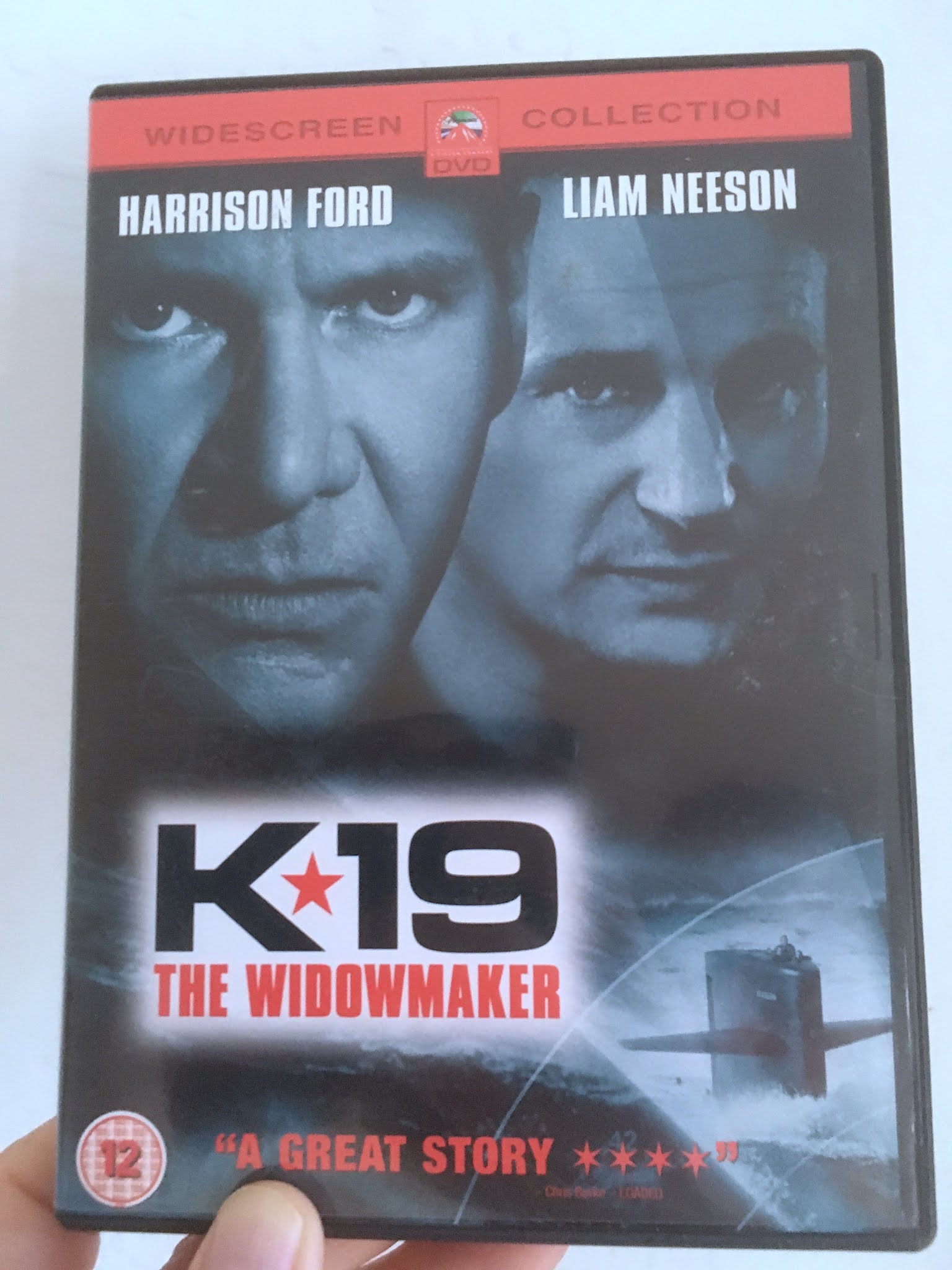
K-19: The Widowmaker (2002)

It’s 1961 and the Soviet Union sends a new nuclear submarine on a test mission. Mikhail Polenin (Liam Neeson) has been demoted from the role of captain and replaced by Alexei Vostrikov (Harrison Ford), who seems unreasonable and needlessly reckless, so tensions are running high from the outset. When a reactor coolant pipe bursts, the sub is in danger of blowing up – and destroying everything around it, including a US destroyer – risking dangerous military escalation and potentially World War III. 

As the drama unfolds and the crisis rapidly accelerates within the claustrophobic interiors of the craft, the two captains have to navigate their own prickly relationship as well as the relationships they have with their men, who clearly favour Polenin’s way of doing things. 

It’s an intelligent film that continually surprises. There are disturbing scenes that change the dynamic from intense Cold War thriller to compassionate human drama. 

The two leads are excellent and exude charisma, even if their Russian accents sometimes come and go.

Apollo 13 (1995)

Ron Howard’s version of the events of April 1970 in which a planned Moon mission goes horribly wrong after an explosion loses vital fuel and oxygen from the craft. Instead of walking on the lunar surface, as they had hoped and dreamed, the three astronauts find themselves in a desperate struggle to return to Earth. 

It’s a taut drama that steadily builds tension. We know that disaster is on the way, so there’s added suspense in waiting for that moment. I especially liked the Mission Control sections, which showed how much of an ingenious team effort the rescue attempt was. 

The casting and acting is spot-on, and makes this film stand out:

• Tom Hanks plays Jim Lovell, from whose memoir this was adapted. Hanks does his usual thing, but it works. His almost bland demeanour seems to match the highly sought after brave-but-calm profile of that of a well-adjusted astronaut.
• Kevin Bacon is perfectly acceptable as backup Command Module pilot Jack Swigert even though this actor is often now seen as a figure of fun.
• Bill Paxton is solid as Lunar Module pilot Fred Haise.
• Kathleen Quinlan is Lovell’s wife, trying to hold it together at home with the kids. The “worried wife” role can’t be a rewarding one for any actor, and too often that part is underwritten (see Deepwater Horizon or The Untouchables), but Quinlan convincingly portrays someone whose personal nightmare becomes a drama watched by the entire world.
• Ed Harris is impressive as the tough but compassionate Flight Director Gene Kranz.
• Gary Sinise is excellent as pilot Ken Mattingly, who misses out on the mission itself but helps the crew by mirroring their predicament in a NASA flight simulator. 

I liked the fact that in the film, as in real life, it wasn’t about luck or heroism or faith or fate. It was science that saved them – a triumph of knowledge and rational thought. A lesson to be learned there for all of us.

Youth (2015)

Paolo Sorrentino drama set at a luxury spa hotel in Wiesen in the Swiss Alps, where wealthy and famous people rest, relax and pass the time doing as little as possible. 

What “plot” there is focuses on the interconnected stories of several characters, but primarily on a retired composer (Michael Caine) and his film director friend of 60 years (Harvey Keitel), who is attempting to write a final masterpiece. Rachel Weisz is the composer’s daughter and assistant, while Jane Fonda plays an elderly actress and Paul Dano is an actor only known for a novelty role as a robot. 

The film is a sort of meditation on growing old and what that process does to relationships of various sorts. Fittingly, the pace is glacially slow and that aspect means it certainly isn’t going to be to everyone’s taste. Likewise, the fairly bleak outlook has little good news to offer about reaching the age of 80. The ugly aesthetic doesn’t help much, either.

There are surreal, whimsical moments and flashes of humour. When Rachel Weisz’s husband leaves her for singer Paloma Faith (played by herself), we see the latter in a pop video sequence that turns out to be a dream. Another scene depicts a vision in which Harvey Keitel sees all the actresses he’s ever worked with, standing in a field.

As the film progresses, at its own particular rate, the threads begin to knit together and greater depths are revealed. “Emotions are all we’ve got,” says Keitel at one point.

Impressive, but difficult to love.

Dragon Wars (2007)

Also known as D-War, this is an instantly forgettable South Korean fantasy film with mostly American actors. The “plot” is almost entirely nonsensical. Wikipedia attempts to explain how Ethan Kendrick (Jason Behr) is tasked by the mysterious Jack (Robert Forster) to “protect the Yuh Yi Joo, an individual who had been born able to change an Imoogi chosen by heaven into a Celestial Dragon, from a corrupt Imoogi identified as ‘Buraki’, who was prevented from obtaining it in the past by Ethan and Jack's previous incarnations. To this end, Jack gives Ethan a medallion formerly belonging to Ethan's previous incarnation Haram, and reveals that the reincarnated Yuh Yi Joo is Sarah Daniels (Amanda Brooks), whom Ethan will find in Los Angeles.” And so on. 

Huge snake creatures appear and terrorise the city, as do high-tech warriors, flying dragons and magical balls of light. None of it is really explained, but it keeps moving so quickly that your questions are quickly replaced by new questions. It would probably seem like a masterpiece if you were a nine-year-old boy. Occasionally the monsters recall the silly creatures shown in the Battle of Naboo in Star Wars Episode I, which is distracting, but the CGI effects are fairly sophisticated and worth seeing if you enjoy that sort of thing. 

The script goes beyond cliché into a surreal world of its own. The plot certainly doesn’t bother with logic. Anything can happen – and it does. The acting is merely functional. There’s no suspense whatsoever. Eventually you give up asking “What?!” and just enjoy the mildly engaging monsters-vs.-copters showdown in the knowledge that it will all be over soon enough.

Ghost Town (2008)

Ricky Gervais stars as Bertram Pincus, a mean-spirited English dentist in New York who briefly “dies” on the operating table. When he recovers, he’s suddenly able to see the spirits of dead people. Not only that, but these spirits also want him to communicate with their living friends and relatives to resolve a matter that’s keeping each of them in spiritual limbo. Pincus is pushed by dead businessman Frank (Greg Kinnear) to break up a relationship between his Egyptologist widow Gwen (Téa Leoni) and a pompous human-rights lawyer (Billy Campbell). But inevitably he begins to fall in love with her. 

It’s not a bad premise at all, but the problem is that it’s simply not very funny for the first half. It improves considerably in the second half as the surreal ghost story resolves into a romantic comedy. But throughout the story, Gervais seems somewhat miscast and he’s far less funny when he’s reading other people’s lines. 

Kristen Wiig is entertaining as a surgeon who’s preoccupied with her fake tan, and the brief scenes with her tend to come alive. 

The film works round to a satisfying conclusion despite some annoying music (romantic scenes are more affecting with instrumental tracks than with someone singing “earnestly”), but it’s uneven and could have been so much better.

Rush (2013)

Rush is a simple film that offers much pleasure. The Formula One rivalry between the cocky, sloppy playboy Brit James Hunt (Chris Hemsworth) and the careful, considered Austrian Niki Lauda (Daniel Brühl) is brought to life in a noisy, exciting way by Ron Howard, who evokes the 1976 Grand Prix season leading up to the all-important final race. 

Period detail of the 1970s is handled well. There’s a colour filter applied that cleverly makes it look how we seem to remember that decade. Fast edits and low angles bring out the maximum drama in a sport that was often surprisingly dull to watch on TV. Howard has the luxury of cramming in all the good bits and omitting all the tedium.

The two leads are both excellent. Hemsworth’s posh English accent is remarkably convincing given that he later came unstuck with his Nantucket accent for In the Heart of the Sea (also directed by Ron Howard). Especially strong is Alexandra Maria Lara as Lauda’s wife. Rarely has a face been so expressive.

I always enjoy biopics. Even when they don't work, they are usually interesting, but this one really does work – and for both protagonists. That said, a decent documentary of the same events would probably be more fascinating. Only one criticism: James Hunt’s wife, played by Olivia Wilde, has a storyline that just peters out – almost as if a scene was cut by mistake.

Saints and Soldiers (2003)

Battle of the Bulge war drama. Four American soldiers try to help a British soldier carrying vital information back to Allied lines. 

Corbin Allred is compelling as the shellshocked, sleep-deprived soldier kept going by faith alone. What makes the film more intriguing is learning that it was funded (and even acted) by members of the Church of Latter-day Saints (a.k.a. the Mormons) in order to put across their message. Impressively, it does this without that message becoming overbearing. Plus, the basic idea that belief in God will help you through dire situations doesn’t tie it to any one religion. It could just as well be promoting Catholicism or C of E Christianity. 

Two things reduce the impact a little. Firstly, the excessive use of colour filters becomes distracting – especially when the greyish tones turn to a sepia shade and then back again. Secondly, the Englishman (awkwardly played by an American, Kirby Heyborne) has a silly accent and his slightly shifty, antagonistic manner is never explained. Why not give him a personality that they (and we, the audience) could relate to?

Those points aside, there’s plenty of dramatic tension and the character development between the four main soldiers is entirely believable. The winter storms look convincingly cold and the bleak, barely survivable conditions are expertly evoked.

Crossroads (2002)

A predictable “star vehicle”. Lucy (Britney Spears) and two other young women from Georgia take off on a road trip. One wants to go to an audition in Los Angeles, one wants to visit her fiancé and one wants to meet her estranged mother in Tucson, Arizona. In the process of taking the trip, they inevitably “find themselves” and rekindle their own childhood friendship. 

It’s formulaic in the extreme. Britney seems natural enough as an actor, but the script has no sparkle and the plot offers no surprises. I hoped they’d rob a bank or encounter a zombie apocalypse or something, but no such excitement occurs. Also, her dreary companions Kit (Zoe Saldana) and Mimi (Taryn Manning) are presumably there to make her look better. Her parents are played by Kim Cattrall and Dan Aykroyd, but it’s a struggle to believe they are the actual mum and dad of Ms. Spears. 

Crossroads tries to deal with issues such as teen pregnancy, the pressures of gender roles and the value of family, but the abundance of cliché means that it does so only superficially. It’s designed as fan fodder (you can almost hear the focus groups behind it), and in that sense it achieves everything it sets out to.

The Adjustment Bureau (2011)

David Norris (Matt Damon) is a US congressman who meets a talented dancer called Elise (Emily Blunt) and forms an immediate and deep connection with her. But then a secret fraternity of shadowy men wearing hats (the so-called Adjustment Bureau) accidentally reveal themselves to him. It transpires that they control everything that happens everywhere (including what we assume to be “chance” events) and that they have big plans for the young politician. But the couple’s meeting was a deviation from their masterplan that must not be repeated. For reasons they won’t explain, they will not permit David and Elise to be together. And they threaten to “reset” him (wipe his mind clean) if he tells anyone what he’s just learned. 

The remainder of the film details the couple’s quest to be together despite the hugely powerful efforts of these remarkable controllers of destiny. It sounds complicated, but it’s not. You just have to accept certain elements:
• The men of the Bureau can effortlessly travel between locations by opening certain doors that act as inter-dimensional portals.
• These men gain their power by wearing hats.
• Their powers are diminished by the presence of water.
• It’s all overseen by “the Chairman”.

Based on a Philip K. Dick story, the premise is terrific but I knew from the outset that it would be almost impossible to resolve the plot in a satisfactory way. How could anyone live in opposition to such formidable forces of control? Sure enough, the ending did seem a bit of a cop-out, but I can’t see how else it could have concluded. 

It works as an exciting thriller with sci-fi and conspiracy-theorist elements. The idea that you can glimpse behind the curtain of reality and see what’s really going on is a hugely appealing one. I loved the electronic “books” that showed the various paths of reality evolving and redrawing themselves in real time. 

Damon and Blunt have great chemistry and the film works primarily because the story details their romance – meeting, being separated, coming together again and facing the future as a couple. In fact, Blunt is so charming that I wished there was more of the pair simply chatting, flirting and getting to know each other. This would have made for an entertaining and touching narrative in its own right.

Anthony Mackie is easy to like as Harry Mitchell, the most sympathetic member of the mystery organisation. Terence Stamp is appropriately creepy as Thompson, a senior official of the Bureau.

The film tackles big themes of freewill vs. determinism, and whether there is any higher power looking over us. The Bureau is presented as a God-like force, and this is meant to be sinister. But then the idea of an all-powerful deity able to control everything we do is surely just as alarming, yet this is accepted as normal by millions of people worldwide. 

It gives you a lot to think about, even if it ultimately cannot completely deliver on its own brilliance.

The Untouchables (1987)

Brian De Palma’s historical crime drama is set in 1930 in Chicago, where gangster Al Capone (Robert De Niro) is running various illegal rackets during Prohibition. The cops are in on them, too. But federal treasury officer Eliot Ness (a handsome Kevin Costner) forms a tiny group of men he can trust (played by Sean Connery, Andy Garcia and Charles Martin Smith) to take on and stamp out corruption. 

It’s an engaging story, but a few flaws stop it being remarkable:

1. The very “1980s” music by Ennio Morricone is impressive in places, but is sometimes used jarringly. For example, a crucial encounter at the Canadian border is accompanied by “adventure” music that completely undercuts any dramatic tension that has been built up. I think of this as “Steven Spielberg syndrome” – see Jaws.

2. There are points at which it seems like an episode of The A-Team in the slightly sentimental way it assembles a gang of diverse “good guys against the world” – even though this apparently really did happen, albeit with a slightly larger gang. The fact that one of them is a nerdy accountant who conveniently happens to be handy with a shotgun makes it a little harder to take seriously. 

3. There’s something awkward and not-quite-right about Patricia Clarkson as Kevin Costner’s wife. Or maybe her role is just underwritten. Plus, the way the script (by David Mamet) focuses on Eliot’s loyalty to his wife and daughter leads you to think they will end up playing a greater part in the story (kidnapped or murdered) than they ever do. 

4. The motivation of Jimmy Malone (Connery) is unclear. Why does he risk everything to help Costner? Why is he so morally upstanding when all the other policemen are crooked? And what’s going on with his Irish-Scottish-American accent?

These points aside, it’s highly enjoyable. De Niro is reassuringly nasty as Capone, gaining weight especially for the role, and Kevin Costner surprises by being highly watchable. Plus, there’s a particularly dynamic scene set in Union Station that involves a mother with a pram being caught in a crossfire.

The Fighter (2010)

This memorable drama directed by the always reliable David O. Russell tells the true-life story of the boxer Micky Ward and his large family life in Lowell, Massachusetts. It particularly focuses on his relationship with his troubled half-brother, who is not only his trainer but also a crack addict who is sent to prison. 

Like I, Tonya, it explores how a desperate, manipulative mother can push to have her child succeed in sport – whatever the personal cost. Unlike that film, it doesn’t employ tricksy narrative devices or self-conscious fourth-walling and so it’s much more affecting as a result. 

Mark Wahlberg and Christian Bale are tremendous as the half-brothers driven apart, with the latter giving the intense, twitchy performance of a lifetime. His eyes say so much, and you never doubt that you’re seeing a real drug addict. Amy Adams is hugely sympathetic as the girlfriend who seems like Micky’s only hope and who wants to save him from his overbearing mother, terrifyingly brought to life by Melissa Leo. His horrible gang of catty sisters will also unfortunately stay with me. 

In some ways it’s a terribly sad story, but it’s also a rousing one owing to the way it charts Micky’s rise to prominence within the boxing world. The fight sequences are difficult to watch, but then I could never understand a “sport” that involves punching someone in the head and causing brain damage.

The Island (2005)

As the back of the DVD explains: “Ewan McGregor and Scarlett Johansson lead an all-star cast as residents of an isolated, high-tech compound. But when they discover they’re actually clones, and worth more dead than alive, they stage a daring escape. Battling an unfamiliar environment and an armed team of mercenaries in hot pursuit, they’ll risk their lives and freedom to save those they left behind – and reveal the truth about The Island.”

This sci-fi thriller has similarities with 1984, The Hunger Games, Elysium and countless other dystopian stories. Its lack of originality wouldn’t have been a problem, though, if it had probed deeper into exploring the ethical issues it merely touches on. Unfortunately, it never feels very substantial. 

Ewan McGregor is as bland as ever as “Lincoln Six-Echo”. He can read his lines as well as anyone, but what else does he bring to the role? I found it bizarre to see him once again looking at a cloning facility, as he did in Star Wars Episode II. Scarlett Johansson (“Jordan Two-Delta”) isn’t given much of an opportunity to act, since most of the film involves the pair of them running around or being shot at. Sean Bean is OK as the supposedly sinister Dr. Merrick, while Steve Buscemi is likewise passable as a friend who helps the protagonists escape. 

The relationships in the film aren’t developed satisfactorily. A couple of scenes have fun with the clones’ naivety (they’ve only been educated to the level of 15-year-olds and know nothing of human society), but others allow them to be improbably worldly when the narrative demands it. As such, the plot only works if you don’t ask too many questions. 

The back of the DVD box warns: “Contains strong language, moderate violence and intense action”. It doesn’t warn about the excessive product placement. It’s intriguing that viewers needed to be warned about “intense action”, which surely is a selling point – especially since those sequences are expertly done. But maybe that’s how they justified the “12” certificate – action as a substitute for violence, or as a way of concealing it.

Visually, it’s striking – the colour has been ramped up and there’s a hyper-reality about the look of it. Yet there’s something missing. The Island hints at making wider points about social control but ends up sidestepping moral complexities to focus on exciting chase scenes instead.

About Schmidt (2002)

Bleak black comedy about a man in Omaha, Nebraska who leaves an insurance company to enjoy his retirement, only to find that his wife dies soon after. Suddenly he has no shortage of free time, but he has no one to spend it with. Struggling to find meaning in his life, he begins to sponsor a child in Tanzania (his letters to the boy form the film’s narration), travelling around in his huge new Winnebago, and trying to persuade his daughter not to marry her waterbed salesman fiancé. 

Jack Nicholson is as fascinating to watch as always, and expertly portrays the bemused, slightly shell-shocked widower. Kathy Bates is excellent as the rather scary mother of his future son-in-law. 

It’s a fairly depressing film, and deliberately so. It’s to be respected for not offering any trite or easy resolutions to this lonely 66-year-old’s predicament in the way that a more obvious narrative might have done. But a few more laughs would have helped since a lot of it is genuinely painful to sit through.

Witness (1985)

Unusual and striking thriller directed by Peter Weir. A child from an Amish community witnesses a murder that Philadelphia detective John Book (Harrison Ford) is assigned to investigate. When it turns out that the Chief of Police is in on the crime, Book goes into hiding among the Amish people he now has to protect. There, he meets a young widow (Kelly McGillis), who he begins to fall for, and he starts to understand her very different way of life. 

The film brilliantly balances a standard thriller with a full-on study of another culture within the USA. It does this with real empathy. There’s a lengthy sequence in which you see a traditional “barn raising”, a custom demonstrating how the community chooses to work collectively to assist its members. 

Ford is his usual charming self, effortlessly watchable as ever, but Kelly McGillis (later in the woeful Top Gun) is the real revelation. She manages to seem simultaneously innocent, naive, frightened and smoulderingly passionate. Her very expressive face conveys so much. There’s a hugely romantic scene in which she and Ford dance to Sam Cooke’s “(What a) Wonderful World”. It expresses her joy, delight and nervousness so well. 

There’s also a timeless quality to the film (it doesn’t seem “1980s” at all) that means it holds up extremely well today. 

Ultimately, it’s touching and even profound. A treasure.

Legal Eagles (1986)

Directed by Ivan Reitman (the talent behind Ghostbusters), this is a film that’s intriguing for being of no fixed genre. It manages to blend courtroom drama, crime, thriller and romantic comedy. 

Robert Redford and Debra Winger are New York lawyers investigating the case of an artist’s work that may or may not have been destroyed in a fire. Terence Stamp is the shifty art dealer mixed up in a fraudulent insurance scheme. And Daryl Hannah is the artist’s daughter who wants the painting her dad dedicated to her – if indeed it even survived. 

There’s something remarkable about the way the film sprawls all over the place and yet still works. Redford and Winger have real chemistry and build up a lot of good-natured warmth as their relationship develops. Both are hugely appealing. The former never seems to age. The latter has a lovely voice and an irresistible smile. Maybe they should have made more films together. 

Daryl Hannah is a little troubling. She’s meant to be an edgy performance artist, but she’s so sleepy and noncommittal that she seems barely present. You’d expect some dynamism or passion in someone who’s trying to push boundaries. But when you see her “performing” her “art”, it’s a ludicrous and unintentionally amusing affair involving light projections, photos of herself, objects bursting into flame and tape recordings of her voice. A clunky mess. Laurie Anderson she is not. The film would have worked better if this character was just a regular person wanting what was rightfully hers rather than an “enigma”. Or maybe they just had the wrong actor for the part. 

Another oddity is the chirpy music, which sometimes seems misjudged for certain scenes. But because the mood and tone keep changing as we race from one genre to another, it’s possibly just struggling to keep up. At the very least, you can see that the soundtrack had to be varied.  

But these are minor flaws. I really liked the fact that it’s so unusual. Plus, the climax is genuinely exciting and the comedy never eclipses the drama. Quirky, rewarding and somehow fascinating.

Earthquake (1974)

When Los Angeles is hit by a major earthquake, it’s up to a few brave heroes to save as many lives as possible. This film performs the standard disaster-film trick of setting up several diverse characters in different places before the incident kicks off. We get to know them a little, and then we get to see how they fare when everything goes wrong. It works because it actually makes us care.

The drama is fairly compelling. On a couple of occasions it lapses into sensationalism – most notably when a lift plunges in its shaft and animated drops of blood superimposed on the screen indicate that everyone in it died. But the film is generally impressive in terms of the special effects of the time (a bursting dam, burning buildings, semi-collapsed structures) and it successfully conveys the huge scale of the disaster. It feels “real” in a way that The Poseidon Adventure never does. 

Charlton Heston is the former sporting hero who has to save work colleagues and his father-in-law. Geneviève Bujold is the young mum who Heston has fallen for. Will he save her or his semi-estranged wife (an oddly unconvincing Ava Gardner)? George Kennedy plays a tough, cynical cop who proves decent enough to do the right thing. Richard Roundtree is a motorcycle stunt driver whose potential is never quite realised in the plot. (I kept expecting him to have to leap across a crack in the ground or cycle through a ring of fire, but his story just peters out.) There are also roles for Victoria Principal (of Dallas fame), who is nearly the victim of a machine-gunning predator, and Walther Matthau, who gets to be a comedy drunk. It’s not clear why they felt the need for comedy in a fairly serious film.

Gripping and suspenseful, this is well worth seeing.

Lost in Translation (2003)

Another masterpiece directed (and also written) by Sofia Coppola. It’s a gentle drama with comic elements. Bob Harris (Bill Murray) is in Tokyo to film a whiskey advert. He meets a young college graduate called Charlotte (Scarlett Johansson). They are both experiencing marital problems and get time alone in their hotel rooms to reflect on them. Bob’s wife faxes him home decor suggestions and posts him carpet samples, while Charlotte’s husband (Giovanni Ribisi) is an absent, immature photographer. Feeling alien, lonely and disorientated in a culture they don’t understand, the two develop a deep connection that goes beyond casual friendship. 

The film is poignant and touching. There are glimmers of romance between the pair, but it’s to the film’s huge credit that it resists that obvious option and instead focuses on the two characters and their far less predictable kind of relationship. Murray and Johansson each give the performance of a lifetime, perfectly handling the empathy and restraint evident in the sensitive script. 

Coppola creates a strange and lovely atmosphere, understanding that what goes unsaid can be more potent than the words actually uttered, and each successive scene builds upon that. By the end, you feel profoundly engaged with these characters in a way that doesn’t usually happen when you watch a film. 

There are too many perfect scenes to mention, but my favourite is the karaoke episode. Charlotte sings “Brass in Pocket” (The Pretenders) and Bob sings “More Than This” (Roxy Music). In each case, they seem to be using the song to communicate something to each other. 

A really special film. One of the very best.

True Lies (1994)

Action comedy thriller that cleverly pastiches the James Bond series, with a lot of added humour. James Cameron directs, handling a potentially complex plot extremely lucidly. He also indulges his usual tic for lots of white and blue backlighting.

Harry Tasker (Arnold Schwarzenegger) works as a secret agent for the Omega Sector intelligence agency. His wife Helen (Jamie Lee Curtis) knows nothing about this and believes he’s a dull computer salesman. When Harry suspects her of having an affair, he contrives an elaborate scheme to fulfil her desperate desire for adventure and excitement but ends up accidentally dragging her into a dangerous terrorist plot led by Salim Abu Aziz (Art Malik). 

The film balances witty observation with genuinely exciting action. Discussing the villain, one of the teams says “They call him the Sand Spider.” “Why?” asks the head of Omega Sector (played by Charlton Heaton). “Probably because it sounds scary,” is the response. 

The ending is one of the most spectacular action sequences I have seen (Cameron is incredibly skilled at this), and the Harrier jump-jet sequence at the climax is absolutely heart-stopping.

The Virgin Suicides (1999)

The first film by Sofia Coppola is a hypnotic piece of work that adapts the 1993 novel by Jeffrey Eugenides. It tells the story of the five Lisbon daughters, and the suicides that destroy their family. Consciously or otherwise it seems to echo Picnic at Hanging Rock – another mystery about disappearing girls – and in places it evokes the same hazy, dreamy atmosphere. Like that story, it’s as much about the after-effects of the key events as it is about what actually happens, as the girls enter the dreams and inner lives of those who knew them. 

Coppola also brings subtle, dry wit into the story, which is impressive given the macabre subject matter. One scene has the strict religious mother trying to burn the girls’ vinyl records (Kiss, Aerosmith, etc) only to nearly choke everyone with the toxic fumes they produce. 

There are clever, tricksy moments that shouldn’t work but somehow do anyway. At one point, an eye “twinkle” is added when Lux (Kirsten Dunst) smiles. At another point, we see “through” Lux’s dress to reveal that she’s written her new boyfriend’s name on her underwear. 

It also works as a teen story, and scenes such as the Homecoming ball – or the romantic moments when the boys and girls play each other records down the phone – would have been compelling as a youth drama in their own right, even without the disturbing undercurrents. 

James Woods and Kathleen Turner are excellent as the parents struggling to comprehend the nightmarish situation that grips their family, while Kirsten Dunst is especially strong as the most outgoing of the daughters.  

At the heart of the film is a mystery: the five girls are an enigma that the film wisely doesn’t even try to explain. And the eerie ambience is perfectly captured by Air’s original soundtrack. 

Trivia: it’s set in Grosse Pointe, Michigan, just like Grosse Pointe Blank.

Somewhere (2010)

Drama directed by Sofia Coppola, the brilliant talent behind Lost in Translation, Marie Antoinette and The Virgin Suicides. 

Johnny Marco (Stephen Dorff) is a famous actor living at Los Angeles hotel the Chateau Marmont. Recovering from an injury, he seems detached and numb. Plus, he’s receiving aggressive texts and it seems that his car is being followed. When he unexpectedly has to look after his 11-year-old daughter Cleo (Elle Fanning) for several days, his world begins to change. 

Like Coppola’s other modern classics, this is all about the characters and their relationships rather than the plot. She’s not afraid to let silences stretch, or to let scenes unfold at their own pace, and the film feels much more “real” as a result. 

Music once again plays a big part, with expertly chosen tracks often playing out in full because they fit the mood or tone so well. 

I like the fact that Somewhere is of no recognisable genre. It hints at evolving into a sort of thriller, but cleverly dismisses those elements and keeps the focus on the evolving father-and-daughter dynamics. A real treat.

Doctor Zhivago (1965)

David Lean’s adaptation of Boris Pasternak’s 1957 novel is a lavish but disjointed epic that grinds on for 200 minutes. Omar Sharif stars as the doctor of the title, who falls in love with young Lara Antipova (Julie Christie). The film takes in World War I, the Russian revolution of 1917 and the Russian Civil War with a plot that’s too meandering to summarise neatly. Sometimes it races through events briskly, while at other times it appears to linger on scenes that don’t warrant being stretched out – a problem with pacing. 

On the plus side, the colours are rich and the all-star cast is uniformly excellent. It’s nice to see Julie Christie and Tom Courtenay back together again two years after Billy Liar, even if they don’t have much chemistry this time around. Omar Sharif is charismatic, with twinkling eyes and an undeniable presence, while Alec Guinness has a certain authority as the doctor’s brother. Geraldine Chaplin, Rod Steiger and Ralph Richardson are all compelling, too.

On the down side, sometimes the narrative signposting is muddled. For example, when Lara cannot find her husband after the battle, we assume he’s dead but she neither mourns him nor asks about him. It’s simply not clear how she feels or how we’re meant to respond. I wondered if this was because the plot had to be condensed to work as a film, but if that’s the case maybe it could have added some simple explanatory sentences to bridge chunks of narrative that had to be cut. And if that is the reason, it’s ironic that they still ended up with such an incredibly long film (it takes up both sides of a DVD) that often feels slow and cumbersome.

Anywhere but Here (1999)

Impulsive, restless Adele August (Susan Sarandon) drags her teenage daughter Ann (Natalie Portman) from Bay City, Wisconsin, to Beverly Hills, California, to begin a new life. It soon becomes clear that Ann is the more sensible of the pair, and her resentment builds as she considers the friends and family she’s been forced to leave behind. 

The film begins with a road trip and I would have liked more of that, but ultimately it’s not about their travels. The focus is primarily on the mother-daughter relationship and how that develops under increasingly strained circumstances. There are a few laughs, too, which emerge from a strong, character-driven script. 

Sarandon sparkles as the maddening but hugely appealing Adele. Portman gives a performance that unlike other films (Star Wars prequels, Garden State), suggests she’s a pretty solid actor who hasn’t always chosen the right roles. 

The conclusion is satisfying and emotional without being mawkish.

The Poseidon Adventure (1972)

The SS Poseidon is sailing from New York to Athens when an underwater earthquake creates a huge wave that turns the ship over. A small group of passengers do their best to survive, despite the water coming in and the fires breaking out.

I was curious to see this film, which I had often heard about. It’s trashier than I expected. There’s a shabby made-for-TV quality to it, and it has none of the big-budget grandeur of disaster classics such as The Towering Inferno. The characters are absurdly diverse “types”, including:
• a rogue preacher (Gene Hackman)
• an angry, bad-tempered cop (Ernest Borgnine) and his ex-prostitute wife (Stella Stevens)
• a gee-whiz American kid (Eric Shea) and his older sister (Pamela Sue Martin)
• a woman given no other function than to be “a fat lady” (Shelley Winters) and her thinner husband Jack Albertson (Grandpa Joe in Willy Wonka & the Chocolate Factory)
• a nervous singer (Carol Lynley) whose band of beardy blokes doesn’t make it
• a kindly, injured waiter (Roddy McDowall)
• an absurd-looking runner (he jogs like a parody of a Carry On character), who’s too shy to have any luck with women (Red Buttons)

Meanwhile, Leslie Nielsen plays the captain. After seeing him in Airplane! and The Naked Gun, it’s strange to see him in a straight role: I kept waiting for the gags that never arrived.

The concept is good, but it’s poorly executed and poorly written. There’s a lack of dramatic tension. Too much of the film becomes a logistical challenge of getting a group of people past an obstacle or from one room to another. The ship is meant to be upside down most of the time, but it rarely looks that way. You only see it in close-up, and the lack of contextual shots mean that what you do see looks like a set. It made me respect the action sequences in James Cameron’s Titanic even more than I did already. 

Character-wise, there are sections that are unintentionally comical – ridiculous, even. Often, one person is speaking and everyone else is holding a strange facial expression, such is the lack of dynamism in the group scenes. There’s a lot of unnecessary shouting, too. And you can tell when someone’s about to die because of the conversation they have beforehand. 

Gene Hackman makes the most of the sub-standard material, but he can only do so much. 

All these points aside, it’s entertaining enough.