Showing posts with label Starring: Steve Carell. Show all posts

Café Society (2016)

Engaging comedy-drama written and directed by Woody Allen. 

It’s the 1930s. Bobby Dorfman (Jesse Eisenberg) goes to Hollywood and gets a job working for his Uncle Phil (Steve Carell). He falls in love with Phil’s secretary Veronica/Vonnie (Kristen Stewart), not realising that she’s already dating someone else – a married man Bobby knows all too well…

The various plot threads play out in a satisfying manner. The film is a slow-burning romance that sensitively explores the “what ifs” of love. 

It’s a fairly low-key film. There are some funny moments, often relating to Bobby’s gangster brother Ben (Corey Stoll). It’s good at showing the contrast between the cultures of California and New York. As always, Woody Allen does an expert job with the nuts and bolts of storytelling, pacing, characterisation and dialogue. 

Kristen Stewart is absolutely spot on as the much-in-demand and conflicted Vonnie.

Crazy, Stupid, Love (2011)

Comedy-drama directed by Glenn Ficarra and John Requa. It’s a sort of American Love Actually, with interwoven strands and an ensemble cast telling several connected stories. 

Steve Carell and Julianne Moore play Cal and Emily Weaver, a middle-aged couple in the process of separating. Ryan Gosling is Jacob, a super-confident ladies’ man, who (implausibly) decides to teach Cal everything he knows about sweet-talking women. Meanwhile, Emma Stone is a law school graduate who turned down Jacob's advances. Kevin Bacon is the co-worker Julianne Moore's character pairs up with. 

It’s quite funny in places if you can suspend disbelief about various scenarios that fail to ring true. Morally, it’s all over the place and I’m not entirely sure what point it was trying to make about predatory men.

Vice (2018)

Punningly titled biopic of Dick Cheney, the US vice president in 2001–2009, during the period that George W. Bush was in power. 

There is a fascinating story to be told here, but director Adam McKay chooses a gimmicky, tricksy approach, breaking the fourth wall, adding text on screen and inserting surreal skits that constantly remind you you’re watching a film, rather than allowing you to become absorbed in it. There’s even a “false ending” about halfway through, with the production credits rolling up the screen. 

Cheney emerges as a complete enigma and the film cannot get inside his character enough to explain the motivations behind his various abuses of power. In reality he was an extreme figure, responsible for introducing torture, abolishing the FCC fairness doctrine (leading to the rise of biased, politicised TV news reporting), rebranding “global warming” as “climate change” to make it more palatable to the masses, and focus-grouping reactions to September 11th in order to further America’s geopolitical interests. It’s all especially relevant in the era of Donald Trump.

There’s no shortage of strong material, and the key performances by Christian Bale, Amy Adams and Steve Carell are outstanding. But Vice is hugely frustrating nonetheless.

Hope Springs (2012)

Light drama with comic moments. 

Kay and Arnold Soames (Meryl Streep and Tommy Lee Jones) have a stale and formulaic marriage, devoid of tenderness. Kay seeks to remedy that when she employs a Maine therapist (Steve Carell) to help them rekindle their former passion. But Arnold resists. 

It’s intriguing in that it could have become a Nancy Meyers-type lifestyle-aspiration film, but it stays just on the right side of watchable. All three leads are strong (even if Streep's mannerisms begin to irritate), and some of the therapy discussions are thought-provoking enough to suggest a real depth to the script.

The problem comes from the film’s strange reluctance to explain what went wrong in the marriage. Why can’t Arnold stand to touch his wife? That’s never illuminated. Plus, his U-turn at the end feels unlikely and bolted on, without a convincing motivation for this sudden change of character. And why does the therapist bring everything down to physical intimacy? What about the couple spending an evening simply talking or holding hands? Instead, it’s all about the sex (for example, they are assigned the task of trying it in the cinema) – perhaps because that makes for a more titillating story. 

Plus, the music is awkwardly intrusive. 

Elisabeth Shue is underused as a woman who works in a bar. She only gets one scene but she's probably the best thing in the film.

Battle of the Sexes (2017)

Semi-biopic of Billie Jean King (played by Emma Stone), who campaigns for equal rights for women in tennis while juggling her own messy love life involving her husband Larry (Austin Stowell) and new lover Marilyn (Andrea Riseborough). Matters get even more complicated when King is challenged to a “battle of the sexes” tennis match by Bobby Riggs (Steve Carell), who is eager to drum up money and publicity with a male-vs-female publicity stunt. 

The leads are all superb and the world of 1973 is convincingly evoked. With the focus on personal matters and the politics of the game, there’s surprisingly little actual tennis until the last quarter of the film. But when you do get to see the pivotal game, it’s dramatic and excitingly shot.

I was slightly disappointed to learn afterwards that the role of Marilyn was changed from secretary (real life) to hairdresser (the film). Surely the truth is interesting enough that a biopic should reflect it rather than mess with the facts.

Seeking a Friend for the End of the World (2012)


This was critically savaged and/or ignored at the time of release. In his one-star Guardian review, Peter Bradshaw wrote: “You will have had handfuls of wet sand in your swimsuit less irritating than this supremely irritating romantic dramedy.” But I liked the title and the concept – in three weeks the Earth will be destroyed by an asteroid. As society breaks down, everyone has to address the question of how they use the time they have left.

Penny (Keira Knightley) and Dodge (Steve Carell) are neighbours in the same apartment block. When looting and rioting hits their street, they take off together on what turns out to be a sort of road trip. They are opposites in many ways – she’s English, he’s American; she’s 28, he’s middle-aged; she’s giddily naive, he’s reliable, worldly and wise – but inevitably they begin to fall for each other as their time runs out. The blossoming love story points at bigger questions: what really matters in these extreme circumstances? Why does it matter? Who should you spend your last few hours with? Friends and family? A lover? Or a random stranger in the new climate of anything-goes lawlessness?

I can see why Peter Bradshaw was irritated, but I think Keira Knightley’s scatty, free-spirited persona is deliberately annoying. She needs to be, initially, because the film is partly about her character’s progression to maturity as she finally meets someone she really cares about.

One thing fails to ring true, though. She’s supposed to be a music fan and she saves a selection of records from her apartment during the riot. (There are prominent displays of LPs by Herb Alpert, John Cale, Leonard Cohen, Lou Reed and Scott Walker at various points in the film.) But there’s something oddly unconvincing about K.K. as a record buyer, even given the faddishness of vinyl in younger consumers. She even self-consciously says: “I love records. You really have to take care of vinyl.”

It’s not a masterpiece – it could certainly have been funnier, and some of the scenes could have worked better – but it seems more relevant than ever during these dark times of a global pandemic. And despite the unevenness, I was both moved and amused.

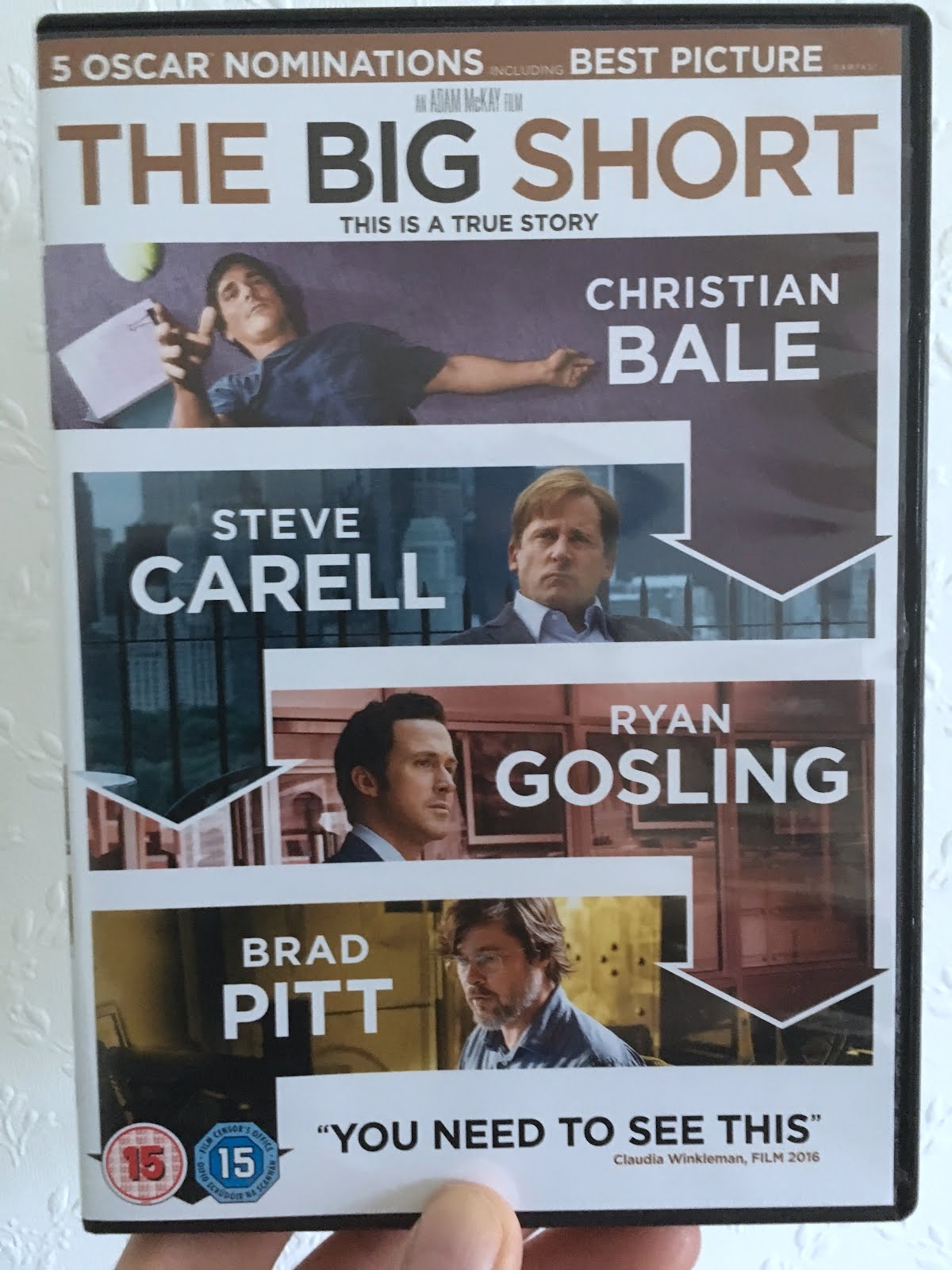
The Big Short (2015)


This highly stylised account of the investment schemes devised in the weeks leading up to the financial crisis of 2007–2008 follows three parallel narratives featuring individuals who stood to gain by the collapse of the US mortgage market.

Complex financial concepts are often hard to grasp, so the film – being somewhat self-conscious and postmodern – has this terminology explained by walk-on celebs (Margot Robbie, Anthony Bourdain, Selena Gomez, etc) talking direct to camera.

It’s not as compelling as The Wolf of Wall Street, which was personality-driven and had the huge advantage of starring Leonardo diCaprio. This film is more about a situation, with the characters seeming secondary to the way it unfolds. That said, the semi-crazed actions of Christian Bale (as Michael Burry) are the most watchable element. Steve Carell, Ryan Gosling and Brad Pitt are difficult to empathise with. That’s surely intentional, but it does make for a less engaging narrative.

Ultimately, I think I would have preferred to watch a well-made documentary about the same events or a fully fictional account that could structure the story in a more satisfying way.