Imelda Staunton is superb in the lead role, adding depth and emotional complexity to the moral issues explored by the script. The fall-out of her actions and the devastating effects on Vera and her family are brilliantly examined by Mike Leigh, with his usual intelligence and empathy.
Another almost-obsolete format, DVDs – like CDs – are cheaper than ever in charity shops. One pound or 50p for two hours of entertainment represents amazing value for money. Here are my brief reviews of some of the films I saw...
Vera Drake (2004)
Crash (2004)
The ensemble cast’s acting is strong (notably Sandra Bullock and Matt Dillon), and the weaving together of threads is expertly handled. What spoils the film is the very intrusive, jarring music that just doesn’t suit the scenes it soundtracks. Also, the visuals seem over-filtered.
Bridget Jones: The Edge of Reason (2004)
On the plus side, the three stars remain watchable no matter what – Renée Zellweger, Colin Firth and Hugh Grant all exude undeniable screen presence, but they can’t improve the wobbly script. There are long patches without any amusing lines at all. Loud music drowns out the dialogue in a few places.
The film gets worse in the second half, seemingly just stringing out a weak premise to make up the full running time. Especially wretched was the gaggle of friends who make up the “Greek chorus” (a standard Richard Curtis tic) offering advice and commentary. Very old-fashioned gender politics, too, and we’re repeatedly told that life is worthless if you don’t have a handsome boyfriend.
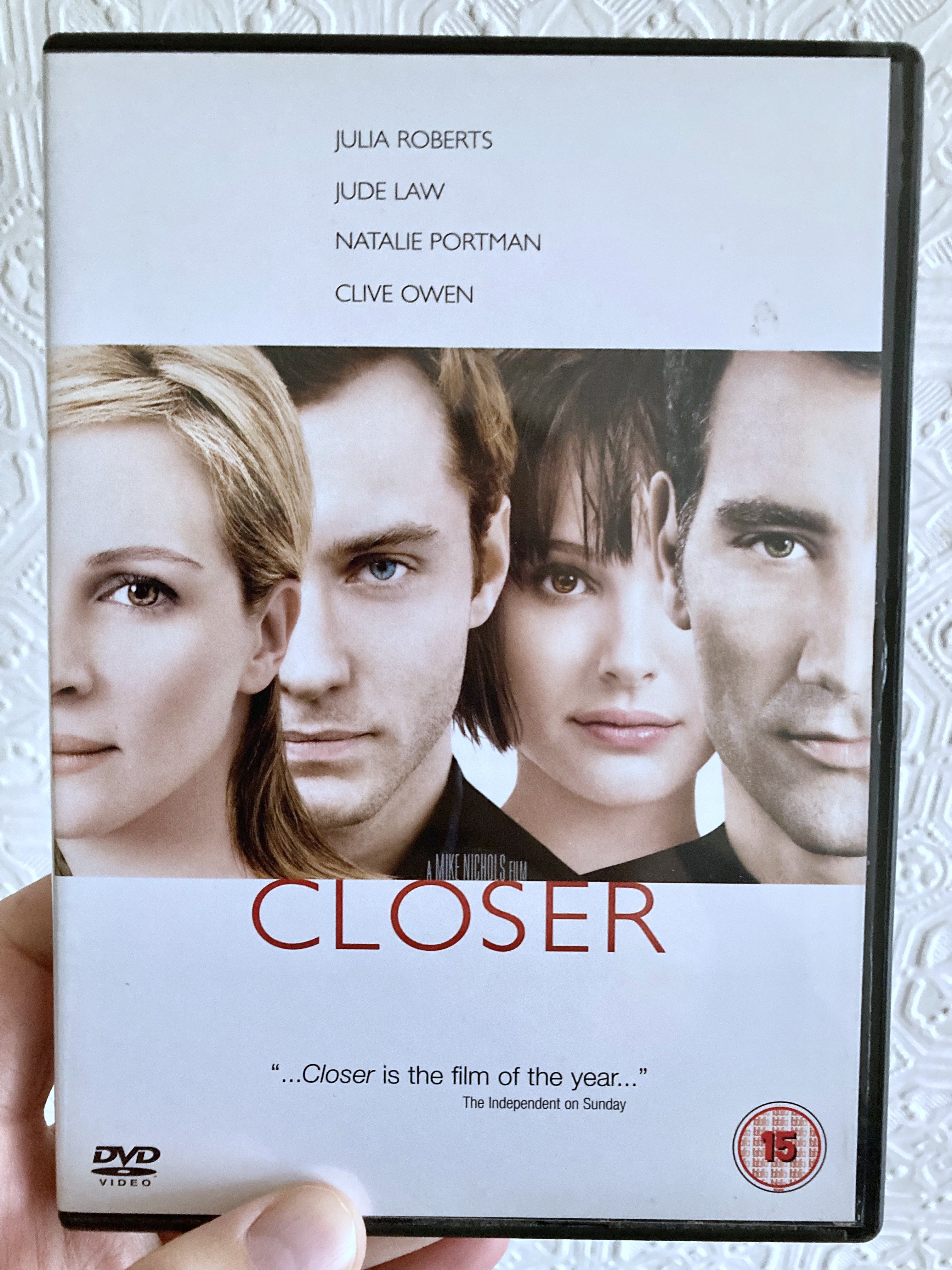
Closer (2004)
The story deals with the intersecting relationships of two men and two women. Clive Owen and Natalie Portman are both excellent at presenting complex, rounded characters. Jude Law just does his usual Jude Law thing. And Julia Roberts is oddly drippy and underwhelming with a character that’s barely there – to the extent that you have no idea why two men would be obsessed with her.
It ends up a little overwrought, with lots of rather pompous statements about truth and honesty uttered by characters who are all over the place. You feel the writing tries too hard to be shocking and morally confrontational. As an account of intense human emotions it’s compelling but difficult to like.
Maria Full of Grace (2004)
Maria (Catalina Sandino Moreno) is a 17-year-old Colombian girl who quits her deeply unpleasant job removing thorns from roses and becomes a drug mule tasked with transporting swallowed drug pellets to New York City. Of course, the job isn't as simple as she has been promised.
It's extremely gripping, and it works as a thriller as well as a human-interest story. Catalina Sandino Moreno is absolutely superb in the lead role, as is Yenny Paola Vega, who plays her friend.
While it's a very sad film, there's a hugely satisfying conclusion.
Finding Neverland (2004)
Barrie is played unexpectedly well by Johnny Depp. Kate Winslet plays Sylvia Llewelyn Davies, the widow he falls in love with and maintains a platonic relationship with, while becoming a sort of father to her children. In the meantime, he’s working on the Peter Pan play that will make his name, and which is inspired by the family he has become so attached to.
It’s quite a touching story. “Neverland” works as a metaphor for make-believe/imagination and also for Heaven. There’s a strong performance by Julie Christie, as Sylvia’s strict and frosty mother. Dustin Hoffman is refreshingly unselfconscious as Charles Frohman, the play’s producer.
It would be easy to criticise the film’s extremely sanitised portrayal of terminal disease, but it’s a story all about the imagination so it therefore seems to make sense that gritty realism is held at bay.
Beyond the Sea (2004)
It’s a baffling film. The set pieces featuring the songs are expertly created and Spacey inhabits the role brilliantly. But things come slightly unstuck with the “magical realist” element of him talking to his younger self. There’s no attempt to describe his rise to fame, but there’s lots about his health problems and his ambiguous parentage.
John Goodman and Bob Hoskins are on screen too much. Brenda Blenthyn is excellent as his mother. Kate Bosworth is underdeveloped as Darin’s wife. It’s suggested that she drinks too much but the question of alcoholism is never explored further.
In terms of storytelling it’s disappointingly shallow and inconclusive, despite moments of brilliance.
Million Dollar Baby (2004)
Clint Eastwood directed, co-produced and scored the music for what may be the greatest film he’s ever been associated with. This is an incredibly powerful and moving drama.
Clint plays boxing coach Frankie, who reluctantly begins training a woman – Maggie Fitzgerald (Hilary Swank) for the first time. Maggie comes from a poor background and her family is heartless and manipulative. Frankie represents the father she lacks, while Maggie fills a space in Frankie’s life caused by his estranged daughter. It seems like it’s going to be a boxing drama, but it takes on a far more personal and upsetting direction in the final third.
The writing and characterisation is brilliant, full of tenderness, compassion and nuance.
Morgan Freeman delivers a career-best performance as Eddie Dupris, the gym assistant and a former boxer.
3-Iron (2004)
Layer Cake (2004)
Brit crime thriller starring Daniel Craig as a drug dealer who – just as he’s about to retire – becomes wrapped up in a dangerous world of gangsters.
It’s highly stylised, but oddly unsatisfying. The twists and turns of the plot are difficult to follow. And some parts seem clichéd, such as the Scorsese-lite touch of using “Gimme Shelter” on the soundtrack. It’s violent and nasty, too.
Michael Gambon is an impressively horrid villain, and Daniel Craig is always watchable, but there’s a shallowness that makes it hard to like. It aims for “gritty” but only achieves “depressing”.
Ray (2004)
It manages to cram in a lot of song performances as well as back story about the death of Ray's young brother and the loss of his vision as a child. There’s also a fair bit about his complicated personal life and his heroin addiction. Foxx is excellent at playing the wildly talented but conflicted character who is simultaneously worshipped and misunderstood.
Director Taylor Hackford gets away with sometimes tricksy visuals (neon signs floating across the screen as text, and so on) by making them work in the context of the narrative.
Melinda and Melinda (2004)
One of the better later-era films written and directed by Woody Allen.
Is life fundamentally comic or tragic? A group of writers sit around a table discussing it. We, the viewers, see their debate explored through two versions of the same story, both centred on the actions of Melinda (Radha Mitchell) – a woman with a complicated history who arrives unannounced at her friends’ New York home.
It’s an odd experiment. I found both of the stories engaging. Will Ferrell is good in the witty, self-deprecating role Woody Allen would have played if he’d cast himself, but Chloë Sevigny and Jonny Lee Miller seem merely wooden as Laurel and Lee. Glossy and a little shallow, parts of the film are a little like an episode of Friends, with relationship-based conversations taking place in luxury apartments.
There are some funny lines and some enjoyable moments. It’s worth watching for Radha Mitchell’s versatile acting and considerable charm.
Shaun of the Dead (2004)
It has a fresh sense of humour, and the jokes never let up. But it also works as a horror drama, utilising all of the tropes associated with that genre in a witty homage to George Romero’s zombie classics.
Super Size Me (2004)
It’s a brave and quite reckless way to make a point, but you have to admire him for sticking to his plan. The various interviews with increasingly alarmed doctors and nutritionists provide a sobering commentary.
Fascinating stuff, it would be quite difficult to watch if he wasn’t so engaging a character.
The Aviator (2004)
It’s a sad and engrossing story that expertly details Hughes’ decline into paranoia, social reclusiveness and the crippling discomfort of extreme OCD.
Scorsese’s usual tricks are all displayed, but it’s refreshing to see them used in a non-crime story. At times it all seems a little too stylised, but then Scorsese handles this visual flamboyance so well that he makes it work. Plus, it’s a film about the veneer of Hollywood success so that lavish styling serves to further underscore the subject matter.
DiCaprio is absolutely superb as the visibly crumbling Hughes. Cate Blanchett is also at her best, capturing the quick-witted energy of Katharine Hepburn.
Also popping up are Kate Beckinsale (as Ava Gardner), Ian Holm, John C. Reilly, Alec Baldwin, Jude Law, Gwen Stefani (as Jean Harlow), Willem Dafoe and Alan Alda (as Senator Ralph Owen Brewster).
The Assassination of Richard Nixon (2004)
Based on a true story, this is a gripping and desperately sad drama starring Sean Penn. He plays Samuel Bicke, a furniture salesman who is suffering at work and in his personal life and who – amid a mental breakdown – decides to kill the president.
Penn is absolutely superb, making you feel his utter isolation and his heartbreaking descent through a series of personal tragedies. He is estranged from his wife (Naomi Watts) and children, is bullied by professional colleagues and sees his plans to set up his own business rejected.
Nixon himself is cleverly woven into the story through the use of archive footage shown on news broadcasts.
When Bicke finally undertakes his assassination attempt we really feel for him. It’s not that you’re rooting for him to succeed – history already tells us that he will fail – but you yearn for him to be happier and to find peace.
The Terminal (2004)
Baffling Steven Spielberg comedy-drama. Tom Hanks plays Viktor Navorski, an Eastern European man who ends up stuck in J.F.K. airport when his country suffers a coup and war breaks out. Unable to return there or to gain access to New York City, he begins a frustrating, surreal life within the airport itself.
It dabbles with romantic comedy when he falls for an air hostess (Catherine Zeta-Jones). He also has to deal with the Acting Field Commissioner (Stanley Tucci), who wants to get rid of him. In the meantime he becomes a sort of celebrity among the airport staff, which include Diego Luna, Kumar Pallana and Zoë Saldaña.
The big flaw of the film is that Stanley Tucci’s fixation with removing Viktor is never really explained. Surely a man that busy would have too many other important things to do. Another problem is that the romance plot fizzles out and a more sentimental quest to honour his father’s wishes takes over. Worse than that, there’s a big loose end relating to the way Stanley Tucci threatens to get rid of Viktor’s friends. Also, John Williams’ soupy music is too prominent.
Despite all of this, Hanks is excellent and the premise is intriguing and unusual. It’s just a shame that Spielberg somehow lost his way in the second half.
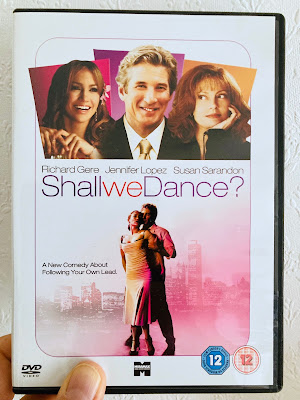
Shall We Dance? (2004)
Richard Gere plays a Chicago lawyer who feels a little jaded with life, despite his successful career and his lovely wife (Susan Sarandon). He secretly takes up dancing, inspired by a moody-looking dance instructor (Jennifer Lopez) he sees from his train window while commuting. He’s also encouraged by his work colleague (Stanley Tucci), who reassures him (and presumably the male viewers) that it’s “OK” for straight men to dance.
It’s a lightweight piece of fluff with plenty of charm. Director Peter Chelsom handles the dance scenes extremely well. The script is adequate-to-good, with the best lines going to Sarandon. She memorably describes love as the idea of bearing witness to a life that might otherwise go unnoticed.
Only Lopez lets the side down. She acts “troubled” but – other than being able to dance – brings little depth to the role.
Wimbledon (2004)
This is a surprisingly entertaining film, with some funny lines. Bettany and Dunst have real chemistry. It’s also quite exciting and dramatic in terms of the tennis itself – even though I don’t much care for the sport. As Colt moves up through the tournament it actually gets quite exciting. I like the way we “hear” his thoughts – all his self-doubts and hopes mixed up in a chaotic interior monologue. It’s also nice to see former champions John McEnroe and Chris Evert playing themselves as commentators, and Nikolaj Coster-Waldau is likeable as Colt’s friend Dieter.
On the downside, the thread regarding Colt’s parents (whose failing marriage is rekindled by their son’s changing fortunes) isn’t really necessary and his mum and dad (Eleanor Bron and Bernard Hill) seem silly and oddly unconvincing.
But overall it’s a charming story, excellently told.
The Bourne Supremacy (2004)
It’s ridiculously exciting – probably even more so than The Bourne Identity. Director Paul Greengrass really understands how to make this kind of film work. The action sequences are superbly filmed and the pacing is spot on. The car chase in Moscow is especially thrilling. Also better in this film is the CIA boss (Joan Allen), who has a commanding presence.
Matt Damon plays it just right: charismatic but understated. It makes the James Bond films (even the Daniel Craigs) look a little old hat.