Showing posts with label Year: 1999. Show all posts

American Beauty (1999)

A brilliantly made and acted – but in many ways quite depressing – drama directed by Sam Mendes.

Kevin Spacey and Annette Bening star as a couple whose marriage is disintegrating. Spacey plays an advertising executive whose midlife crisis manifests itself in an obsession with the best friend of his teenage daughter. 

It’s compelling and disturbing stuff that ponders suburban ennui and the meaning of life.

The Story of Us (1999)

Extremely well written and ultimately touching comedy drama about a couple and their marriage. 

Ben and Katie (Bruce Willis and Michelle Pfeiffer) choose to separate when the children are away on summer camp. We see them working through the new relationship status, while looking back on the highs and lows of the marriage. 

Director Rob Reiner (who also stars as a family friend) wisely keeps the film simple and focused.

Lake Placid (1999)

Directed by Steve Miner, this is an awkward horror-comedy that never really comes to life. 

A huge killer crocodile is on the loose in Maine. The local Fish and Game officer Jack Wells (Bill Pullman), paleontologist Kelly Scott (Bridget Fonda), sheriff (Brendon Gleeson) and an eccentric professor of mythology (Oliver Platt) try to track down the beast. 

The film can’t decide if it’s meant to be funny or scary and ends up neither. There are hints of Jaws and Crocodile Dundee in there, but with none of the ingredients that made those films so engaging.  

Fonda has a degree of charm, as always, but the script is weak and you long for wittier lines. Gleeson seems entirely miscast as the grumpy sheriff and you can only wonder exactly what the actor or character was meant to contribute to the film. There are a couple of laughs but with some tweaking it could have been so much better.

Instinct (1999)

Intriguing psychological drama directed by Jon Turteltaub. The credits say it was “suggested by” a novel by Daniel Quinn, which sounds like legal speak for something more ambiguous. 

Anthony Hopkins plays anthropologist Ethan Powell, who is now held in a high-security prison and refusing to speak. Earnest psychiatrist Theo Caulder (Cuba Gooding Jr) attempts to get to know Powell and uncovers the true story of what happened when he spent two years living in the jungle with gorillas. It should really have been called One Flew Over the Gorilla’s Nest or The Silence of the Lambs in the Mist, since there are hints of those Hannibal Lecter, Dianne Fossey and Randle McMurphy stories wrapped up in this narrative. 

There are interesting themes about freedom and social control, but there’s too much about the dysfunctional prison society (and inmates) and too little about Powell’s psychological development. It’s also hammy in places. Plus, the music is somewhat jarring. 

Donald Sutherland is a wasted as a professor who the plot doesn’t really require. Gooding is so-so: one-dimensional until a sudden and unexpected outpouring of emotion is unleashed at the end. But that emotion doesn’t seem warranted by what has gone before. Hopkins is as magnetically watchable as ever, even with a silly beard and even when the material is plain silly.

The Matrix (1999)

Written and directed by the Wachowskis, this much hyped sci-fi thriller turns out to be a huge disappointment. It's dull and vacuous, as well as tonally all over the place. 

The dialogue is trite, preventing any development of the characters (weakly portrayed by Keanu Reeves, Laurence Fishburne and Carrie-Anne Moss). There's an ugly aesthetic, too. The plot isn’t explained very well and there's not even much action – just a lot of “enigmatic” non-conversations that go nowhere. You get no sense whatsoever of the wider world or the notion that humanity is in peril. 

I really couldn’t see what all the fuss was about.

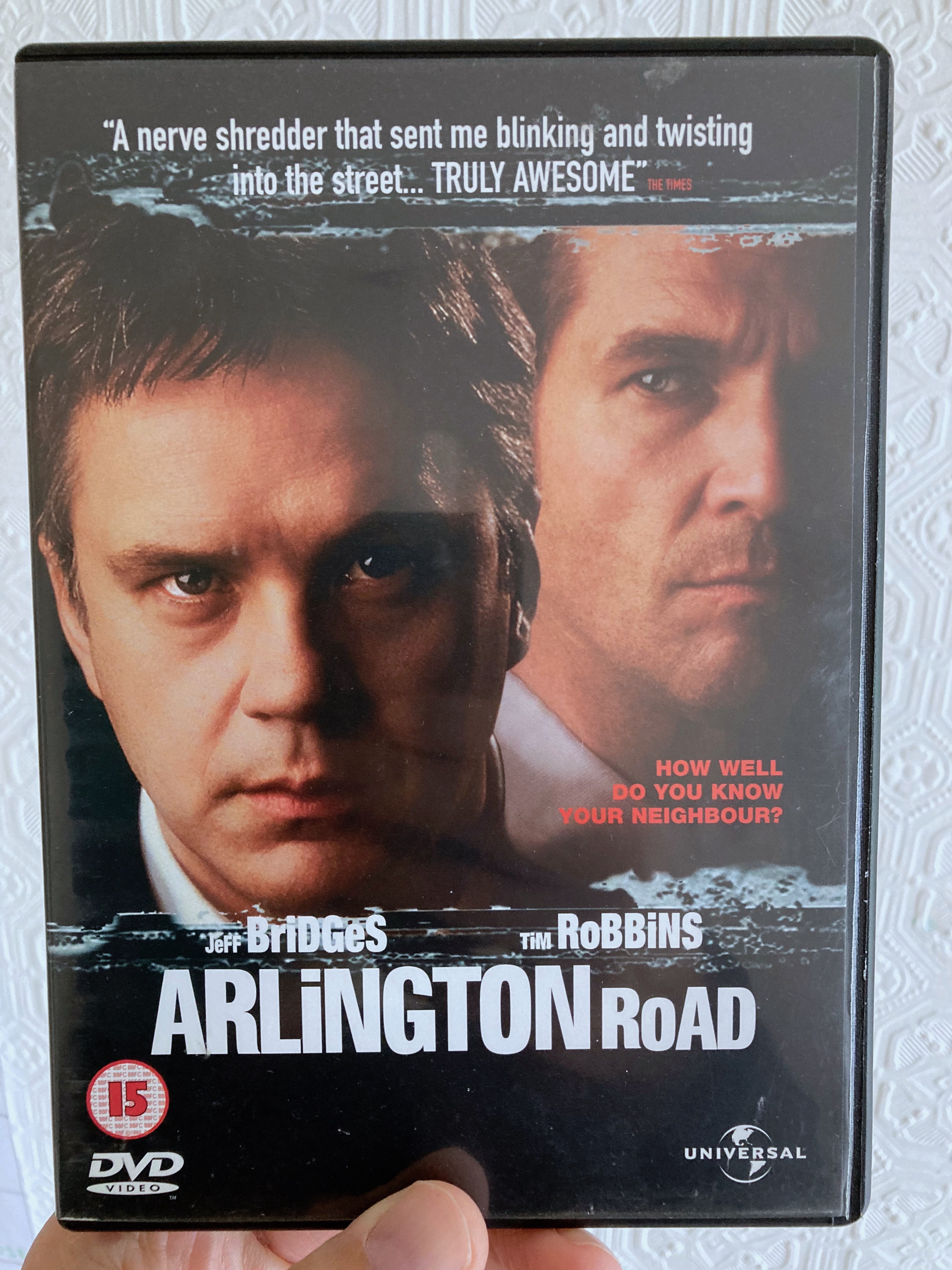
Arlington Road (1999)

Conspiracy thriller directed by Mark Pellington. 

Jeff Bridges is a widowed college professor who begins investigating his suspicious neighbours (Tim Robbins and Joan Cusack), who appear to be mixed up in a terrorist plot. It’s tense and fairly gripping but sadly goes completely off the rails towards the end. Once the big twist is revealed, very little of the story seems credible. There are simply too many coincidences and assumptions for things to have worked out the way Tim Robbins’ character planned. I felt cheated and quite angry. 

It’s a shame, because there are lots of good things about the film. Bridges is compelling and as watchable as always. There is an excellent jump scare, brilliantly framed. And I like Hope Davis, as the professor’s former graduate student.

The Hurricane (1999)

Directed and produced by Norman Jewison, this is a biopic of the boxer Rubin “Hurricane” Carter, who was falsely imprisoned for a New Jersey murder because of racial prejudice. 

Denzel Washington is excellent in the main role, with a compelling intensity that makes him highly watchable. Vicellous Reon Shannon is good, too, as Lesra Martin – the young man who identifies with Rubin and befriends him after reading his autobiography. Unfortunately, the secondary plot about the boy’s carers – a group of three Canadians who help him get a fair trial – is leaden and awkward. When we see them pinning notes on their noticeboard that say things like “Liar” and “Guilty”, it becomes clunky and almost laughable. It’s as if there are two films badly sandwiched together – a hugely powerful character study that elegantly tackles weighty themes, and a rather pedestrian B-movie about some amateur investigators. Even more odd is that it’s never explained why the three Canadians live together. What’s their domestic arrangement? Are they romantically connected? Friends? Members of a liberal communal-living project? On the plus side, you get to hear Bob Dylan’s song “Hurricane” and even see an archive clip of Bob himself. 

It’s a shame it’s all a bit of a mess, because the best parts – such as Hurricane talking about transcending his confinement – are genuinely inspiring.

Man on the Moon (1999)

Directed by Miloš Forman, this is a brilliant biopic of the wildly original comedian Andy Kaufman. 

Jim Carrey is superb in the main role, but he’s expertly assisted by Paul Giamatti (as Kaufman’s best friend) and Danny DeVito (as Andy’s manager). The film traces Kaufman’s career, but it escapes the trapping of bog-standard biopics by embracing the playful qualities of the comedian’s work. 

Courtney Love plays his girlfriend well, but isn’t really given enough lines.

The famous R.E.M. song is the theme tune.

Drop Dead Gorgeous (1999)

Very sharp, very funny mockumentary about a beauty pageant in the small town of Mount Rose, Minnesota. 

Every member of the cast is outstanding. Kirsten Dunst is the sweet Amber Arkins, who wants to follow in the footsteps of her hero Diane Sawyer. Ellen Barkin plays Amber's mother, and Allison Janney is her mother’s friend. Kirsty Alley plays the head of the pageant’s organising committee and a former winner of the same competition. Meanwhile, her daughter (Denise Richards) may or may not be killing off her rival contestants.  

Surprisingly, the film wasn't a success. It’s in the style of This Is Spinal Tap and Best in Show, but it has a savage black humour and intelligence of its own.

The End of the Affair (1999)

Neil Jordan’s adaptation of Graham Greene’s classic 1951 novel, which had previously been adapted by Edward Dmytryk in 1955, is by far the better of the two films. It’s rare that this is the case with remakes, but if anyone could fashion a satisfying film from this material it was Neil Jordan. 

During World War II, writer Maurice Bendrix (Ralph Fiennes) falls in love with Sarah Miles (Julianne Moore), the wife of a civil servant (Stephen Rea). But other forces keep the couple apart. Whereas the 1955 film is awkward and improbable, this remake comes alive as a psychological drama because the characters are three-dimensional and sympathetic. You can really believe that Sarah and Maurice love each other because the acting is so strong. 

There’s also an excellent performance by Ian Hart as the detective assigned to follow Sarah’s activities. 

Graham Greene’s somewhat overwrought handling of Catholic themes is softened here so that the character motivations become credible.

The Talented Mr. Ripley (1999)

Brilliant adaptation of the Patricia Highsmith novel, starring Matt Damon as Tom Ripley, an inventive young man who infiltrates and ultimately ruins the lives of a couple played by Jude Law and Gwyneth Paltrow

It’s brilliantly plotted, with Ripley somehow staying on top of the absurd twists and turns of the various crises he creates. Matt Damon is superb in this part – charming enough to be credible as someone the couple instantly like and creepy enough to always present a sense of nervy threat. 

Cate Blanchett and Philip Seymour Hoffman are both excellent in supporting roles. 

The Italian scenery looks stunning too.

Election (1999)

Excellent comedy set in a high school in Omaha, Nebraska

Matthew Broderick plays a popular school teacher whose life unravels when he gets involved with running the election for the student body president. Reese Witherspoon plays the ambitious Tracy Flick, who is determined to win it – whoever the cost. And Chris Klein and Jessica Campbell are the siblings who run against Flick. 

It’s fresh and funny, and you can easily relate to the characters and their predicaments.

Notting Hill (1999)

Romantic comedy written by Richard Curtis

William Thacker (Hugh Grant) works in a travel bookshop in Notting Hill. One day a famous actress (played by Julia Roberts) walks in. They begin an unlikely romance, but fame and other matters complicate their relationship.

It’s a sweet and funny love story. Grant and Roberts are both excellent. As with other Curtis narratives, a bunch of friends and relatives act as a sort of Greek chorus, commenting on the action and helping to move it along. These are all excellent in their own right. 

Grant is particularly appealing in this role. He seems so relaxed and at ease that his scenes are just a pleasure to watch. 

Rhys Ifans is a little too silly as his flatmate, and you cannot believe that someone as sensitive and gentle as Thacker would like or tolerate him. 

Also on the down side, there’s conspicuous product placement. And the music (Boyzone, Ronan Keating) is often terrible enough to take you out of the story. 

But ultimately it’s slick and charming. The characters come alive and the romance is touching.

Galaxy Quest (1999)

Sci-fi comedy. 

The cast of a TV show that's very similar to Star Trek find themselves in a real-life space adventure when their episodes are intercepted by aliens who regard them as “historical documents”. 

Tim Allen, Sigourney Weaver and Alan Rickman are all superb as the faded celebrity actors who are required to become their fictional counterparts. 

It works as both a satire and an example of a sci-fi story. It's silly and in places very funny.

Gloria (1999)

A brilliant hybrid of crime thriller and human drama. 

Sharon Stone plays a woman who has just got out of prison and returned to see her gangster boyfriend (Jeremy Northam) in New York. But one of his henchmen has just shot dead a family, leaving only a seven-year-old boy alive. Gloria grows attached to the child and tries to save him – and herself – from a life of crime. 

It’s a touching and funny story. Both Gloria and the boy have a brash, smart-talking exterior that masks their true vulnerability, and they bring out the best in each other. 

Directed by Sidney Lumet, it’s lively and exciting but also full of unsentimental warmth and charm. The script is sharp, and Stone gets some witty lines. She’s magnetic and highly convincing. Jean-Luke Figueroa is superb for a child actor, too, simultaneously expressing toughness and fragility.

Gloria lost money and was critically panned – perhaps because people were more fond of the 1980 film it remade. It deserves more credit, though, as it’s hugely enjoyable.

The Thomas Crown Affair (1999)

Hugely enjoyable remake of the 1968 film, with Pierce Brosnan and Rene Russo in the Steve McQueen and Faye Dunaway roles. 

The plot is fairly similar, although Crown’s playful crimes take place with valuable paintings instead of him orchestrating a bank robbery.  

Brosnan is perfect for the role: a sort of clinical charm. He’s better here than he was as James Bond, perhaps simply because the script is superior. Russo also gets it spot-on as the insurance investigator who slowly begins to fall for the man she should be incriminating. She’s stylish, sharp and sexy, always just one step behind him in their perpetual cat-and-mouse game. 

As a neat little reference to the original, Faye Dunaway returns – but as Thomas Crown’s shrink. The only problem is that the film gives no inkling as to why a man so supremely confident and perfectly accomplished might need a shrink in the first place. Denis Leary is also impressive as the Detective Michael McCann, and the progression of his relationship with Russo’s character is developed nicely. 

Whereas the original has a slightly impressionistic element, this version is crisp and precise – tightly plotted and excellently done all round. Probably the best remake I have seen.

The Insider (1999)

A whistleblower thriller based on a true story. Russell Crowe plays Jeffrey Wigand, who – when fired from his job in the tobacco industry – shared secrets about the conduct of his firm, even though he and his family were threatened and intimidated for doing so. Al Pacino plays the TV producer responsible for the 60 Minutes documentary that will air Wigand’s revelations. Christopher Plummer is the presenter of the show, who has a conflict of interests in terms of honouring his ethics vs. protecting his TV career. 

It’s entertaining and fairly gripping, if a little too long at 158 minutes. Director Michael Mann turns in something more sophisticated and less trashy than Heat, which also featured Pacino and the actor playing Wigand’s wife, Diane Venora

Pacino is terrific, even if (or because) he plays the same character in all his films: a hardboiled-yet-sensitive tough guy with integrity. 

It’s a little thin on the topic of Wigand’s marriage and the strains placed upon it. That thread could have been explored better. Otherwise, it's difficult to fault.

An Ideal Husband (1999)

Charming and entertaining adaptation of Oscar Wilde’s 1895 play starring Rupert Everett, Jeremy Northam, Cate Blanchett, Julianne Moore and Minnie Driver. With source material and actors that strong it would be difficult to go wrong, and sure enough director Oliver Parker makes the most of both. 

Moore is especially good as the scheming Laura Cheveley, intent on blackmailing a government minister. Driver is appealing as Mabel Chiltern, although for some reason she seems too “modern” to fit into the era that was being evoked. Everett gets it just about right, pitching his character somewhere between affable buffoon and trusty good sort.

It’s wittily and nimbly constructed. It works both as a piece of lighthearted froth and as a fairly engaging study of human nature in its various forms.

The Virgin Suicides (1999)

The first film by Sofia Coppola is a hypnotic piece of work that adapts the 1993 novel by Jeffrey Eugenides. It tells the story of the five Lisbon daughters, and the suicides that destroy their family. Consciously or otherwise it seems to echo Picnic at Hanging Rock – another mystery about disappearing girls – and in places it evokes the same hazy, dreamy atmosphere. Like that story, it’s as much about the after-effects of the key events as it is about what actually happens, as the girls enter the dreams and inner lives of those who knew them. 

Coppola also brings subtle, dry wit into the story, which is impressive given the macabre subject matter. One scene has the strict religious mother trying to burn the girls’ vinyl records (Kiss, Aerosmith, etc) only to nearly choke everyone with the toxic fumes they produce. 

There are clever, tricksy moments that shouldn’t work but somehow do anyway. At one point, an eye “twinkle” is added when Lux (Kirsten Dunst) smiles. At another point, we see “through” Lux’s dress to reveal that she’s written her new boyfriend’s name on her underwear. 

It also works as a teen story, and scenes such as the Homecoming ball – or the romantic moments when the boys and girls play each other records down the phone – would have been compelling as a youth drama in their own right, even without the disturbing undercurrents. 

James Woods and Kathleen Turner are excellent as the parents struggling to comprehend the nightmarish situation that grips their family, while Kirsten Dunst is especially strong as the most outgoing of the daughters.  

At the heart of the film is a mystery: the five girls are an enigma that the film wisely doesn’t even try to explain. And the eerie ambience is perfectly captured by Air’s original soundtrack. 

Trivia: it’s set in Grosse Pointe, Michigan, just like Grosse Pointe Blank.

Anywhere but Here (1999)

Impulsive, restless Adele August (Susan Sarandon) drags her teenage daughter Ann (Natalie Portman) from Bay City, Wisconsin, to Beverly Hills, California, to begin a new life. It soon becomes clear that Ann is the more sensible of the pair, and her resentment builds as she considers the friends and family she’s been forced to leave behind. 

The film begins with a road trip and I would have liked more of that, but ultimately it’s not about their travels. The focus is primarily on the mother-daughter relationship and how that develops under increasingly strained circumstances. There are a few laughs, too, which emerge from a strong, character-driven script. 

Sarandon sparkles as the maddening but hugely appealing Adele. Portman gives a performance that unlike other films (Star Wars prequels, Garden State), suggests she’s a pretty solid actor who hasn’t always chosen the right roles. 

The conclusion is satisfying and emotional without being mawkish.