Showing posts with label Year: 2001. Show all posts

Lovely & Amazing (2001)

Comedy-drama written and directed by Nicole Holofcener.

Jane Marks (Brenda Blethyn) is the mother of two grown-up daughters, Michelle (Catherine Keener) and Elizabeth (Emily Mortimer). Jane has also adopted a pre-teen girl called Annie (Raven Goodwin). Each of them experiences various ups and downs in their personal lives, and the story expertly examines these domestic threads and how they interrelate.

Catherine Keener absolutely shines as a would-be artist who cannot sell her craft creations. She goes to work in a photo-development shop and becomes involved with a teenage co-worker (played by a young Jake Gyllenhaal), with inevitable consequences.

It’s a funny and perceptive film that’s highly entertaining.

Spy Game (2001)

Retiring CIA officer Nathan Muir (Robert Redford) learns that his protege Tom Bishop (Brad Pitt) is in trouble in Hong Kong. Muir’s CIA colleagues begin to dig in to his past, and the film then reveals his story in a series of flashbacks. The somewhat disjointed and bitty narrative focuses on specific incidents in Vietnam, Berlin and Beirut. 

It’s not quite the thriller you might have imagined or hoped for – mainly because Redford never gets out of the office. Somehow he is able to run rings around his CIA colleagues, even though they would’ve had the same training as him. As such, it’s an intriguing thriller that doesn’t quite work. The basic ingredients are good, and with more focus in the storytelling, it might have been more satisfying.

15 Minutes (2001)

A fundamentally misconceived thriller that somehow stars Robert De Niro. It’s an extremely heavy-handed satire about fame and the media that fails on multiple levels. 

Two eastern European criminals arrive in New York City. (They are portrayed in a crassly simplistic, racist manner.) The pair want to be famous, and will commit murder to achieve that. Meanwhile, a detective (De Niro) and a fire investigator (Edward Burns) team up to catch them. 

There are lots of unexpected twists – not because the film is well-plotted, but because it’s a sprawling mess. Certain threads are never resolved, such as the fate of Vera Farmiga’s character. She’s meant to be the love interest, but she’s quietly sent away rather than being allowed to develop her relationship with Burns’ character. 

The biggest flaw of all is the two criminals, who are woefully one-dimensional and presumably intended to be semi-comedic (the tone of the film is especially uneven). One of them video-tapes everything they do, thereby incriminating them. Maddeningly, the film presents some of the action through their camera footage – a gimmick that very quickly wears thin. This camcorder view of the violence also seems like exactly the sort of sensationalist rubbish the film claims to be satirising. It’s way dumber than it thinks it is. 

There’s also a silly plot about a true-crime TV show presented by Kelsey Grammer (of Frasier) that feels like a different film entirely. 

It’s frustrating because De Niro, Burns and Farmiga are all on good form, and some of their scenes are highly watchable. It’s as if director John Herzfeld sub-contracted some of the work, so jarring and uneven are the various different kinds of film clumsily cobbled together for the final edit.

Evolution (2001)

Comedy sci-fi directed by Ivan Reitman. 

Arizona college professor (David Duchovny) and his geologist pal (Orlando Jones) investigate the site of a meteor landing. Exploring the site they encounter life-forms with the ability to evolve at high speed. Before long, all civilisation is at risk. 

Julianne Moore plays an epidemiologist who keeps tripping over and bumping into things, while Dan Ackroyd is the state governor, keen to avert an embarrassing disaster.

It’s extremely silly, but it’s quick-witted and there are enough laughs to keep you hooked in until the end.

Last Orders (2001)

Written and directed by Fred Schepisi, this is a disappointing adaptation of Graeme Swift‘s Booker Prize-winning novel. 

When Alex (Michael Caine) dies, his friends and son honour his final wishes by travelling to Margate to scatter his ashes from the end of the pier. In undertaking this journey, they consider their memories of him and their feelings for each other, past and present.

Somehow, what works beautifully on the page fails to translate to the screen.

Graeme Swift's elegant weaving together of different times and places makes perfect sense in a written context. But filmed, the multiple time frames and young/old juxtapositions seem clunky. Plus, the cheesy music by Paul Grabowsky is jarring and inappropriate. 

Helen Mirren is solid as Jack’s wife Amy. Ray Winstone, Bob Hoskins and Tom Courtenay just do what they always do.

Bridget Jones’s Diary (2001)

Romantic comedy directed by Sharon Maguire and starring Renée Zellweger, Hugh Grant and Colin Firth. It’s co-written by Richard Curtis and adapted from the popular 1996 novel by Helen Fielding. It’s also a sort of reinterpretation of Jane Austen’s Pride and Prejudice

It’s funny in places, although Hugh Grant is given all the best lines. Colin Firth seems less well catered for in terms of the script, with the unfortunate result that you aren’t rooting for him when the plot suggests that you should be. Zellweger has a bumbling charm, and is perfect as the heroine everyone can relate to, even if her English accent doesn’t sound quite right. 

Some of the references wouldn’t have made it to a modern-day film, which makes it all the more interesting now. 

Gemma Jones is absolutely awful as Bridget’s mother – a misconceived role, badly handled. Jim Broadbent is marginally better as her father, but he’s not given a great deal to go on.

Beautiful Creatures (2001)

Usual drama/thriller directed by Bill Eagles. 

Rachel Weisz and Susan Lynch star as two women victimised by men – until they take the law into their own hands. 

It’s a black comedy that’s a sort of Glasgow-based Thelma and Louise. But unlike that film, it doesn’t develop the relationship between them fully enough. There are some good lines and it’s well plotted, though. But with additional work it could have been so much better.

Serendipity (2001)

Romantic comedy directed by Peter Chelsom and starring John Cusack and Kate Beckinsale. 

John and Sara meet by chance in a shop in New York and hit it off. Both are involved with someone else, but they cannot ignore their mutual attraction. For reasons not fully explained, Sara won’t give John her full name or number. Instead, she says they can trust it to fate to bring them back together – if that’s what’s “meant to be”. It’s quite a forced premise, but it would have worked better if the film had Meg Ryan, Tom Hanks and a better script. You can imagine Woody Allen doing great things with the same material. 

In addition to the lack of sparkle in the script, Serendipity falls down on several levels. In particular, for the pair’s one evening together to have been so life-changing it would have needed to be more remarkable than the rather ordinary set of events we saw them share (shopping, some chat, ice skating). Cusack does his best but Beckinsale seems barely present in certain early scenes. Also, her boyfriend – a silly rock star who has got into “eastern” self-discovery – is a ludicrous figure who she would never have been drawn to in the first place. You know that the film has to make him unappealing so that you’re rooting for her to get together with Cusack, but they could have at least made him credible. Cusack’s fiancée, meanwhile, is too blandly sketched out to prompt any kind of response at all. Again, that must be deliberate – the plot won’t work if we side with her – but it does make for some two-dimensional characterisation. 

All that said, the film slowly grew on me as it progressed. I like the way the intricate plotting shows destiny always pushing the pair together without them even realising. I also liked the escalation towards their inevitable reunion. It’s actually quite romantic, if you overlook the shortcomings, and makes for a fairly entertaining 91 minutes.

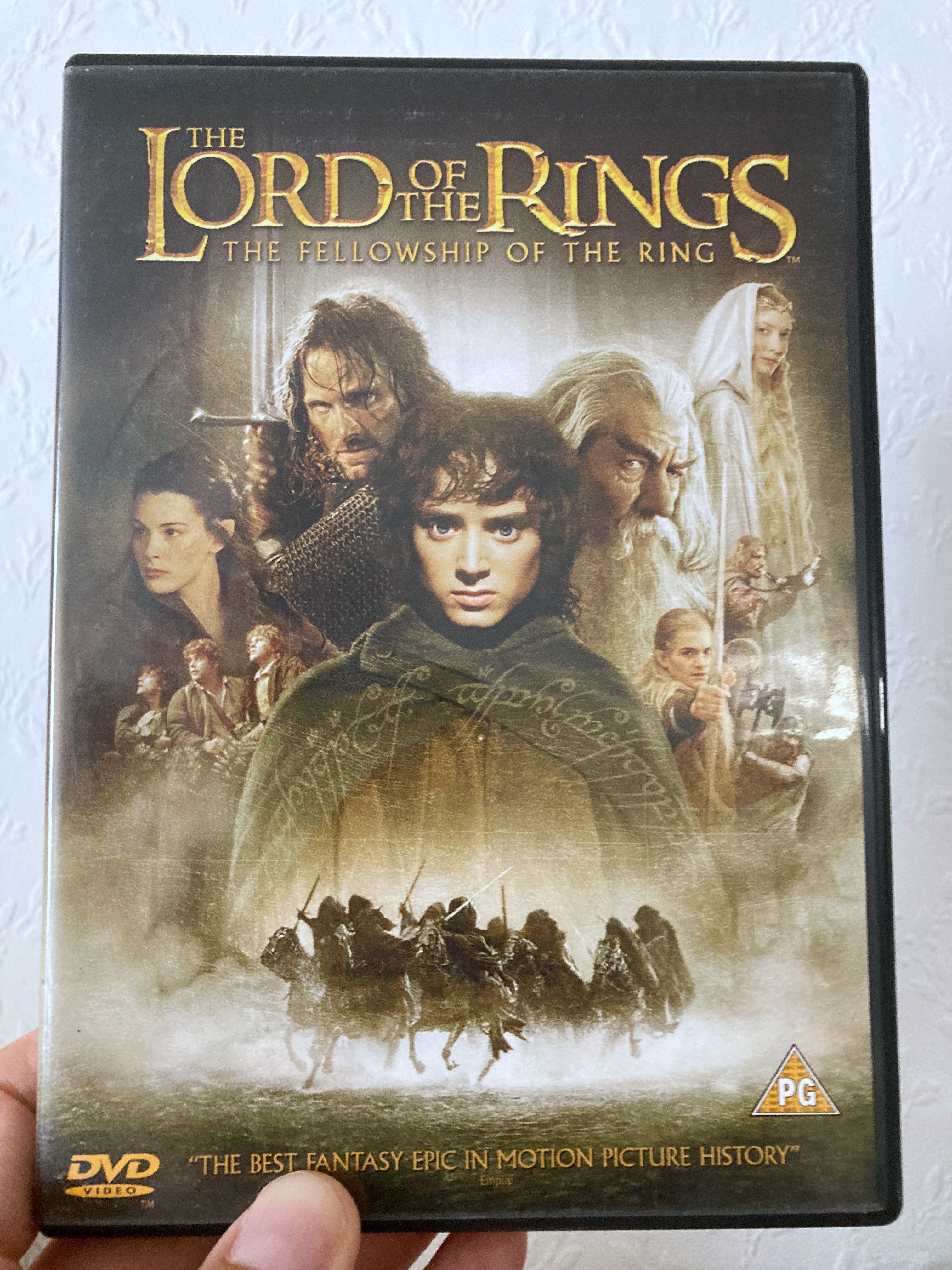
The Lord of the Rings: The Fellowship of the Ring (2001)

First part of Peter Jackson’s version of J. R. R. Tolkien’s fantasy epic. 

A hobbit called Frodo Baggins (Elijah Wood) journeys through Middle-earth to destroy a ring containing immense evil power. Along the way there are battles and mystical happenings that help and hinder his progress. 

I was somewhat dreading watching this – anything with wizards, elves, magic and beards is a big turn-off – but it was better than I thought. The storytelling is coherent and the acting is above par. 

Ian Holm, Ian McKellen, Liv Tyler, Cate Blanchett, Orlando Bloom, Christopher Lee, Sean Bean and Andy Serkis, among others, all do their bit. It’s ludicrous, but they take it seriously enough to make it just about hang together. 

My objection remains the arbitrary-seeming, make-it-up-as-you-go-along “rules” (i.e., this sword will glow blue when orcs or goblins are approaching) that typify fantasy. This thing has this power. That thing can defeat this thing. This other thing can destroy that other thing.

The Others (2001)

Deeply creepy supernatural thriller. 

Nicole Kidman is a mother of two children living in Jersey in 1945. The family begin to hear strange noises and see odd things in their large old house. They are joined by a new housekeeper, a gardener and a mute girl, and the inexplicable happenings become more frequent. It’s difficult to say more without spoil the film, which all hinges on one massive plot twist. 

Kidman is superb as a woman on the edge, driven by love for her children and a profound sense of loss after her husband failed to return from the war. Fionnula Flanagan is perfect as the housekeeper Bertha Mills – an initially reassuring and later fairly unsettling presence. The suspense is built up expertly, with added tension coming from the reactions of the children to the way events unfold. 

Music by writer/director Alejandro Amenábar adds to the sense of threat, and the uncanny atmosphere – big, dark echoing spaces, the persistently swirling mist outside – is sustained well.

The Mexican (2001)

Foolish amateur gangster Jerry (Brad Pitt) has to perform “one last job”, which involves transporting a legendary gun from Mexico back to the USA. Predictably, nothing goes to plan. Events are further complicated when his girlfriend (Julia Roberts) is kidnapped by another gangster (James Gandolfini) and the pair develop a strange friendship. 

This is a comedy thriller with an unusual tone. It flits between tense moments and genuinely funny ones – a tricky balancing act that director Gore Verbinski pulls off with skill. 

Brad Pitt is better than usual because he’s playing an idiot and therefore doesn’t need to seem credible. Roberts is terrific – vividly full of life and personality – and her evolving relationship with Gandolfini provides the heart of the film. 

Gene Hackman has a cameo. Plus, there’s a nice sub-plot about a ferocious dog.

Enemy at the Gates (2001)

An expert Russian sniper, Vasily Zaytsev (Jude Law) plays a cat-and-mouse game with German sniper Major König (Ed Harris) during the Battle of Stalingrad in 1942. Vasily, who becomes a national hero, is aided by his lover Tania (Rachel Weisz), his friend Danilov (Joseph Fiennes) and Nikita Khrushchev (Bob Hoskins), who realises the marksman's value in terms of propaganda. 

Some of the sets don’t look especially realistic (not sure if that’s because it’s early CGI or whether it’s something to do with the models they used), but the scenes of soldiers being shot down in their hundreds look all too plausible. 

The relationships between the key characters are convincing, and Law and Weisz in particular create a strong chemistry together. 

It’s one of the more compelling war films because it makes you care about the characters and understand their motivations – including those of the villain. And while the love story is touching, the overall narrative never gives way to sentimentality.

Donnie Darko (2001)

Richard Kelly’s deeply enigmatic, fascinating film straddles psychological thriller and horror-tinged mind-bender. Donnie is a troubled teenager who encounters a creature in a rabbit costume. This creature tells him that the world will end in 28 days, 6 hours, 42 minutes and 12 seconds. As that countdown progresses, he continues to visit the boy and advise him on his actions, which become increasingly extreme. 

Meditations on the nature of time, reality and identity are set against the backdrop of an American suburb. The film develops several other strands: Patrick Swayze is the too-good-to-be-true motivational speaker Jim Cunningham, who has a polarising effect on the town, while Drew Barrymore is a school teacher too open-minded for the culture of the school. There’s also lots about Donnie’s family, who love him without understanding him. 

The ending can be taken multiple ways and I’m not sure you’re even meant to fully “understand” it. Instead, you are left with a glimpse into a powerful, multilayered world beneath or behind the one we take for granted. 

Jake Gyllenhaal is superb as the main character. His face has to convey menace, fear, amusement and confusion, and does so brilliantly. Katharine Ross is excellent as Donnie’s psychiatrist, Dr. Lillian Thurman. But, as with all great films, there’s not a single performance that could be improved upon.

Iris (2001)


A biopic of Iris Murdoch, a love story and a study of the great writer’s decline into Alzheimer’s, this is a gripping and sad drama.

Adapted from John Bayley’s book about his dying wife, Iris: A Memoir of Iris Murdoch (1998), it cleverly flits between young Iris (Kate Winslet) and old Iris (Judi Dench) in order to show you the strength of talent and personality being eroded by the disease. The two eras dovetail perfectly, often connected by visual signifiers (such as the couple swimming “then” and “now”) that make them flow together seamlessly.

Jim Broadbent plays Bayley as a bumbling figure who remains deeply in love with the brilliant, unconventional woman he met in Oxford. My only criticism of the film is that this almost comically awkward characterisation gives little sense that he also had a remarkable intellect of his own.

Winslet and Dench are both highly convincing as the celebrated writer – painfully so in the case of the latter. It’s almost unbearable to watch her “sailing into darkness”, as she puts it, as she slowly but steadily forgets everything she ever knew and even who she is.

I also found it deeply uncomfortable to see the appalling mess in the couple’s home. They were truly living in squalor with no outside support.

Penelope Wilton (of Ever Decreasing Circles fame) is excellent as Iris’s friend Janet Stone.

Apocalypse Now Redux (2001)


Francis Ford Coppola’s astonishing film deserves all the acclaim it has received. Set during the Vietnam War, but not really about the conflict as such, it details a mission by Captain Benjamin L. Willard (Martin Sheen) to locate and kill a rogue officer named Colonel Walter E. Kurtz (Marlon Brando). Kurtz has built an entire religion around himself and is seen as a threat to US forces. The story picks up on Heart of Darkness by Joseph Conrad.

It’s a stunning piece of cinema. The visuals are remarkable – again and again I was left wondering how something was filmed and how it could look so realistic.

The acting is terrific. Sheen is great as the troubled captain becoming obsessed with tracking down Kurtz. Robert Duvall is fascinatingly bonkers as the lieutenant colonel who just wants to go surfing, despite the explosions going off around him that he doesn’t even seem to notice. His scenes have rightly become iconic, from “I love the smell of napalm in the morning” to the moments when his men blast out Wagner’s “Ride of the Valkyries” from their helicopters as they invade the Viet Cong.

The soundtrack is also remarkable: I love the spooky electronic sounds that so perfectly set the ominous tone of the trip upriver.

You get to see a young Harrison Ford as Colonel G. Lucas – a nod to George Lucas, who nearly ended up directing the film. Thank goodness he didn’t. And Dennis Hopper plays a photojournalist who has been inducted into Kurtz’s cult.

I haven’t seen the original 1979 edit of the film so I can’t tell how different the Redux version is. But you can see that certain scenes – such as meeting the French colonials – weren’t needed for narrative purposes. That said, I do like the way they further enrich the experience of the film. It’s so rich and compelling that there’s space for additional material.

Certainly the best war film I have seen. It hammers home the point that no one is left undamaged by conflict.

Black Hawk Down (2001)


Brutal military drama by Ridley Scott that details the US involvement in the 1993 civil war in Somalia.

A UN taskforce is sent into Mogadishu to capture the leader of the militia, Mohamed Farrah Hassan Aidid. It sounds straightforward enough, but the mission goes horribly wrong when a US helicopter is shot down. Chaos ensues, and the Americans seem naive and ill-prepared. You know there isn’t going to be a simple resolution or a happy ending.

The film is extremely violent – sometimes almost unbearably so. In no way does it glamorise war (you see body parts galore), but – perhaps inevitably – it does only show it from the Americans’ perspective.

The ensemble cast has no real star or focal point. This has the benefit of making it about the team rather than any one “hero”.

Being a Ridley Scott film, it looks stunning and the soldiers’ relentless, harrowing experience of being under constant attack is detailed brilliantly.

Enigma (2001)


Tom Stoppard’s adaptation of a Robert Harris World War II thriller set at Bletchley Park in 1943. Dougray Scott plays Tom Jericho, troubled code-breaking “genius”. Kate Winslet plays Hester Wallace, best friend of Tom’s ex-girlfriend who has gone missing. The pair team up to look for the missing girl and also to crack the code that could prevent Nazi U boats attacking an Allied shipping convoy. It’s an intriguing, mostly low-key story with moments of suspense, but it’s less captivating and emotionally involving than the Alan Turing cryptography-themed biopic The Imitation Game (2014). Kate Windswept is endearing, but Jeremy Northam out-acts everyone else as the sinister Secret Service operative Mr. Wigram. Surprisingly, the film was co-produced by Mick Jagger, who has a brief cameo as an officer sat at a table during a dance. What’s unfortunate is that Alan Turing’s role in inventing the Enigma machine is completely overlooked. In fact, its creation is here attributed to a fictional character – another sad example of the glossing over of Turing’s remarkable achievements.

Ocean's Eleven (2001)


Completely unbelievable casino heist thriller. Some of the 11 criminals are caricatures, while Brad Pitt just eats during every scene. There are too many things in the plot that simply couldn’t happen, such as when they need to create a power cut and so steal a big piece of scientific equipment to release an electromagnet pulse that plunges all of Las Vegas into darkness. The guy with the English cockney accent is plain embarrassing. Why do American films and TV shows so often completely misjudge how English people speak? 

George Clooney is charming as Danny Ocean and Andy Garcia is convincingly nasty as the evil casino owner, but it’s too visually stylised and self-conscious to let you ever become fully engrossed in the story. 

Would I watch it again? No.