Showing posts with label Starring: Naomi Watts. Show all posts

J. Edgar (2011)

Directed by Clint Eastwood, this is a surprisingly dull biopic given the rich source material. 

J. Edgar Hoover (Leonardo DiCaprio) looks back on his life and work as the head of the FBI. Along the way we learn about his repressed homosexuality and a series of world events as presidents come and go. 

Naomi Watts is wasted as a secretary with little to go on in terms of a fleshed-out character. Judi Dench is much better as Edgar’s domineering mother. Much of the story is told in flashback and the worst aspect is the prosthetics used to age the character. DiCaprio and Watts look OK, but Armie Hammer as Clyde Tolson looks comically awful in his rubbery “older” face, and it’s a major distraction. 

In a very brief appearance only, Adam Driver makes his film debut.

Dream House (2011)

Psychological thriller starring Daniel Craig as an editor who moves into a new suburban home with his wife Libby (Rachel Weisz) and two daughters. But all in the house is not as it seems and only his neighbour (Naomi Watts) seems to really know what’s going on. 

There are a couple of major plot twists, so it’s difficult to reveal any more about the story without ruining it. Craig and Weisz are OK (and it’s quite interesting to watch this real-life couple play a pretend couple), but Watts is oddly underused. The creepy premise isn’t quite followed through, so it slightly runs out of steam. 

Shutter Island is a better treatment of similar themes. Also, the main part of the film works as a psychological study, so it’s a shame that a genuine supernatural element is confirmed near the end. All that said, it’s a fairly entertaining romp.

21 Grams (2003)

Powerful and disturbing drama directed by Alejandro González Iñárritu and starring Sean Penn, Naomi Watts, Benicio Del Toro, Charlotte Gainsbourg and Danny Huston.

The plot interweaves the lives of several characters, told with extensive flashbacks. The mixed-up chronology can be challenging – it might have worked better in linear sequence – but the material is harrowing in any order. The relentlessly dark subject matter includes alcoholism, drug addiction, bereavement, born-again religion, relationship separation and terrible psychological anguish. 

Del Toro, Penn and Watts are all excellent, tackling extremely difficult scenes. It’s searing, gut-wrenching storytelling that is quite painful to watch. 

It’s visually striking, too. The colour and graininess of the film changes with the mood and tone of the events, but overall there’s very little lightness or hope offered.

The Painted Veil (2006)

Drama, brilliantly directed by John Curran, based on the 1925 novel by W. Somerset Maugham. 

Bacteriologist Walter Fane (Edward Norton) meets Kitty Garstin (Naomi Watts) in London and they quickly marry. Then Walter accepts a post in China, helping a village amid a cholera outbreak, forcing Kitty to go with him to punish her for her infidelity. 

It’s beautifully shot and extremely poignant. There’s a historical/political thread, but the main focus is on the couple’s complicated relationship and the way it evolves.

The script is subtle and nuanced. Likewise, the graceful and restrained-but-powerful performances.

The Assassination of Richard Nixon (2004)

Based on a true story, this is a gripping and desperately sad drama starring Sean Penn. He plays Samuel Bicke, a furniture salesman who is suffering at work and in his personal life and who – amid a mental breakdown – decides to kill the president. 

Penn is absolutely superb, making you feel his utter isolation and his heartbreaking descent through a series of personal tragedies. He is estranged from his wife (Naomi Watts) and children, is bullied by professional colleagues and sees his plans to set up his own business rejected. 

Nixon himself is cleverly woven into the story through the use of archive footage shown on news broadcasts. 

When Bicke finally undertakes his assassination attempt we really feel for him. It’s not that you’re rooting for him to succeed – history already tells us that he will fail – but you yearn for him to be happier and to find peace.

Fair Game (2010)

Superb thriller. Adapted from the memoirs of the two protagonists, it tells the story of CIA operative Valerie Plane and her diplomat husband Joseph C. Wilson. The pair were responsible for exposing the US government’s fabrication of the evidence about Weapons of Mass Destruction that was used to justify the invasion of Iraq. 

Naomi Watts and Sean Penn deliver remarkably convincing performances in the lead roles. There’s the political saga, but also the story of their marriage and family, and the strain that these events put on them. 

I admire the realism of it, such as the way that every scene featuring the couple’s children had them constantly asking questions and demanding attention. I also respect the film for delving into the moral ambiguities of the topic – should you tell the truth even if it puts loved ones at risk? – and not providing any simplistic answers.

The International (2009)

Satisfyingly unformulaic thriller. 

Clive Owen and Naomi Watts play the cutely named investigators Salinger and Whitman, who try to bring down the International Bank of Business and Credit (IBBC). 

It’s fast-paced and very nicely shot, with a stylish take on locations in Berlin, Milan, New York and Istanbul. In the case of Istanbul, the exact same area – the rooftops of the Grand Bazaar – would later be used for a motorbike chase in Skyfall (2012). The most dramatic section is an extended shoot-out in the NYC Guggenheim Museum, painstakingly replicated just for this film. 

The script avoids cliché and it’s refreshing that the lead pair do not end up becoming a couple. Both in terms of their personal lives and the corruption their work exposes, there are no easy solutions offered. But the very existence of the film emphasises the immense, insidious power of global finance and the way banks drive the behaviour of governments and determine the outcome of global conflicts. 

Watts is always reliable, and impresses throughout. Owen, meanwhile, surprises with a blend of toughness and vulnerability that’s just right for this particular story.

King Kong (2005)

Peter Jackson’s epic remake of the monster classic is every bit as big and bold as its subject. 

The generally underrated Naomi Watts is superb as the woman captured and then befriended by the giant gorilla. The empathy and understanding between the two forms the emotional core of the film. Both are lost and misunderstood until they find each other. Jack Black seems miscast as Carl Denham, the ambitious, canny film director who has the map to Skull Island and wants to achieve fame and fortune by filming the extraordinary mysteries there. He’s not quite right for the role, somehow, and there are too many close-ups of his face looking “perturbed”. 

The visuals are impressive, even if I don’t really like the garish/ugly aesthetic style Jackson adopts. Some of the CGI scenes – such as Kong fighting dinosaurs as they tumble into a valley – are remarkable, even if he sometimes favours an ugly “high style” that doesn’t even try to be “realistic”. It’s more like a homage to a cinematic golden age that embraces its own artifice. 

Kong himself is motion-captured from Andy Serkis, who would provide the same function for Rise of the Planet of the Apes (2011) and its 2014 and 2017 sequels. You instantly relate to his predicament, and it’s heartbreaking to see him ruined by the greed and selfishness of the humans who seek to exploit him. 

The famous Empire State Building sequence (faithfully reconstructed from the 1933 original) is terrifying and genuinely disturbing.

Diana (2013)


Unfairly savaged biopic of the Princess of Wales, dealing with the last two years of her life. During this time she gave the famous BBC interview that spilled the beans on the royal family and how unhappy she’d been. This was also the period in which she had an intense relationship with heart surgeon Hasrat Khan, and their love story forms the main narrative thread.

Naomi Watts is believable as Diana, expertly replicating mannerisms such as the eyelash flutter and tilt of the head. She successfully depicts a ludicrously famous icon who is both insecure and cocky, willing to play with her position of power. Naveen Andrews is charismatic as her lover. And as a love story it works well. On the down side, the character of Dodi Fayed (her new boyfriend, who died with her in the Paris underpass on 31st August 1997) is entirely undeveloped. He barely gets a line of dialogue.

Critics were right to point out that there's a “Sunday night TV drama” aspect to it – mainly visually. It lacks “cinematic” qualities and doesn’t give off the lavish feel you would expect from a story about a princess. But it certainly doesn’t deserve the trashing it received.

Diana was directed by Oliver Hirschbiegel. I realise I’m in a tiny minority by far preferring this film to his more celebrated Downfall.

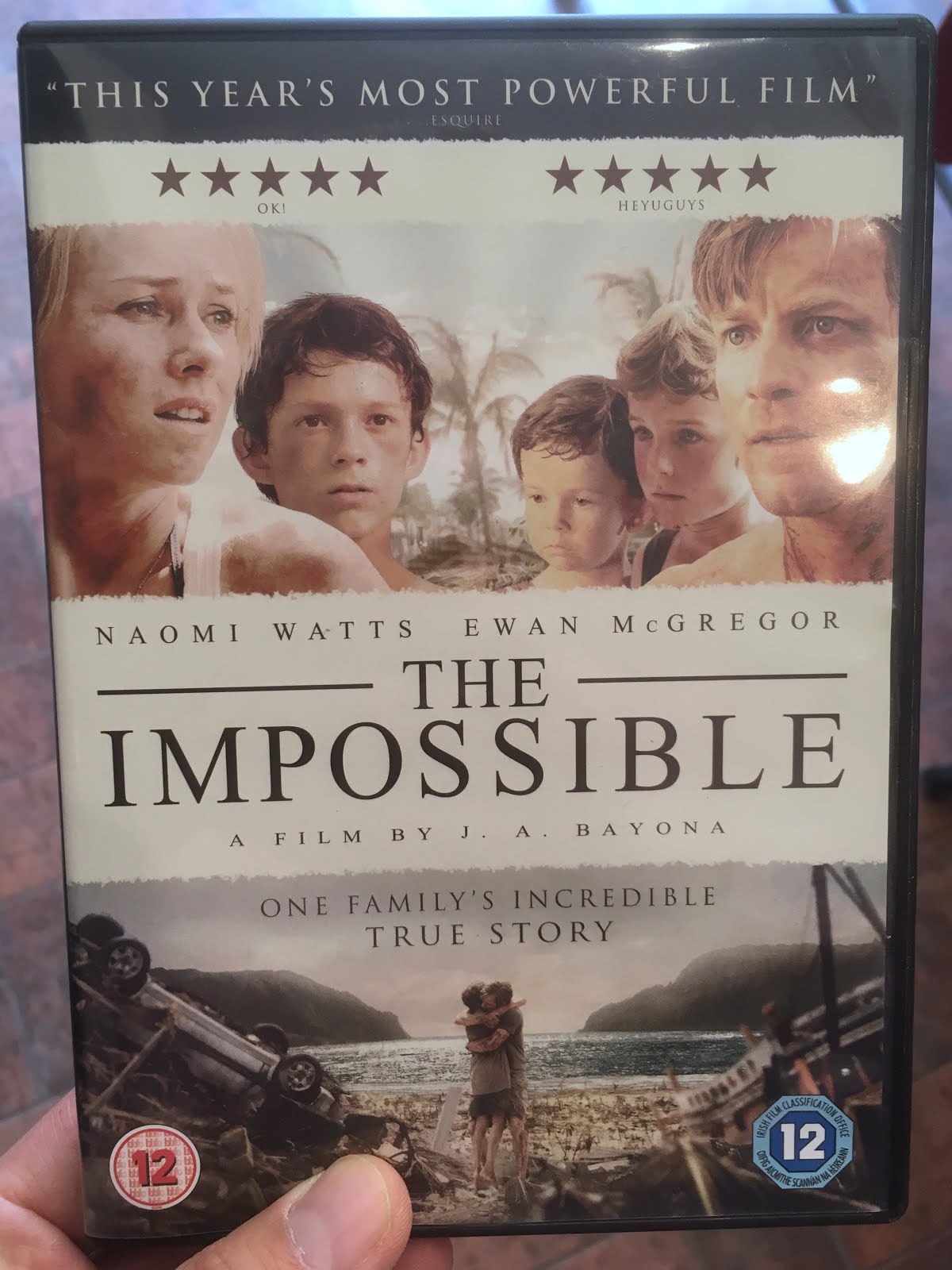
The Impossible (2012)


Scary and moving true story of a family caught in the 2004 tsunami that redrew the map around the Indian Ocean. It shows the shocking brutality of the event itself, but the focus is on what happens to the family when they are split up and wounded. It could so easily have been corny, but there were several moments that brought me to tears. It's gruelling and distressing to see so much human pain on such an epic scale.

Naomi Watts is highly convincing as the badly injured mother, trying to keep going for the sake of her son and the family members she believes lost. Ewan McGregor is less so as the father, although he's much better here than when he was being Obi-Wan Kenobi.

The film has been criticised for focusing on the "tourist experience" of the tsunami, rather than on how the event affected local people. That seems inevitable, somehow, but at its centre The Impossible celebrates the universal value of life and portrays all of the victims with compassion. For a "disaster film", there’s a refreshing absence of cliché and sensationalism.