Showing posts with label Starring: Anthony Hopkins. Show all posts

Magic (1978)


Anthony Hopkins is at his absolute best in this riveting drama about a ventriloquist, Charles “Corky” Withers, whose dummy (“Fats”) appears to take him over. It cleverly walks a tightrope between a psychological thriller and a horror film. Is it all in the ventriloquist’s mind? Or is there a genuinely supernatural element, with the dummy actually coming to life? That question is eventually answered but not before you’ve been put through a terrifying roller-coaster. 

Magic was presumably influenced by Dead of Night, which had a section that explored a similar scenario. 

The film is brilliantly directed by Richard Attenborough. Burgess Meredith (the Penguin from the Batman TV show) is excellent as Corky’s agent, Ben Greene, who soon learns that nothing is quite as it should be.

Instinct (1999)

Intriguing psychological drama directed by Jon Turteltaub. The credits say it was “suggested by” a novel by Daniel Quinn, which sounds like legal speak for something more ambiguous. 

Anthony Hopkins plays anthropologist Ethan Powell, who is now held in a high-security prison and refusing to speak. Earnest psychiatrist Theo Caulder (Cuba Gooding Jr) attempts to get to know Powell and uncovers the true story of what happened when he spent two years living in the jungle with gorillas. It should really have been called One Flew Over the Gorilla’s Nest or The Silence of the Lambs in the Mist, since there are hints of those Hannibal Lecter, Dianne Fossey and Randle McMurphy stories wrapped up in this narrative. 

There are interesting themes about freedom and social control, but there’s too much about the dysfunctional prison society (and inmates) and too little about Powell’s psychological development. It’s also hammy in places. Plus, the music is somewhat jarring. 

Donald Sutherland is a wasted as a professor who the plot doesn’t really require. Gooding is so-so: one-dimensional until a sudden and unexpected outpouring of emotion is unleashed at the end. But that emotion doesn’t seem warranted by what has gone before. Hopkins is as magnetically watchable as ever, even with a silly beard and even when the material is plain silly.

The Edge (1997)

Extremely flawed disaster/survival thriller written by David Mamet. 

Anthony Hopkins is the only good thing about the film, and thankfully he’s in virtually every frame. He plays a know-it-all billionaire, Charles, who survives a plane crash in Alaska and attempts to walk back to civilisation. His efforts are hindered by the vain photographer, Bob, who he accompanied (Alec Baldwin), who happens to be having an affair with his wife (a miscast Elle MacPherson). 

For some reason, Charles and Bob are continually saying each other's names.

The situation is exciting enough – there are plenty of showdowns with bears – but the execution is third-rate and even comical. In one laugh-out-loud scene, Hopkins and Baldwin don bear-hide costumes that they have apparently rustled up in mere minutes. They look like Ewoks.

The Wolfman (2010)

1891. A mysterious attack takes place in the woods...

This is a less-than-inspired retelling of the standard werewolf myth starring Anthony Hopkins, Benicio del Toro, Emily Blunt and Hugo Weaving. It’s a remake that didn’t need to be remade. 

There’s a lot of gore but very little dramatic tension, partly because you see way too much of the werewolf. No mystery or suspense can survive close-up scenes of a monster that looks slightly ridiculous.

A far better film is American Werewolf in London (1981), in which director John Landis addresses similar subject matter with wit and imagination.

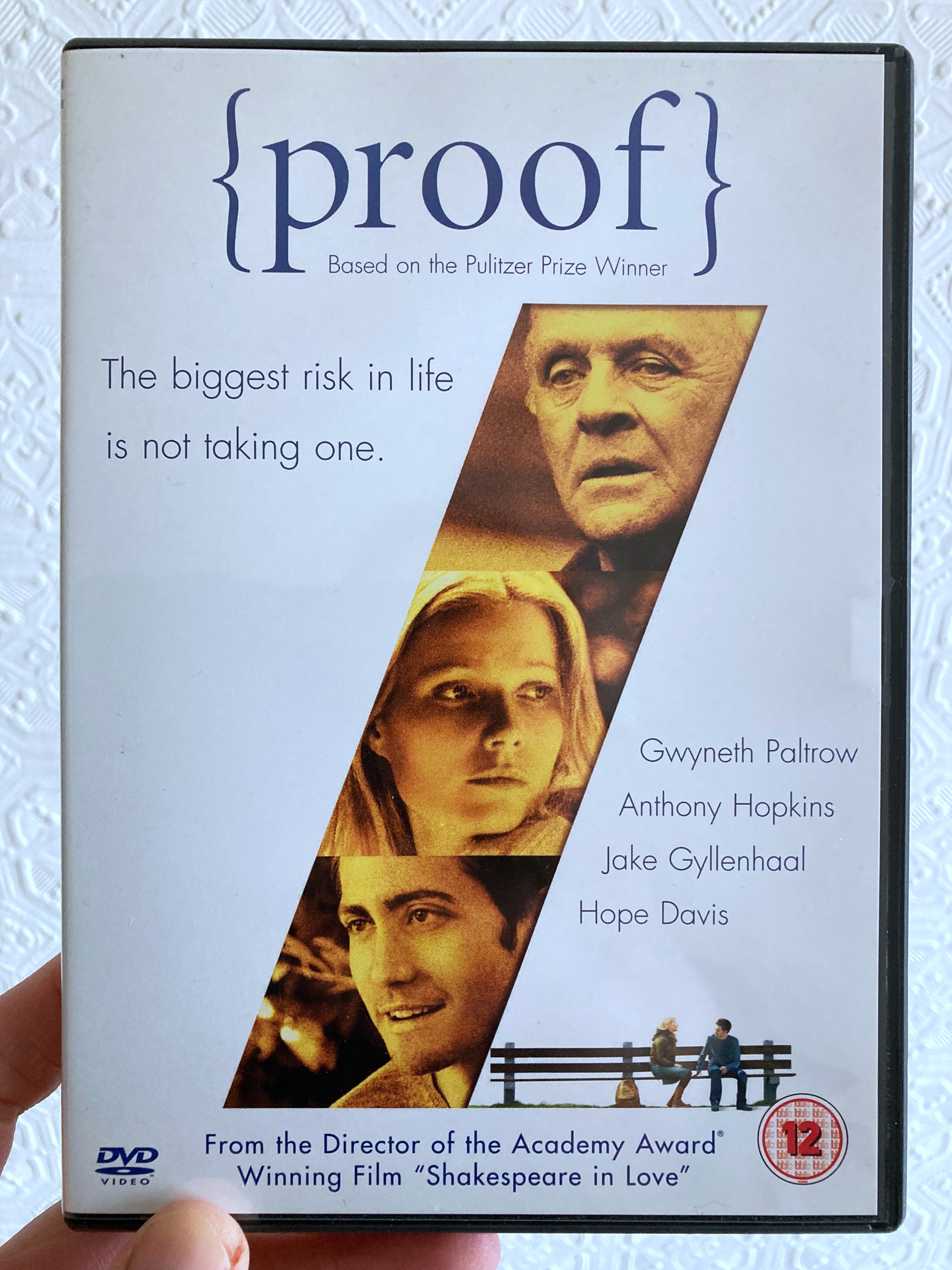
Proof (2005)

Excellent drama, directed by John Madden and adapted from the Pulitzer Prize-winning play by David Auburn. 

A brilliant mathematician, Robert Llewellyn (Anthony Hopkins), suffered mental problems and has recently died. His daughter Catherine (Gwyneth Paltrow) – also a genius with numbers – appears to suffer a similar condition. She has been caring for him in his troubled final years. After Robert’s death, Catherine’s controlling sister (Hope Davis) arrives from New York and tries to organise her. Meanwhile, Hal (Jake Gyllenhaal) is a former graduate student of Robert’s who wants to go through his papers and find out if he left anything else of worth.

All four characters are brilliantly drawn and portrayed. The dialogue is plausible. 

The “troubled maths genius” trope recalls Ron Howard’s 2001 film A Beautiful Mind, but there’s strong enough acting and a compelling enough premise to make this well worth watching.

Howards End (1992)

Brilliant adaptation of E.M. Forster’s so-so classic novel. Directed by James Ivory, it seems more nuanced and subtle than the book. The actors are skilled enough to bring out a sense of humanity that is rarely evident in Forster’s rather cold prose. 

The plot is thus summarised by Google: “Helen Schlegel falls for Paul Wilcox, but is rebuffed. Her sister Margaret becomes friends with his mother, who promises her the family house, Howards End. Unfortunately, after her death, the will disappears and it appears the inheritance will disappear. Until the widower, Henry Wilcox, becomes attracted to Margaret.”

It’s a tale about class and prejudice. 

Emma Thompson, Helena Bonham-Carter and Anthony Hopkins are superb as the primary characters, with Thompson in particular delivering an astounding performance. She also acted alongside Hopkins in Remains of the Day (1993), and the two seem made to work together. There are also roles for Vanessa Redgrave, Jemma Redgrave and Prunella Scales.

There are some slightly odd cuts and edits, but these actually work to punctuate the story and provide narrative focus.

The Remains of the Day (1993)

Masterful slow-burning drama based on Kazuo Ishiguro’s Booker Prize-winning novel. It was directed by James Ivory and produced by Ismail Merchant. 

The story focuses on a butler (Anthony Hopkins) and a housekeeper (Emma Thompson), who develop a deep love for one another but are unable to declare it. We see their story in two time periods – when they work at Darlington Hall in the late 1930s at a point when Lord Darlington (James Fox) begins entertaining fascist-sympathising aristocrats, and their attempt to meet up again in 1958.

The two lead performances are astonishing and perfectly nuanced. There’s so much feeling and power in what they don’t say. There’s passion and tenderness, too, even though it’s all held back behind the mask of duty. 

It’s a superbly shot film, too, becoming hypnotic where a lesser director would have made it merely dull.

Hugh Grant is excellent as Lord Darlington’s godson and Christopher Reeve adds gravitas as US Congressman Jack Lewis.

Legends of the Fall (1994)

Family saga, domestic drama, western, war film, homage to Native American traditions and mini-history of the USA. 

Three brothers live with their father (Anthony Hopkins) in the wilderness and plains of Montana. The youngest, Samuel (Henry Thomas), is due to marry Susannah (Julia Ormond), but his would-be wife is attracted to the middle brother Tristan (Brad Pitt) and simultaneously yearned for by the older brother Alfred (Aidan Quinn). These conflicting emotions play out against the changing times (World War I, Prohibition), and – in Tristan’s case – against the Native American traditions he embraces. 

This is an unusual, intelligent film that covers a lot of narrative ground but never becomes trite or silly. 

There are excellent performances all round. It’s moving but not sentimental. Hopkins a little wasted in terms of minimal dialogue, but when he’s on he’s very good. Pitt is better than usual, too, rising to the challenge of being at the centre of the story.

Shadowlands (1993)

Biographical drama about the relationship between author C.S. Lewis and an American divorcee who is dying of bone cancer. Directed by Richard Attenborough, it’s adapted from the stage play (which was itself adapted from a TV drama). 

Anthony Hopkins and Debra Winger are absolutely superb as the two leads. Their unusual love story is more believable because of the restraint with which it’s demonstrated. The film picks up on every nuance of their speech and behaviour. 

It’s extremely moving, firstly when Lewis surprises himself by discovering that he’s in love and secondly when he finds out how much he now has to lose. 

The film tackles big questions about the meaning of life, too. How can we love when the end of love causes such pain? And what value do spiritual beliefs have in the face of seemingly godless events that lead to overwhelming grief?

There’s gentle humour too, such as in Joy and her son’s observations of English life in the 1950s.

The Silence of the Lambs (1991)

This scared the pants off me – possibly even more so than on first viewing 30 years ago.

Adapted from the Thomas Harris novel, it’s a psychological thriller with more intelligence than your standard film from that genre. Trainee FBI agent Clarice Starling (Jodie Foster) tries to capture a serial killer nicknamed Buffalo Bill (Ted Levine) with the help of another killer, who is living out his life in prison – Hannibal “the Cannibal” Lecter (Anthony Hopkins).

Director Jonathan Demme’s masterstroke is to make it as much about the Starling/Lector relationship as it is about solving the case. He develops both characters brilliantly, sometimes filming them face-on for added intensity – without making it look like a tricksy fourth-wall device. Lector is a talented psychiatrist with the uncanny ability to get inside people’s heads, and Hopkins captures that quality with perfect menace. He plays the character as a refined gentleman who just happens to like eating people. Foster also gives the performance of a lifetime, being forced to confront the fears from her childhood alongside the very real terrors of her new job.

The climax, in which Starling is stalked by Buffalo Bill in total darkness while he wears night-vision goggles – accompanied by The Fall’s “Hip Priest” on the soundtrack – is as hypnotic and chilling as cinema ever gets.