Showing posts with label Starring: Jude Law. Show all posts

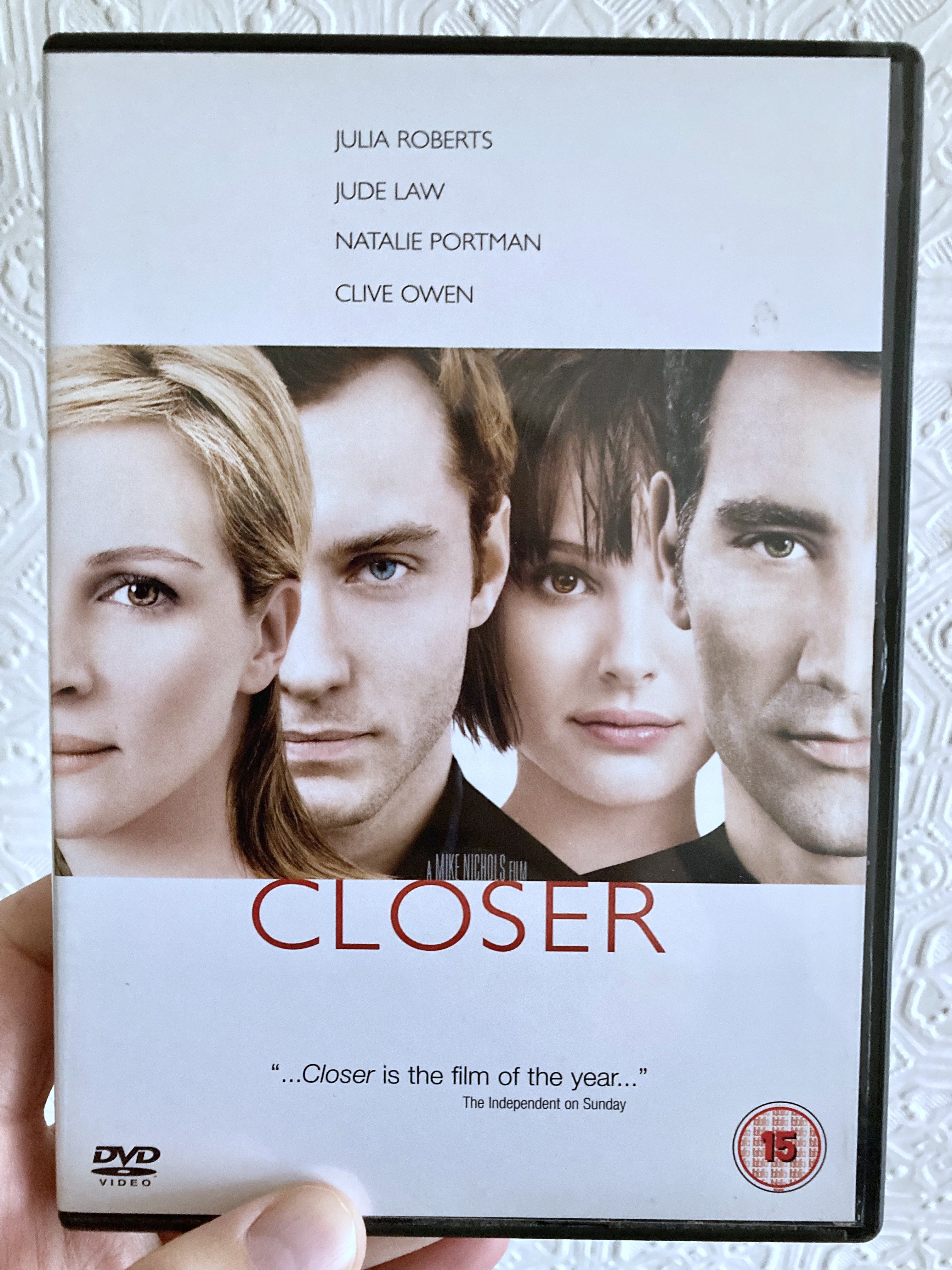
Closer (2004)

Drama directed and produced by Mike Nichols, based on a 1997 stage play by Patrick Marber. 

The story deals with the intersecting relationships of two men and two women. Clive Owen and Natalie Portman are both excellent at presenting complex, rounded characters. Jude Law just does his usual Jude Law thing. And Julia Roberts is oddly drippy and underwhelming with a character that’s barely there – to the extent that you have no idea why two men would be obsessed with her. 

It ends up a little overwrought, with lots of rather pompous statements about truth and honesty uttered by characters who are all over the place. You feel the writing tries too hard to be shocking and morally confrontational. As an account of intense human emotions it’s compelling but difficult to like.

Music from Another Room (1998)

Extremely unusual romantic comedy. 

It’s 1973. The five-year-old Danny (Cory Buck) is with his father, visiting family friend Grace (Brenda Blethyn). Grace is about to give birth and – bizarrely – Danny helps save the baby by freeing the umbilical cord round its neck. When the baby, Anna, is born he announces that one day he will marry her. Twenty-five years later, Danny (now played by Jude Law) is back in the USA and has a chance meeting with the Swan family. (He would have just decided to visit them, but the writers clearly preferred a far more unlikely scenario.) He sees Anna (Gretchen Mol) and falls in love. But Anna is part of a big, complicated family and about to get engaged to a man she doesn’t really love. 

The film is strange in many ways. The plot doesn’t really ring true, but the members of the family are quirky, well-drawn characters and you are quickly drawn into their world. There’s a blind sister, a suicidal sister and a slightly odd sister. 

There’s a thread about Anna Karenina running through it, and the sisters are named Anna, Karen and Nina accordingly. Some of their stories don’t quite work (the suicidal sister actually shoots her husband and nothing more is said about it). A writer such as Nora Ephron or Woody Allen would have done a better job of neatly tying those threads together. But the film exudes charm and all of the performances are hugely likeable. There are genuinely touching parts and a few laughs too.
Cold Mountain (2003)

Truly excellent drama set during the US civil war. It’s a war film, a love story and a historical epic. 

When the war breaks out, the quiet, inarticulate Inman (Jude Law) is one of the young men from North Carolina who has to fight with the Confederate army. But he has just fallen for Ada (Nicole Kidman), the daughter of the preacher (Donald Sutherland), and has to leave her – just as their relationship is beginning. Injured in battle, he attempts to make his way back home to Ada while being hunted for deserting. 

All of the leads are on excellent form. Renée Zellweger plays Ruby, a plucky free spirit who helps Ada salvage her farm and her self-respect. Philip Seymour Hoffman is a crooked preacher. Natalie Portman is a widowed mother. There are also parts for Jack White, Ray Winstone, Brendan Gleeson and Cillian Murphy. 

It’s an emotional and affecting work that avoids cliché, especially since the romance is unconventional to begin with. The couple barely know each other, but their connection is overwhelmingly powerful. As a result, the film is too.

The Talented Mr. Ripley (1999)

Brilliant adaptation of the Patricia Highsmith novel, starring Matt Damon as Tom Ripley, an inventive young man who infiltrates and ultimately ruins the lives of a couple played by Jude Law and Gwyneth Paltrow

It’s brilliantly plotted, with Ripley somehow staying on top of the absurd twists and turns of the various crises he creates. Matt Damon is superb in this part – charming enough to be credible as someone the couple instantly like and creepy enough to always present a sense of nervy threat. 

Cate Blanchett and Philip Seymour Hoffman are both excellent in supporting roles. 

The Italian scenery looks stunning too.

Contagion (2011)

A pandemic thriller made fascinating by the real-world events in the era of Covid 19. 

Matt Damon’s wife (played by Gwyneth Paltrow) contracts a mysterious virus and is quickly dead. From this initial beginning spin off a variety of threads and characters as we see the virus spread around the globe, accompanied by panic and social disorder.

The narrative perspective shifts across an ensemble cast also featuring Marion Cotillard, Laurence Fishburne, Jude Law, Kate Winslet, Bryan Cranston, Jennifer Ehle and Sanaa Lathan. Director Steven Soderbergh just about holds it all together. 

Knowing what we now know, it’s almost uncanny to watch scenes in which the “R” number is explained. It also deals with the conspiracy theorists – in this case, Jude Law, who’s told “Blogging is not writing, it’s graffiti with punctuation” – who try to scare people from taking the vaccine.

Enemy at the Gates (2001)

An expert Russian sniper, Vasily Zaytsev (Jude Law) plays a cat-and-mouse game with German sniper Major König (Ed Harris) during the Battle of Stalingrad in 1942. Vasily, who becomes a national hero, is aided by his lover Tania (Rachel Weisz), his friend Danilov (Joseph Fiennes) and Nikita Khrushchev (Bob Hoskins), who realises the marksman's value in terms of propaganda. 

Some of the sets don’t look especially realistic (not sure if that’s because it’s early CGI or whether it’s something to do with the models they used), but the scenes of soldiers being shot down in their hundreds look all too plausible. 

The relationships between the key characters are convincing, and Law and Weisz in particular create a strong chemistry together. 

It’s one of the more compelling war films because it makes you care about the characters and understand their motivations – including those of the villain. And while the love story is touching, the overall narrative never gives way to sentimentality.

Anna Karenina (2012)

When I first saw this lavish Joe Wright/Tom Stoppard adaptation of the Tolstoy novel, at the cinema in 2012, I wasn’t sure what to make of it at all. The radical decision to stage many of the scenes in a theatre set means that you never know quite what to believe – is the action really taking place or is it a stylised manifestation of a character’s feelings? On second viewing, I began to see it as a masterpiece that deliberately pulls apart the “reality” it constructs – perhaps to suggest that everything we do is a sort of fiction. It has a lot of fun with this – for example, switching from footage of a real train to a toy train and seeming to delight in the fact that it’s obviously a miniature model. In another scene, a letter is torn up and thrown into the air. The pieces keep falling because they have become snowflakes. Sometimes a door or window on the stage opens to another place entirely. There’s a sort of Escher logic to it, and you wonder how on Earth they planned it all so cleverly.  

The danger is that such a stylised approach might limit the film’s emotional impact, but if anything it works the other way, elevating simple scenes into works of art that magnify the characters’ situations. It would presumably have been so much easier to make the film as a standard costumer, but instead it operates on a higher level. 

Keira Knightley is appealing and convincing in the title role. Jude Law looks nothing like himself as her rigidly controlling husband. Aaron Taylor-Johnson plays the dangerous, icily charming Count Vronsky, who Anna has a devastating affair with. The love story is expertly told. There’s a parallel tale of what happens when passion and freedom conflict with social conformity. Should you follow your heart or do what’s expected of you by your peers and your class? For Anna, of course, neither option works out well.

Gattaca (1997)


Quietly profound thriller set in a near-future world where genetics are everything. People are graded as “valids” or “in-valids”, depending on their genetic profile. Ethan Hawke plays Vincent Freeman – a man whose “defects” (a weak heart) prevent him realising his dream to go to space. He impersonates Jerome Morrow (Jude Law), a valid who was paralysed in a self-inflicted accident. Uma Thurman plays a work colleague who falls in love with “Jerome”, not realising he is really an imposter. Gore Vidal plays their boss – the mission director with a dangerous agenda of his own.

The film asks complicated questions about the ethics of genetic engineering. It also looks at ambition, human identity, nature vs. nurture and brotherly love.

The “sci-fi” premise is nicely offset by the visuals, which are 1950s-themed. The retro-futuristic look is stylish and believable.

It builds to a surprisingly emotional ending.

Road to Perdition (2002)


Crime thriller set in 1931. Tom Hanks plays a mobster out to kill the man (Daniel Craig) who murdered his wife and youngest son. Paul Newman is the father and don who places Mafia loyalties before all else.

Told from the perspective of the mobster’s elder son (played sensitively by Tyler Hoechlin), the film examines both the boy’s relationship with his father and also his immersion into a world of gangland corruption and cold-blooded killing.

Sam Mendes’ direction is a little too stylised – there’s lots of “enigmatic” rain – but the storytelling is nevertheless powerful.

Jude Law is a little unconvincing as the murderous photographer. The character isn’t developed enough to explain why he has a thing about dead bodies. Maybe it makes more sense in the graphic novel from which this is derived.

“Cuddly” Tom Hanks isn’t quite right as Michael Sullivan, but the film cleverly has it both ways: he’s a heartless killer who truly loves his family and therefore comes across as a reasonably nice guy.

These points aside, it’s fairly atmospheric and engrossing.