Showing posts with label Starring: Daniel Craig. Show all posts

Knives Out (2019)

Directed by Rian Johnson, this is a brilliant parody of a classic Agatha Christie-style murder mystery. 

Daniel Craig stars as the detective Benoit Blanc, who is hired to investigate the suspicious death of a hugely successful crime novelist named Harlan Thrombey (Christopher Plummer). All of Harlan’s family stand to gain from his will, and all of them have a motive for killing him. So who actually committed the murder?

Craig’s “deep south” accent takes some getting used to, but he’s compelling in the role nevertheless. Ana de Armas is perfect as Marta Cabrera, Harlan’s kindhearted nurse who becomes inextricably mixed up in the events and who – in a surreal twist – cannot tell a lie without vomiting.

It works because alongside the mystery needing to be unravelled there’s also an intriguing portrait of a dysfunctional family. And in a surprisingly old-fashioned way, the film seems to offer a simple moral about kindness.

A sequel followed in 2022.

Dream House (2011)

Psychological thriller starring Daniel Craig as an editor who moves into a new suburban home with his wife Libby (Rachel Weisz) and two daughters. But all in the house is not as it seems and only his neighbour (Naomi Watts) seems to really know what’s going on. 

There are a couple of major plot twists, so it’s difficult to reveal any more about the story without ruining it. Craig and Weisz are OK (and it’s quite interesting to watch this real-life couple play a pretend couple), but Watts is oddly underused. The creepy premise isn’t quite followed through, so it slightly runs out of steam. 

Shutter Island is a better treatment of similar themes. Also, the main part of the film works as a psychological study, so it’s a shame that a genuine supernatural element is confirmed near the end. All that said, it’s a fairly entertaining romp.

Layer Cake (2004)

Brit crime thriller starring Daniel Craig as a drug dealer who – just as he’s about to retire – becomes wrapped up in a dangerous world of gangsters. 

It’s highly stylised, but oddly unsatisfying. The twists and turns of the plot are difficult to follow. And some parts seem clichéd, such as the Scorsese-lite touch of using “Gimme Shelter” on the soundtrack. It’s violent and nasty, too. 

Michael Gambon is an impressively horrid villain, and Daniel Craig is always watchable, but there’s a shallowness that makes it hard to like. It aims for “gritty” but only achieves “depressing”.

No Time to Die (2021)


Famously much-delayed by the Coronavirus pandemic, the 25th James Bond film finally hit cinemas in September 2021 – five years after work on it first began. There was a lot of additional baggage because we knew in advance that it would be the final episode starring Daniel Craig. With plenty of threads to tie up, there was a lot it had to achieve to be a truly satisfying finale. Unfortunately, despite plenty of striking moments, it doesn’t quite deliver. 

On the downside there’s a somewhat muddled plot that lacks the graceful coherence of the storylines in Skyfall and Spectre. Some of the gimmicks are tired, too: a secret base on a remote island really wasn’t very original. And while it’s nice to see the familiar gang back together – with welcome returns for Jeffrey Wright (as Felix), Ralph Fiennes (M), Ben Whishaw (Q) and Rory Kinnear (Tanner), all of whom suddenly look a lot older – it’s odd that the roles of Moneypenny (Naomie Harris) and Blofeld (Christoph Waltz) seem to have been minimised. Other limitations include a silly Russian scientist played by David Dencik and a hammy main villain played by Rami Malek. The latter was unconvincing as Freddie Mercury in Bohemian Rhapsody and is just as unconvincing here – especially when delivering his ponderous speeches. The whole film seems a little underwritten, and even a rival “00” agent (Lashana Lynch as Nomi) doesn’t quite come to life as a character. 

On the plus side, the action sequences are vivid and exciting, and Hans Zimmer’s musical score maximises the drama. Daniel Craig has a magnetic charm, if a little less sparkle than usual. And Léa Seydoux is fully believable as Bond’s on/off lover Madeleine Swann. The introduction of a child character (Madeleine’s daughter) also adds a new dimension to the series. The most entertaining section features an evening-gowned Cuban agent named Paloma (Ana de Armas), who briefly assists Bond with martial-arts kicks and a cheery energy that’s otherwise lacking in a rather dour 163 minutes. 

The shock ending – really not what I expected – raises some big questions about the future of the franchise. I wish the film hadn’t concluded the way it does, but we are assured that somehow or other James Bond will return.

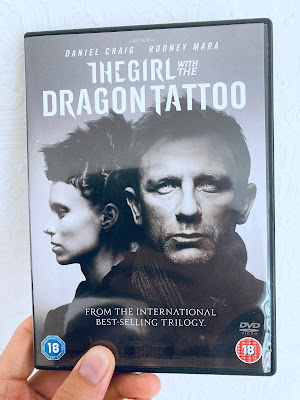
The Girl with the Dragon Tattoo (2011)

Adapted from the Swedish bestseller by Stieg Larsson, this is a surprisingly disappointing thriller. I wanted to see what all the fuss was about, and couldn’t. 

1. The plot is made complicated by poor storytelling but is actually very simple: a journalist (Daniel Craig) and a young, troubled computer hacker (Rooney Mara) investigate a girl’s disappearance from 40 years ago, uncovering the secrets of a wealthy family. 

2. It’s highly stylised, but the aesthetic seems deliberately ugly. 

3. It’s unnecessarily violent: the scenes with Mara and her abusive social worker seem completely gratuitous. She could have filled in her backstory as dialogue. Did we really need to see it?

4. Something about the story doesn’t ring true. I never believed in the characters or the main relationship between Craig and Mara. In fact, there’s no chemistry between anyone. 

5. The film seemed too impressed with its own tech. There are way too many shots of laptops being typed into. There are also too many shots of Mara riding a motorbike. 

6. It’s unevenly paced. One unexciting scene in which Mara researches in a library seems to go on forever. But then the “action” (and there’s very little of it), is oddly rushed. 

On the plus side, Daniel Craig is always watchable. But unfortunately that isn’t enough. Maybe the original Swedish film from 2009 is better.

Sylvia (2003)


Engaging biopic of Sylvia Plath, mainly focusing on her relationship with Ted Hughes and the decline of her mental health. Gwyneth Paltrow is fairly strong as the American writer in the lead role. Daniel Craig is pretty good as her famous husband except that the Yorkshire accent tends to come and go and it’s difficult to see “James Bond” as a poet. Also, both film-stars are too good-looking to seem like struggling writers.

It’s appropriately grim and grimy in its depiction of England in the early 1960s. Everything seems dimly lit and rather grubby.

I like the way the film presents poetry as such a powerful force. The scenes in which they read out their work and are urged by their friends to do it even faster help to position it as a raw and vital pursuit that’s full of life and energy.

Hughes emerges as a major contributing factor in the depression that led to Plath’s suicide. I don’t know how fair or accurate that is, but the film certainly took Sylvia’s side.

As the story leads to its inevitable conclusion you are left feeling sorry for this young woman who simply needed help (the kindly neighbour played by Michael Gambon wasn’t enough) and for the two children she left behind.

Skyfall (2012)


The third Daniel Craig Bond film is not only his best, but also the best Bond film overall. Directed by Sam Mendes, it’s pretty much perfect. The witty and dry dialogue is so much stronger than in previous episodes. And it’s visually stunning. The opening sequence (before the mind-bending titles over the Adele song) is a stunning piece of extended action in Istanbul involving a car chase through a crowded market, a shoot-out, a motorbike chase over rooftops, an absurd episode involving an excavator, a fight on the roof of a moving train, and, most dramatically, Bond being shot “dead”.

I’ve heard fans say that this film humanises Bond too much, with his family backstory and the “psychological” dimension, but for me that only makes it better. There’s even the first hint of homoeroticism in a Bond film. The villain teases him, only for 007 to counter “What makes you think this is my first time?”

It’s ideally cast, introducing the new Q (Ben Whishaw) and Moneypenny (Naomie Harris) plus the new Chairman of Intelligence (Ralph Fiennes) and an impressively nasty villain called Raoul Silva (Javier Bardem). Rory Kinnear resumes his role as Bill Tanner, getting the part just right. And Judi Dench is wonderful as M. When she starts reading a poem by Tennyson as Bond runs through the London streets to save her (the film is also a British tourism brochure), it’s deeply stirring stuff.

Defiance (2008)


War saga set in Belarus in 1941. It tells the story of the Bielski partisans, who saved Jewish people from the Nazis by hiding in the forest and building a resistance community. It’s also the story of four brothers, played by Daniel Craig, Liev Schreibe, Jamie Bell and George MacKay.

There are harrowing moments, as you might expect, but also unexpected lightness and even romance.

Daniel Craig is as charismatic as ever, even if his accent comes and goes at times.

Cowboys & Aliens (2011)


Inspired fusion of sci-fi and western. Daniel Craig and Harrison Ford are the cowboys battling the mysterious aliens who have stolen their people and who want their gold. Daniel Craig is the sole survivor of an abduction and cannot remember any of what happened to him, but he wears one of the aliens’ bracelets, which acts as a superweapon he can use against them. Olivia Wilde plays the blue-eyed girl assisting him and turns out to be not quite what she seems.

The brilliance of the film comes from the fact that it plays it straight. There are no knowing smirks and winks. No self-conscious irony. It’s a proper western in which the enemy just happens to be from another world.

There’s plenty of character development, with a father/son theme running across several relationships. Clichés were avoided and scenes that could have turned corny were sufficiently humanised to work well. I suspected it would “go rubbish” at various points – when the aliens started running around, when the big battle began – but refreshingly it stayed original and watchable to the end.

Surprisingly the film wasn’t a commercial success. Too intelligent? Too unusual? It’s a shame – especially when tripe such as Independence Day (1996) does so well.

Road to Perdition (2002)


Crime thriller set in 1931. Tom Hanks plays a mobster out to kill the man (Daniel Craig) who murdered his wife and youngest son. Paul Newman is the father and don who places Mafia loyalties before all else.

Told from the perspective of the mobster’s elder son (played sensitively by Tyler Hoechlin), the film examines both the boy’s relationship with his father and also his immersion into a world of gangland corruption and cold-blooded killing.

Sam Mendes’ direction is a little too stylised – there’s lots of “enigmatic” rain – but the storytelling is nevertheless powerful.

Jude Law is a little unconvincing as the murderous photographer. The character isn’t developed enough to explain why he has a thing about dead bodies. Maybe it makes more sense in the graphic novel from which this is derived.

“Cuddly” Tom Hanks isn’t quite right as Michael Sullivan, but the film cleverly has it both ways: he’s a heartless killer who truly loves his family and therefore comes across as a reasonably nice guy.

These points aside, it’s fairly atmospheric and engrossing.

Spectre (2015)


The opening sequence in Mexico City is one of the most exciting and visually striking you will ever see, with a glorious long, uninterrupted take without edits that shows James Bond prowling among the masked people in the Day of the Dead parade, entering a hotel lobby with his girlfriend, taking the lift to another floor, entering his room, leaving the room (and the girl) and walking along the top edge of the building to assassinate a terrorist. This flows into a scene with collapsing buildings and a dizzying helicopter fight. And all this before the titles sequence.

As in Skyfall, which this is nearly the equal of, there’s dry humour and the character has been refined to a perfect crystalisation of what Bond is about. Daniel Craig – in his fourth appearance in the role – absolutely nails it.

It’s visually stunning and the pacing is expertly handled. The villain (Christoph Waltz as Blofeld) is convincingly creepy and the Bond girl (Léa Seydoux as Dr. Madeleine Swann) is refreshingly unimpressed by 007 – for a while, anyway, until she inevitably falls for him.

Aside from Bond’s invincibility, the only thing that doesn’t ring true is the big meeting of SPECTRE agents. Would such a top-secret organisation really put all of its members in one room?

Really looking forward to the follow-up.

Quantum of Solace (2008)


Not a promising title, and it’s never really explained either.

Daniel Craig is excellent again (this was his second of five Bond films), but the girl Camille Montes (Olga Kurylenko) and the villain Dominic Greene (Mathieu Amalric) are weaker than usual. The former gets shoddy lines and a simplistic “revenge” motivation. The latter isn’t particularly scary or “evil”, just difficult to feel strongly about.

The plot isn’t easy to follow on first viewing, although it works better second time around. It’s extremely violent – sometimes more so than the story demands. Ludicrously, there’s an MI6 agent called Strawberry Fields (played by Gemma Arterton). She comes to a sticky end in a scene that seems to acknowledge the fate of Shirley Eaton’s character Jill Masterson in Goldfinger. The climax is a little underwhelming – perhaps because the stakes aren’t very high. Whereas Bond is usually saving the world from imminent destruction, this time he’s merely battling a nasty crook selling water back to the Bolivian government after creating an artificial drought.

Judi Dench is reliably watchable as M and raises the quality of the film whenever she appears. Her scenes are much needed as there’s sometimes a tendency for it to dip into trashier territory than Casino Royale (2006) or Skyfall (2012).

The title theme by Jack White and Alicia Keys has an appealingly fuzzy riff, but as a song it’s a total mess.

All in all, the least effective of the Daniel Craigs but still well worth a watch or two.

Casino Royale (2006)


Daniel Craig’s first James Bond film can be found on DVD in every charity shop in the land. The opening section – designed as a flashback to set up the reboot – doesn’t really work and didn’t need to be there, and the use of black and white seemed clichéd. Fortunately, the film improves enormously after that.

The action sequences are stunning – fighting on cranes and leaping between them, an airport showdown and a collapsing building in Venice. There’s real drama in the multi-million-pound poker game and when Bond is poisoned and almost dies in his car.

Judi Dench is great as M. At one point she quips “In the old days, if an agent did something that embarrassing, he'd have the good sense to defect. Christ, I miss the Cold War.”

I really liked the unexpected love story: Bond actually falls for Vesper Lynd (Eva Green) and displays an emotional depth that would have been impossible in the Roger Moore era. On first viewing I thought it was a shame that after developing the asthmatic, blood-weeping Le Chiffre (Mads Mikkelsen) as a convincingly creepy baddie, the real villain turned out to be the characterless Mr. White. Or so you are led to believe until the subsequent films peel back further layers of intrigue. On second viewing, and with knowledge of where the series was heading, I enjoyed this ending much more.