Showing posts with label Starring: Tom Hanks. Show all posts

Philadelphia (1993)

Directed by Jonathan Demme, this is an emotional drama starring Tom Hanks as Andy Beckett, a lawyer who is dismissed from his firm for being a gay man with AIDS. Denzel Washington plays Joe Miller, the lawyer who represents him in court. 

The drama comes from two parallel threads. The first details Andy’s swift decline in health. The second deals with Joe having to work through his homophobia and put aside his prejudices to do what he knows is right. Washington is excellent at portraying that conflict. You can see his mixed feelings in every scene, as he slowly comes round to what his conscience is telling him. 

Parts of the film are unusually shot, and especially a section in which Andy enters a heightened state while listening to opera. Later, in the courtroom, unusual camera angles are employed to show his faltering consciousness.

It’s to Demme’s credit that he doesn’t opt for a tragic feel to the inevitable ending. Instead, he introduces a celebratory quality based on the sense of community and family love that the film has successfully established around Andy. 

There’s a strong soundtrack, mixing classical music with new songs written for the film by Bruce Springsteen and Neil Young.

Big (1988)

Extremely charming comedy starring Tom Hanks as Josh, a 13-year-old boy who – because of some vague magic that takes place with a fairground fortune/telling machine – wakes up in an adult’s body. His mother won’t believe it’s really him, so he’s forced to join the adult world, working for a toy company. He also begins a romance – his first – with the cynical Susan (Elizabeth Perkins), who is transformed by his good nature and innocence.

It’s an extremely sophisticated film that understands how children and adults think. Hanks is absolutely perfect in the role. His body language and facial expressions uncannily reflect those of a child, so you totally believe in the unlikely scenario. There’s a real poignancy to it, too, because the characters are so well-written. You can feel Josh’s conflict when he wants to return to his childhood world just as he’s laying down roots and finding his way among adults. 

Big explores the idea of the “child” in all of us and asks how we can grow up without losing sight of that. There’s a huge emotional intelligence in the writing and direction, and Hanks – sometimes taken for granted – should be applauded for conveying it so effectively.

I enjoyed the film when I was young, but I got so much more out of it as an adult.

Charlie Wilson’s War (2007)

Directed by Mike Nichols, this is based on a true story. 

A US congressman takes it upon himself to assist the Afghan troops suffering at the hands of Soviet invaders by raising the funds to equip them with weapons.

Tom Hanks is ideally cast as the charming, heavy-drinking Wilson. Julia Roberts is good as an influential socialite Joanne Herring, but doesn’t have enough scenes to really shine. Better is Amy Adams as Wilson's personal assistant Bonnie Bach. Philip Seymour Hoffman is charismatic as CIA operative Gust Avrakotos. Emily Blunt is weirdly underused in a role that gets very little screen time.

Hanks is deliberately ambiguous and the film steers clear of passing judgement on his character. The story is excellently told, so I’m not quite sure why I didn’t enjoy it more. Perhaps it's because it aims at comedy in places but could have been much funnier.

Larry Crowne (2011)

Strange – and strangely enjoyable – romantic comedy that’s neither especially funny nor romantic. 

Tom Hanks plays a middle-aged man who loses his job and goes to college to educate himself. There, he develops a friendship with a much younger woman (Gugu Mbatha-Raw) and also with his teacher (Julia Roberts). Both of these relationships transform him. Before long, he’s riding a scooter with a gang, wearing more fashionable clothes and sporting a less fusty haircut. 

It’s odd because the tone is so unusual. Parts of it are like a gentle drama. There’s subtle wit, but it doesn’t really emerge until the second half – and even then there are few laughs. Also, there are elements of the story that simply don’t ring true. 

But Hanks and Roberts are appealing and you find yourself rooting for them to get together, so the film must be doing something right. I found myself liking it a lot, despite not thinking it quite worked.

The Terminal (2004)

Baffling Steven Spielberg comedy-drama. Tom Hanks plays Viktor Navorski, an Eastern European man who ends up stuck in J.F.K. airport when his country suffers a coup and war breaks out. Unable to return there or to gain access to New York City, he begins a frustrating, surreal life within the airport itself. 

It dabbles with romantic comedy when he falls for an air hostess (Catherine Zeta-Jones). He also has to deal with the Acting Field Commissioner (Stanley Tucci), who wants to get rid of him. In the meantime he becomes a sort of celebrity among the airport staff, which include Diego Luna, Kumar Pallana and Zoë Saldaña

The big flaw of the film is that Stanley Tucci’s fixation with removing Viktor is never really explained. Surely a man that busy would have too many other important things to do. Another problem is that the romance plot fizzles out and a more sentimental quest to honour his father’s wishes takes over. Worse than that, there’s a big loose end relating to the way Stanley Tucci threatens to get rid of Viktor’s friends. Also, John Williams’ soupy music is too prominent. 

Despite all of this, Hanks is excellent and the premise is intriguing and unusual. It’s just a shame that Spielberg somehow lost his way in the second half.

Forrest Gump (1994)

Masterful comedy-drama directed by Robert Zemeckis

Tom Hanks plays a simple but kindhearted man whose life unexpectedly touches those around him. He also finds himself accidentally woven into key moments in American history of the 1960s and 1970s. 

It’s sweet and touching, romantic and sad. Hanks is perfect in the role – he keeps it on the right side of the endearing/annoying divide. 

As in Back to the Future, Zemeckis handles the storytelling with almost supernatural empathy and skill. The pacing is spot on and there’s not a moment of filler nor a line out of place. He also handles the changes in tone superbly well, so comedy can turn to poignancy without jarring – and vice-versa. 

Robin Wright and Gary Sinise are excellent as the love of his life and his former Vietnam lieutenant and long-standing friend, while Sally Field is wonderful as his wise, caring mother. 

The shaggy-dog story takes in his spell in the army, his time as a table-tennis champion, working on a shrimp boat, and his three years of running across America. 

There’s a message about kindness being more important than anything else, which is hard to disagree with, and a great soundtrack, too.

The Post (2017)

I’m not much of a Spielberg fan, as documented elsewhere, but I bought this without realising he was involved. 

It tells the story of how the Washington Post acquired and published the Pentagon Papers, which incriminated the US government in their handling of the Vietnam War. Meryl Streep plays Katharine Graham, who owns the newspaper. Tom Hanks plays Ben Bradlee, its editor. 

Hanks is terrific, giving one of his most convincing performances. I really believed in his character, rather than merely thinking “there goes Tom Hanks again” (as is usually the case). Streep was less impressive, perhaps because there’s too much of Graham being weakly indecisive in the first half before she suddenly finds her mojo and seems to become a different character in the second. In reality, it surely can’t have been that straightforward or simplistic. Likewise, the connection to Watergate at the very end seems abruptly and conveniently bolted on, while other threads are left dangling. What happened to Daniel Ellsberg (played by Matthew Rhys), who first leaked the papers? And what happened to Robert McNamara (Bruce Greenwood), the Secretary of Defense, who was friends with Graham at the time of the leak?

The Post is interesting because of the historical moments it alludes to, but it’s difficult to accept it as an accurate account of events. And there’s something mannered and stilted about the way it’s filmed that prevents it ever becoming truly engrossing.

Apollo 13 (1995)

Ron Howard’s version of the events of April 1970 in which a planned Moon mission goes horribly wrong after an explosion loses vital fuel and oxygen from the craft. Instead of walking on the lunar surface, as they had hoped and dreamed, the three astronauts find themselves in a desperate struggle to return to Earth. 

It’s a taut drama that steadily builds tension. We know that disaster is on the way, so there’s added suspense in waiting for that moment. I especially liked the Mission Control sections, which showed how much of an ingenious team effort the rescue attempt was. 

The casting and acting is spot-on, and makes this film stand out:

Tom Hanks plays Jim Lovell, from whose memoir this was adapted. Hanks does his usual thing, but it works. His almost bland demeanour seems to match the highly sought after brave-but-calm profile of that of a well-adjusted astronaut.
Kevin Bacon is perfectly acceptable as backup Command Module pilot Jack Swigert even though this actor is often now seen as a figure of fun.
• Bill Paxton is solid as Lunar Module pilot Fred Haise.
• Kathleen Quinlan is Lovell’s wife, trying to hold it together at home with the kids. The “worried wife” role can’t be a rewarding one for any actor, and too often that part is underwritten (see Deepwater Horizon or The Untouchables), but Quinlan convincingly portrays someone whose personal nightmare becomes a drama watched by the entire world.
• Ed Harris is impressive as the tough but compassionate Flight Director Gene Kranz.
• Gary Sinise is excellent as pilot Ken Mattingly, who misses out on the mission itself but helps the crew by mirroring their predicament in a NASA flight simulator. 

I liked the fact that in the film, as in real life, it wasn’t about luck or heroism or faith or fate. It was science that saved them – a triumph of knowledge and rational thought. A lesson to be learned there for all of us.

Sully: Miracle on the Hudson (2016)


Reasonably engrossing saga of the true-life events of 15th January 2009, when Captain Chesley “Sully” Sullenberger landed a damaged Airbus A320 in New York’s Hudson river after both engines failed. The film intercuts the story of that day with flashback scenes and details of the aftermath in which Sully is subjected to a public hearing. The National Transportation Safety Board questions his decision not to return to LaGuardia airport, despite the fact that he's being widely celebrated as a hero who saved all 155 lives on board. He has to deal with post-traumatic stress disorder, the sudden adoration of the public and the threat of seeing his career and reputation in ruins.

Tom Hanks takes the lead role and is his usual blandly competent-but-unremarkable self. Laura Linney is rather weak as his wife, stuck at home worrying and not given much of a role. Ironically, Sully’s actual wife is tougher, more glamorous and more charismatic – as can be seen in the DVD-extra documentary.

Road to Perdition (2002)


Crime thriller set in 1931. Tom Hanks plays a mobster out to kill the man (Daniel Craig) who murdered his wife and youngest son. Paul Newman is the father and don who places Mafia loyalties before all else.

Told from the perspective of the mobster’s elder son (played sensitively by Tyler Hoechlin), the film examines both the boy’s relationship with his father and also his immersion into a world of gangland corruption and cold-blooded killing.

Sam Mendes’ direction is a little too stylised – there’s lots of “enigmatic” rain – but the storytelling is nevertheless powerful.

Jude Law is a little unconvincing as the murderous photographer. The character isn’t developed enough to explain why he has a thing about dead bodies. Maybe it makes more sense in the graphic novel from which this is derived.

“Cuddly” Tom Hanks isn’t quite right as Michael Sullivan, but the film cleverly has it both ways: he’s a heartless killer who truly loves his family and therefore comes across as a reasonably nice guy.

These points aside, it’s fairly atmospheric and engrossing.

Saving Private Ryan (1998)


I overcame my Steven Spielberg prejudice (haven’t liked one of his films since Duel or Jaws) to watch this World War II epic. The battle scenes are extremely dramatic – bloody and terribly tense – and he deserves credit for these. What I didn’t like was the “present day” segments that top and tail the film. I don’t think these were needed at all. (Titanic suffered from the same slightly naff device.) Also unnecessary was the soupy music that is laden onto so many scenes. This is intrusive and emotionally obvious, undercutting the realism.

The other fundamental flaw is that the film can never explain why the life of Ryan (Matt Damon) is important enough to be worth rescuing at such a high price in terms of human sacrifice, just as Miller (Tom Hanks) can never explain it to his men. (General George Marshall decides that Ryan should be saved because all three of his brothers were killed.) What about all the other men who were not favoured? Or is the point precisely that life and death decisions are always made arbitrarily by those in the upper ranks?

It’s a shame because there is so much that is remarkable about this as a war film. In particular, the recreation of the Omaha Beach battle (part of the Normandy landings) is astonishing in the way it depicts the merciless brutality that both sides faced. Knowing that this slaughter actually happened makes it genuinely painful to sit through.

Cast Away (2000)


Yet another Tom Hanks film. A FedEx engineer has his plane crash and survives four years on a desert island before making a raft and attempting to escape. It’s a moving story with a surprising amount of humour as a result of “Wilson” his football “friend”. It’s impressive how the film allows for the passing of time, with Hanks visibly losing weight as well as gaining hair. I also like the way it didn’t simply end with his rescue, but instead started to ask some of the “What now?” questions. The slight cop out was how well-adjusted he seemed after four years away from all human contact. Where were the psychologists and therapists?

You've Got Mail (1998)


A sort of remake of the 1940 James Stewart film The Shop Around the Corner. Tom Hanks and Meg Ryan are reunited from Sleepless in Seattle as different characters in another romantic comedy. It’s flabbier than that earlier film and less sweet as a result. For example, the father and grandfather characters didn’t work at all and the convoluted scene with the children was just bolted on so that you could see Tom Hanks being a nice guy. That said, Meg and Tom work well together and it was nice that they had more on-screen time as a pair. In SiS, the film had ended at the moment they got together. It’s interestingly of its time in the way that e-mail and coffee shops are both new enough to be presented as novelties.

Sleepless in Seattle (1993)


Wonderful romantic comedy. It’s extremely well-written and would work well as a play – it’s all dialogue. No helicopter crashes here. 

Meg Ryan is brilliant as the slightly crazed woman who sets out to find the man (Tom Hanks) she heard baring his soul on a radio phone-in. 

Sweet and sentimental.

The pair would reunite for You've Got Mail.

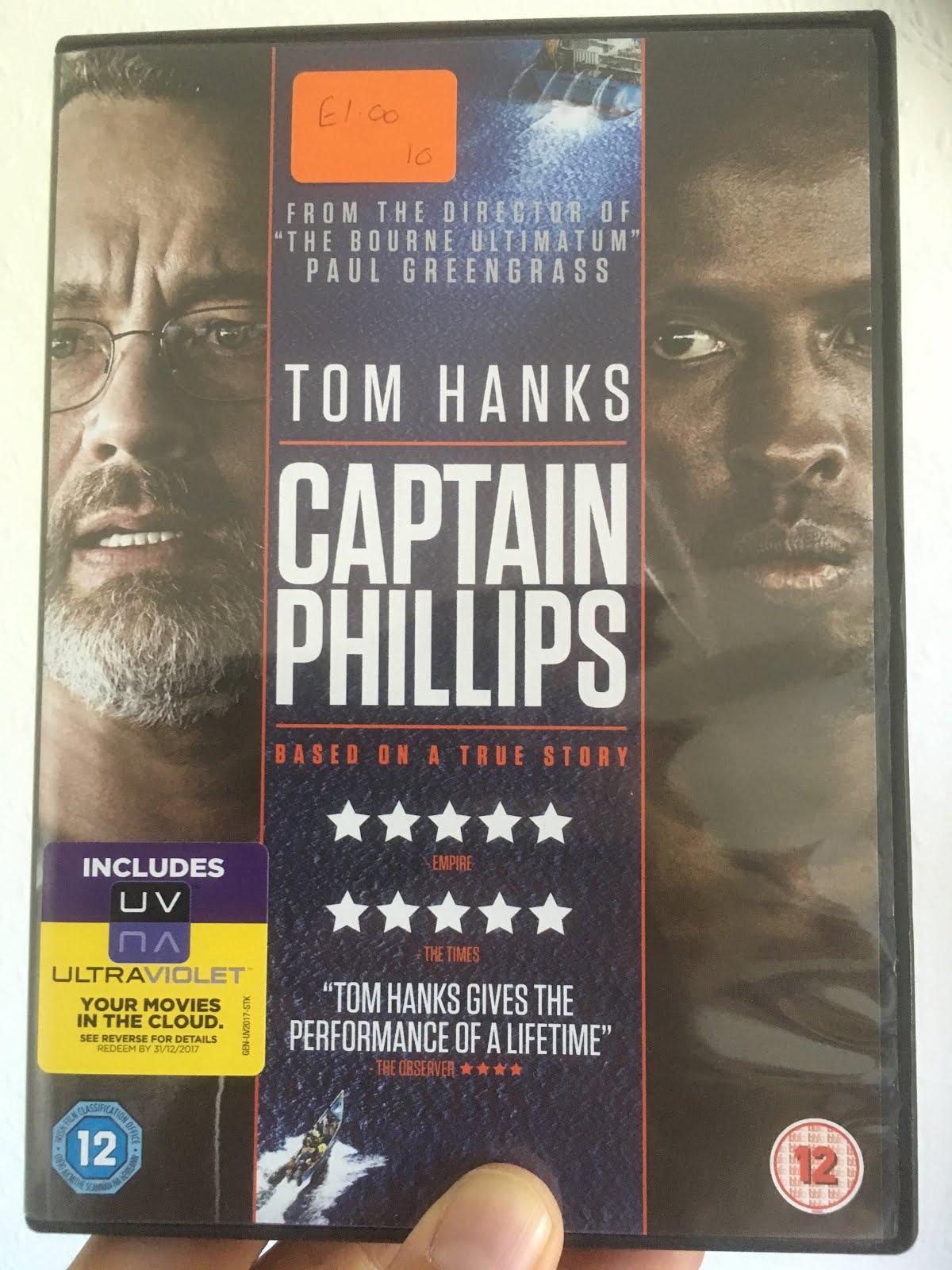
Captain Phillips (2013)


Terrifying true-life story about a Maersk cargo ship hijacked by Somali pirates. 

The film steadily ramps up the tension to unbearable levels, with director Paul Greengrass expertly managing to relentlessly heighten the drama. There are no clichés and it’s entirely believable – even with Tom Hanks in the lead role. The music by Henry Jackman does a lot to build the atmosphere.

There was controversy that the film wrongly presented Richard Phillips as a hero, but I saw him as a mere victim. It inspired me to read his book A Captain’s Duty: Somali Pirates, Navy SEALs and Dangerous Days at Sea.

Splash (1984)


Hugely entertaining film about a mermaid and a young New Yorker who fall in love. There’s lots of comedy value in the “life viewed through the eyes of an alien” aspect. There’s also a surprisingly poignant element: the “message” that you should be with the one you love, however “different” they might be. Being a 1984 film, it has the same look, feel, New York setting and music styles as other feel-good films from this time – such as Ghostbusters. In fact, you can almost imagine Bill Murray acting the Tom Hanks part. Best of all is the wide-eyed innocence of Daryl Hannah as the beautiful mermaid with the unpronounceable name (she speaks it once and the high-pitched noise she makes shatters the glass of all the TV screens in the department store). This film is a lot of fun, but it makes you think too. I enjoyed it even more on DVD today than I did at the cinema when it first came out. Plus, the ending is superb.