Showing posts with label Starring: Ryan Gosling. Show all posts

Half Nelson (2006)

Excellent drama directed by Ryan Fleck.

Ryan Gosling stars as a troubled New York school teacher. When one of his young students (Shareeka Epps) discovers him taking drugs in the bathroom, the pair form an unusual relationship. 

It’s a powerful and gritty story, subtly written and brilliantly acted. As well as the two leads, there’s Anthony Mackie as Frank, a local drug dealer who has his own problems. 

It could have become sentimental and trite, but there are no easy resolutions offered and it remains disturbing and  depressing. 

The music is by Canadian band Broken Social Scene.

Crazy, Stupid, Love (2011)

Comedy-drama directed by Glenn Ficarra and John Requa. It’s a sort of American Love Actually, with interwoven strands and an ensemble cast telling several connected stories. 

Steve Carell and Julianne Moore play Cal and Emily Weaver, a middle-aged couple in the process of separating. Ryan Gosling is Jacob, a super-confident ladies’ man, who (implausibly) decides to teach Cal everything he knows about sweet-talking women. Meanwhile, Emma Stone is a law school graduate who turned down Jacob's advances. Kevin Bacon is the co-worker Julianne Moore's character pairs up with. 

It’s quite funny in places if you can suspend disbelief about various scenarios that fail to ring true. Morally, it’s all over the place and I’m not entirely sure what point it was trying to make about predatory men.

The Ides of March (2011)

Political drama adapted from Beau Willimon’s play Farragut North. It’s directed by George Clooney, who plays a liberal-minded governor running for president. Stephen Meyers (Ryan Gosling) is his junior campaign manager, reporting to the skilled but cynical Paul Zara (Philip Seymour Hoffman). And Evan Rachel Wood is the young intern whose affair with the governor threatens to bring down the entire campaign. 

It’s a fascinating insight into the politics behind the politics. Because it’s from a play, it’s strong on dialogue and character. There’s an escalating tension that’s brilliantly handled by everyone involved. There’s a theme about idealism being eroded by the cynical realities of the political system, and Gosling is superb as a representation of that conflict. Also at their best are Paul Giamatti as a rival campaign manager, Marisa Tomei as a reporter for the New York Times and Jeffrey Wright as the Democratic Senator from North Carolina.

Gangster Squad (2013)

Gangster thriller set in Los Angeles in 1949.  

Sean Penn is Mickey Cohen, a brutal mobster. Sergeant John O'Mara (Josh Brolin) is a World War II veteran who leads a team of cops (including Ryan Gosling) to hunt him down. Emma Stone is Cohen’s girlfriend and “social etiquette teacher”, who becomes attached to Gosling, putting both of them in great danger. 

It’s exciting when there’s action taking place, and the chase and shoot-out sequences are exceedingly well filmed, but it's let down by a sub-standard script. The characters aren’t really developed, so you don’t see any of these excellent actors at their best. The group scenes are especially flat, with no one seeming to have anything to say. Even the Stone/Gosling pair-up – so potent in La La Land – fails to sparkle. 

There’s an interesting theme about the war not yet being over, and O’Mara not knowing what else to do but fight. Oddly enough, the most three-dimensional character is Connie (Mireille Enos), his pregnant wife, who goes from warning him about the dangers of what he’s doing to hand-picking the “gangster squad” who work with him.

The Nice Guys (2016)

Unusual comedy thriller directed by Shane Black. 

An inept private eye (Ryan Gosling) and a brutal enforcer (Russell Crowe) investigate a missing girl in late-1970s Los Angeles

It’s a strange film. The humour is as dark as it gets, with an uneasy violence behind it. Crowe’s character seems equally capable of cold-blooded murder and compassion, and that makes for an awkward mix – probably deliberately so. The emotional development, based around Gosling’s relationship with his teenage daughter, cones across as shallow and unconvincing.

The party section was especially well done, and the action is expertly presented, but overall – despite some genuine laughs – it’s little too slick to fully engage. And off-puttingly, a tubby Crowe looks uncannily like John Goodman throughout.

Drive (2011)

A disturbing thriller.

Ryan Gosling plays a getaway driver who becomes mixed up in a crime involving the husband of his neighbour (Oscar Isaac and Carey Mulligan respectively). After a brooding, menacing start, it turns very, very violent indeed. Gosling seems superbly intense in the lead, initially, but his character development takes him down a path that means you can no longer identify with him.

I found the violence somewhat gratuitous. I know that violence was in many ways the subject of the film, but a couple of the scenes were horrifically drawn out in a way that they really didn’t need to be. It was difficult to know what I was supposed to take away from it.

On the plus side, the driving sequences were exciting and the locations were well chosen. Gosling and Mulligan had a certain chemistry, too. There are echoes of Taxi Driver, but it doesn’t have the consistent logic or magnetic pull of that masterpiece.

The Place Beyond the Pines (2012)

Remarkable drama that seems to consist of several films elegantly woven into one. It begins with a story about motorcycle stunt rider (excellently portrayed by Ryan Gosling), whose discovery that he has a son with his ex-girlfriend (a passable Eva Mendes) leads him into a spate of bank robberies. That, in turn, introduces a story about the cop (superb-as-ever Bradley Cooper) who tries to apprehend him. The consequences of their brief meeting ripple out across the years and affect the lives of several others. 

I love the way the film keeps surprising you with its various sideways turns. It’s also encouraging that rather than simply glorifying guns, there's an intelligent exploration of the ethics around them.

Bradley Cooper perfectly conveys a good man who makes mistakes that will always trouble him.

This is a multi-part tale that never sacrifices clarity to realise its ambition.

The Notebook (2004)

Summer 1940: a young couple meet at a South Carolina carnival and begin an intense relationship. She’s from a wealthy family and her parents don’t want her associating with “trash” in the form of this poor lumberyard worker. 

Present day: an old man reads a romance story to an old woman with Alzheimer’s in a nursing home. Inevitably, we soon twig that they are the same couple and that the notebook he reads from is her journal. 

There are quite a few problems with this flashback device:

• despite being asked to accept this contrivance, I never once believed it was the same couple.

• more troublingly, the Alzheimer’s plot simply doesn’t work. It’s never explained how Allie can remember the story Noah is telling her, nor who she thinks he is for the majority of the time (i.e., when she’s forgotten he’s her husband). 

• the “miracle” ending is, frankly, ludicrous. 

The highly watchable scenes with the younger version of the couple seem to have greater emotional intelligence, almost as if two different films have been bolted together. Ryan Gosling and Rachel McAdams have a degree of chemistry together, and they exchange some good lines about the complexity of relationships that confirm this isn’t merely a dumb script. Plus, Joan Allen and Sam Shepard convince as Allie’s mother and Noah’s father. 

There’s a sweetness to the summer romance and you do find yourself rooting for the young couple. But it could have been a far better film if we’d left them in the past.

La La Land (2016)

Remarkable musical directed by Damien Chazelle. 

Emma Stone and Ryan Gosling are just perfect as the young, ambitious Los Angeles dreamers who fall in love. He’s a jazz pianist who wants to open his own club. She’s an actress who writes a one-woman play and hopes to be a film star. 

The singing, dancing and choreography are a joy. I love the long shots that seem not to have any edits. The colours are bright and vivid. And the on/off relationship plot is strong. 

It’s not perfect. Arguably the “magic realism” goes too far on a couple of occasions and takes you too far out of the story, such as when they seem to start flying at the Griffith Observatory. And the two songs packed into the first 10 minutes set it up to be more of a musical than it ends up being, which makes it a little uneven. 

It’s certainly more emotional than a standard musical. It’s hugely romantic and ultimately a little sad, while also somehow being uplifting. It was incredibly fresh when it came out and it still feels just as fresh five years on.

Blade Runner 2049 (2017)


A sequel to the 1982 masterpiece, set 30 years later. Ryan Gosling plays K, the replicant seeking answers about his origins. It transpires that in one unprecedented instance, a replicant gave birth. That replicant was Rachael from the first film. K’s discovery of this knowledge begins a quest that ultimately leads him to Deckard (Harrison Ford), who he believes to be his father. But the sinister Wallace Corporation also wants to understand replicant breeding for its own ends.

It's visually stunning – possibly even more so than the original – and asks similarly deep philosophical questions about life, identity and memory. For a few reasons, though, Denis Villeneuve's film does not satisfy in the way that Ridley Scott’s does. Firstly, it’s simply too long (163 minutes). Some of the scenes are ponderous and slow. You can sit back to admire the expansive, luxurious quality or you can become infuriated with the glacial pace. The villains (Sylvia Hoeks and Jared Leto) didn’t quite convince. And too much of the film was given over to Gosling’s time with his synthetic “hologram” girlfriend (Ana de Armas). I liked her as a character, but – other than filling in details of how relationships and technology work in 2049 – this plot didn’t really lead anywhere. 

Harrison Ford’s appearance was surprisingly successful. I had feared it would be a tokenistic attempt to drag the star of the original back on screen for the sake of “sequel credibility”, but they wisely built the plot around him – even though he’s barely in it. And unlike in Star Wars Episode VII, where he’s depicted as the same Han Solo except older, with no character development at all, here he seems wiser and not in any way ridiculous.

I’d like to see it again, and on a big screen. With the plot twists now fully understood, I think I could get more out of it on second viewing.

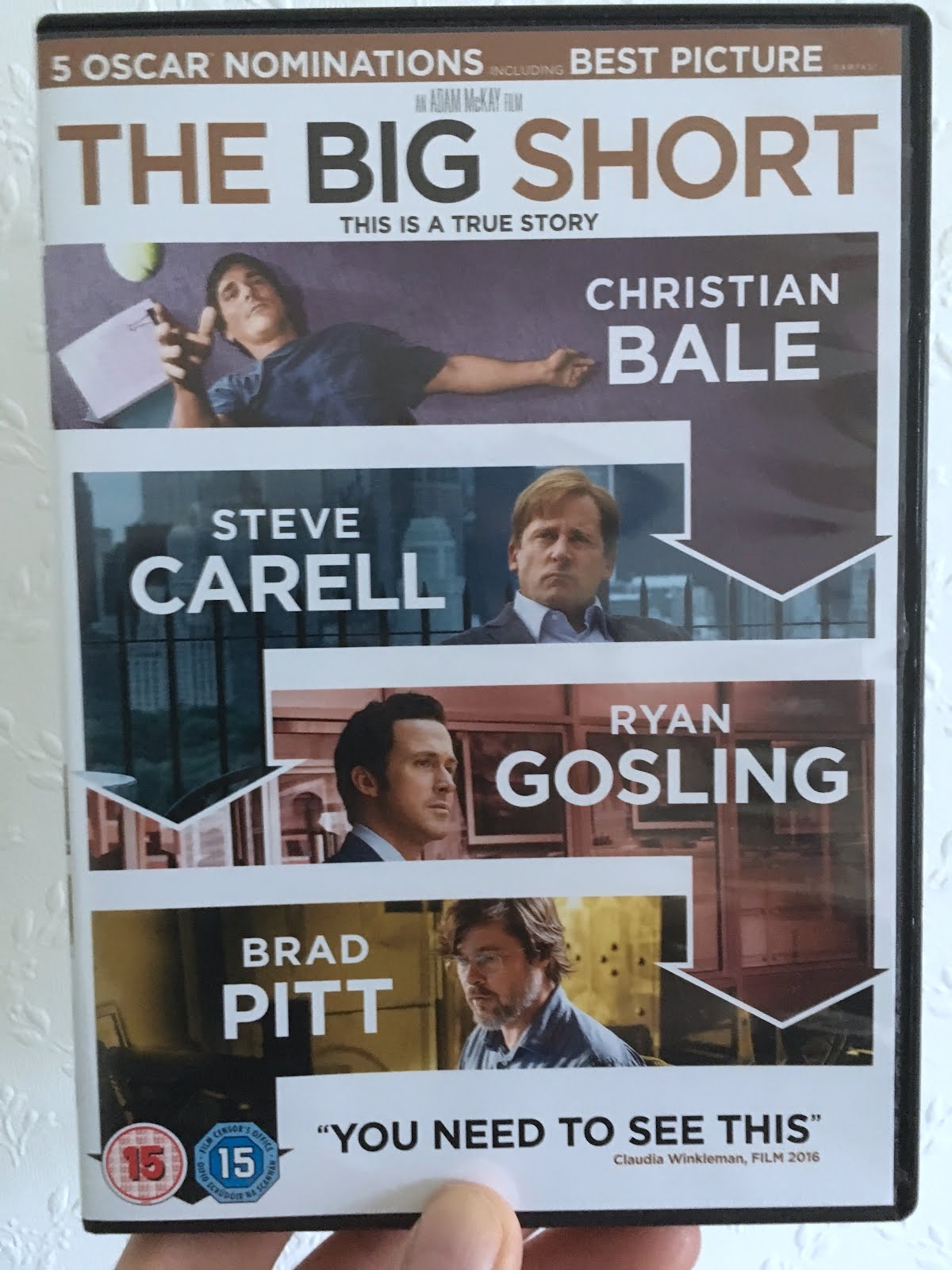
The Big Short (2015)


This highly stylised account of the investment schemes devised in the weeks leading up to the financial crisis of 2007–2008 follows three parallel narratives featuring individuals who stood to gain by the collapse of the US mortgage market.

Complex financial concepts are often hard to grasp, so the film – being somewhat self-conscious and postmodern – has this terminology explained by walk-on celebs (Margot Robbie, Anthony Bourdain, Selena Gomez, etc) talking direct to camera.

It’s not as compelling as The Wolf of Wall Street, which was personality-driven and had the huge advantage of starring Leonardo diCaprio. This film is more about a situation, with the characters seeming secondary to the way it unfolds. That said, the semi-crazed actions of Christian Bale (as Michael Burry) are the most watchable element. Steve Carell, Ryan Gosling and Brad Pitt are difficult to empathise with. That’s surely intentional, but it does make for a less engaging narrative.

Ultimately, I think I would have preferred to watch a well-made documentary about the same events or a fully fictional account that could structure the story in a more satisfying way.