Showing posts with label Year: 1988. Show all posts

Run Lola Run (1988)

Written and directed by Tom Tykwer, this is a German film that takes a somewhat experimental approach. Like a student art film, it’s quirky and doesn’t follow standard narrative conventions. 

Lola (Franka Potente) needs to raise 100,000 Deutschmarks in 20 minutes to save the life of her boyfriend Manni (Moritz Bleibtreu). She has to run across the city and acquire the funds along the way. But, as with Groundhog Day, we see her repeat this narrative multiple times in her attempts to get it right.

It’s a great idea, but the execution is all over the place. At one point in the repeating sequence, live action is briefly replaced by animation. It’s also noticeable that one of the cameras produces higher-resolution footage than one of the others, making for an uneven mix. It’s unclear whether this is intentional, to vary the visual texture, or merely the result of poor production values.

Some of the acting is hammy, too. Overall, you feel it had potential that was never realised. But the central concept – of Lola running to the rescue – is a powerful one.

The Vanishing (1988)

Hypnotic Dutch thriller. 

A man and his wife are holidaying in France when the wife, Saskia (Johanna ter Steege), suddenly goes missing. The husband, Rex (Gene Bervoets), needing answers and closure, dedicates the next three years of his life to searching for her. 

When I first saw this film I was wrapped up in the Hitchcockian psychological mystery. Like Rex, I just wanted to find out what happened to Saskia. Watching it again, decades later, I see it as a story about love, loss and bereavement – a sort of relationship drama. 

The film is simultaneously chilling and heartbreaking. The couple seem so real that you really care about them. 

Director George Sluizer adapted The Vanishing from Tim Krabbé’s 1984 novella The Golden Egg. He also remade the film in 1993 as an English-language Hollywood production with a silly new ending.

The Dead Pool (1988)

Directed by Buddy Van Horn, the final part of the Dirty Harry series is unfortunately the weakest.

Harry (Clint Eastwood) investigates a series of murders linked to a bizarre game in which the players predict celebrity deaths. The theme of fame is an intriguing one, but it's not explored well. 

Liam Neeson awkwardly plays Peter Swan, a director of music videos. He's all over the place with a wobbly accent that could be part-English, part-New Zealand. 

The one highlight is the sequence involving a remote-control car carrying a bomb through the streets of San Francisco. But overall, it's a hammy, sad end to a great series. 

On the plus side, Lalo Schifrin’s soundtrack still sounds terrific – even though in terms of textures he's clearly enbraced the styles of the 1980s.

Rain Man (1988)

Excellent drama directed by Barry Levinson. 

Charlie Babbit (Tom Cruise) is a car dealer having business problems. He’s selfish and brash. After his father dies, Charlie learns that he has been denied an inheritance but also finds out that he has a brother, Raymond (Dustin Hoffman), who lives in a mental institution and who is described as an “autistic savant”. Charlie essentially kidnaps him, hoping to get his share of the will. But then his relationship with his brother begins to develop. 

Tom Cruise delivers his best ever performance because the script and direction are so strong that even he can’t mess them up. Hoffman is extremely compelling, too. You wonder, however, what autism organisations make of his portrayal. Is it accurate or does it simplify and mislead? 

The film works as a “road movie”, with the car trip being a central motif. Ultimately, it’s a touching character study.

Ronin (1998)

Woeful action thriller directed by John Frankenheimer and written by John David Zeik and David Mamet. 

Robert De Niro stars as one of a team of special operatives working in France, hoping to seize a special suitcase from a super-criminal. But, inevitably, there are double-crossings and other complications... 

It’s deeply odd. The directing is off, somehow, with strangely framed shots and stilted camerawork lingering on the wrong details. Whenever someone is portrayed as waiting, they are forced to sit and sip coffee. That soon stands out as a conspicuous, awkward directorial tic. People just can’t stop drinking coffee in this film. There’s a kind of flatness that comes from a below-average script and actors who don’t believe in the lines they’re speaking. Jean Reno and Sean Bean have a degree of presence, but unfortunately they don’t have fleshed-out characters. Even De Niro is clearly struggling to rise above the shoddy material. 

The “Ronin” concept falls flat, with forced references to Japanese warrior culture not really working at all. It looks cheap, and it’s amazingly dull for a film with so many high-speed car chases. Parts of it are so ridiculous that it becomes laugh-out-loud funny. 

The music is intrusive and ill-judged – for example, when a “romantic” theme is matched to a dramatic scene. 

All in all, a total mess that should be regarded as a set text for film students wanting to learn how not to make a thriller.

Big (1988)

Extremely charming comedy starring Tom Hanks as Josh, a 13-year-old boy who – because of some vague magic that takes place with a fairground fortune/telling machine – wakes up in an adult’s body. His mother won’t believe it’s really him, so he’s forced to join the adult world, working for a toy company. He also begins a romance – his first – with the cynical Susan (Elizabeth Perkins), who is transformed by his good nature and innocence.

It’s an extremely sophisticated film that understands how children and adults think. Hanks is absolutely perfect in the role. His body language and facial expressions uncannily reflect those of a child, so you totally believe in the unlikely scenario. There’s a real poignancy to it, too, because the characters are so well-written. You can feel Josh’s conflict when he wants to return to his childhood world just as he’s laying down roots and finding his way among adults. 

Big explores the idea of the “child” in all of us and asks how we can grow up without losing sight of that. There’s a huge emotional intelligence in the writing and direction, and Hanks – sometimes taken for granted – should be applauded for conveying it so effectively.

I enjoyed the film when I was young, but I got so much more out of it as an adult.

Beaches (1988)

Bette Midler is middling in this musical comedy drama that’s neither funny nor dramatic. 

Beaches tells the story (in flashback) of two childhood friends who keep in touch by writing letters and meet up again as adults. Cecilia Carol (“C.C.”) Bloom (Midler) is a singer who finally makes it big, while Barbara Hershey plays her pal Hillary, a well-to-do lawyer. When Hillary gets ill, C.C. abandons a headlining concert to drive a long distance to be by her side.

The film is also a sort of musical, with Midler performing several songs. The problem is that I found her singing and acting completely devoid of appeal. She’s like a cut-price Barbra Streisand with none of the charm or charisma. 

If you like Midler’s voice and brash persona, you’ll probably love the film. If you don’t, you’ve had it. The big “emotional” conclusion doesn’t move you because the characters don’t seem real enough. It’s difficult to believe they would ever have been friends, such is the lack of chemistry. The film also fails to chronicle C.C.’s rise to fame. We’re shown at the beginning that she’s a big star because she’s sold out a stadium show, but there’s nothing about how she made it to that point. Indeed, the storytelling is oddly patchy throughout, with too much time given to certain events and then significant happenings skipped entirely. Did they simply film the first draft of the script, before someone could take a look at the pacing and rhythm?

Beaches is also notable for especially weak and underwritten male roles. I know the focus is meant to be on the two women, but did their boyfriends and husbands really have to be so one-dimensional?

Dirty Rotten Scoundrels (1988)

Charming comedy starring Michael Caine and Steve Martin as two rival con artists working in the south of France. Both actors are on top form. Also great is Glenne Headly as Janet Colgate, the woman they try to cheat out of $50,000. 

There are lots of laughs, some of them subtle and some of them silly, but it’s surprisingly sophisticated in places. 

Ian “Emperor Palpatine” McDiarmid plays a butler.

Coming to America (1988)

Silly romantic comedy. 

Eddie Murphy plays an African prince who – in order to escape an arranged marriage – travels from the fictional country of Zamunda to New York City to meet his bride. He wants to find someone who likes him for who he really is and not just for his money. 

Murphy is hugely appealing, as usual, but he’s operating on a higher level than everything happening around him. The “plot” is fairly lame and there aren’t enough laughs. It’s enjoyable if you can accept the usual 1980s aspirational fixation of upward mobility. 

What doesn’t work is that Murphy and co-star Arsenio Hall play a range of other minor parts for no apparent reason. It’s directed by John Landis, who certainly likes an in-joke (all of his films feature the phrase “See You Next Tuesday” in some form). He even revives the characters of Mortimer and Randolph (Don Ameche and Ralph Bellamy) from Trading Places, which also starred Eddie Murphy. 

It’s entertaining fluff that’s fun to watch, but it’s probably not a film you need to see twice. Surprisingly, perhaps, a sequel was released in 2021.

Without a Clue (1988)

Amusing and intelligent spin on Sherlock Holmes, starring Michael Caine as the famous detective. The twist is that this Holmes is a total buffoon – merely an actor hired by Dr. Watson (Ben Kingsley), and it’s Watson who has to do all the hard work of solving mysteries. But of course Holmes wins all the public adoration anyway, causing a degree of tension between the two. 

The plot deals with arch villain Moriarty's scheme to print fake bank notes. It’s mainly set in London but there’s an inconsequential detour to Lake Windermere, possibly just to get in some “tourist brochure” scenery.

Lysette Anthony is reasonably appealing as the young woman both Holmes and Watson are attracted to, but of course Leslie isn’t quite what she seems.

It’s very amiable and surprisingly funny, with quite a few laugh-out-loud moments based on Holmes’ ineptitude.

The Big Blue (1988)

Strange and profound drama written and directed by Luc Besson. It tells the story (only loosely based in reality) of Jacques Mayol (Jean-Marc Barr) and Enzo Molinari (Jean Reno), childhood friends who have grown up as rival freedivers. Jacques is virtually half-dolphin and continually feels the pull of the sea, despite – or perhaps because of – the fact that his own father drowned while diving. When Jacques meets the devoted Johanna Baker (Rosanna Arquette), he is torn between a life on land and the world he is truly drawn to. 

I really liked the love story. Arquette has a goofy, ditzy charm that seems incredibly natural and charming. Barr, meanwhile, has a peaceful, zen-like presence on screen that makes him special and magnetic. The freediving competition stuff is interesting, as are the swimming and communicating with dolphins. 

On the down side, the horrible soundtrack of 1980s synth and fretless bass simply doesn’t fit. Also, the film is extremely long and could have been improved by editing. 

I found the humour around Enzo awkward and misplaced. There’s a whimsy to it and a peculiar tone that doesn’t always resonate for me. But the film becomes progressively more serious and compelling as it goes on. Ultimately, it’s able to make sophisticated observations about the value of life in ways that will stay with me. The closing moments are touching indeed.

Gorillas in the Mist (1988)

Sigourney Weaver plays naturalist Dian Fossey, who worked to monitor and protect the mountain gorillas of Rwanda from 1966 until her murder in 1985. 

Directed by Michael Apted and adapted from Fossey’s own memoir, this (sort-of) biopic is remarkable for its close-ups of the gorillas seeming to interact directly with Weaver. It’s not clear how that was achieved, and I’m not sure I want to know, but the effect of seeing her living so closely with the animals is powerful indeed.

There’s a strong empathy for these critically endangered creatures and there are heartbreaking scenes showing the impact of the poachers. 

Weaver gives the performance of a lifetime, expressing great tenderness with the gorillas (and briefly with Bob Campbell, her photographer lover played by Bryan Brown) alongside her increasingly fierce determination to protect the species (going so far as to mimic a witch to scare the locals) – whatever the cost. 

It’s both tragic and uplifting. Fossey paid the ultimate price for her commitment, but was able to raise enough awareness to ensure that the gorillas remain protected to this day.

Dangerous Liaisons (1988)


Directed by Stephen Frears, this is an adaptation of the 1985 play of the 1782 novel by Pierre Choderlos de Laclos set in pre-Revolution France. Glenn Close and John Malkovich play a pair of scheming socialites who use and abuse human relationships for their own sadistic ends, ultimately destroying the lives of everyone they meddle with.

The all-star cast includes Peter Capaldi, Michelle Pfeiffer, Keanu Reeves and Uma Thurman, but for various reasons, the film simply doesn’t work. The entire plot hinges on John Malkovich’a character being so charming and irresistible that Close, Pfeiffer and Thurman all want to throw themselves at him. But instead of charming, he’s quite incredibly creepy – in fact, downright repulsive. He’s supposedly full of passion, but his seductions seem clinical – almost a technical matter he has to apply himself to.

Another problem is that Close and Malkovich are almost cartoonish in their pantomime-villain love of cruelty. Maybe that works in a French novel written hundreds of years ago, but it seems overwrought and silly when brought to the screen in this way.

Malkovich’s character blackmails and manipulates people into sleeping with him in a way that is aggressively predatory. Could it have been made in the “Me Too” era? Certainly, it’s particularly uncomfortable to watch in a post-Weinstein context.

On the plus side, Glenn Close acts well. She’s given little depth (we could have done with some wider context of who she is and how she got there), but she does “evil villain” as well as anyone. Indeed, some of her facial expressions and mannerisms are spot-on for a nasty piece of work barely able to contain her delight at ruining others. But ultimately Dangerous Liaisons feels one-dimensional and oddly uninvolving. Even the victims of the arch-manipulators (such as the wronged lover played by Michelle Pfeiffer, who I generally always like) are difficult to care about.

Hideous Kinky (1998)


It’s 1972 and Julia (Kate Winslet) has gone to live in Morocco with her two young children. She leaves behind her old relationship and hopes to “discover herself”. She becomes involved with a kindly drifter named Bilal (Saïd Taghmaoui), who turns out to be more complicated than he seems.

Winslet is strong as the endearingly naive and earnestly questing young mother. Bella Riza and Carrie Mullan are excellent as the precocious children able to cut through their mother’s hippy-dippy aspirations and speak the truth. They are among the most impressive child actors I’ve seen.

It’s a plot that seems to unfold sideways in almost unrelated episodes, so you can never guess what will happen next. Adapted from Esther Freud’s novel, itself autobiographical, it benefits from seeming “real” because the events it depicts actually took place.

There’s an excellent soundtrack – Canned Heat, Richie Havens, Nick Drake, Incredible String Band – that brings 1972 alive. The colours are rich and vital, making it even more pleasurable to watch.

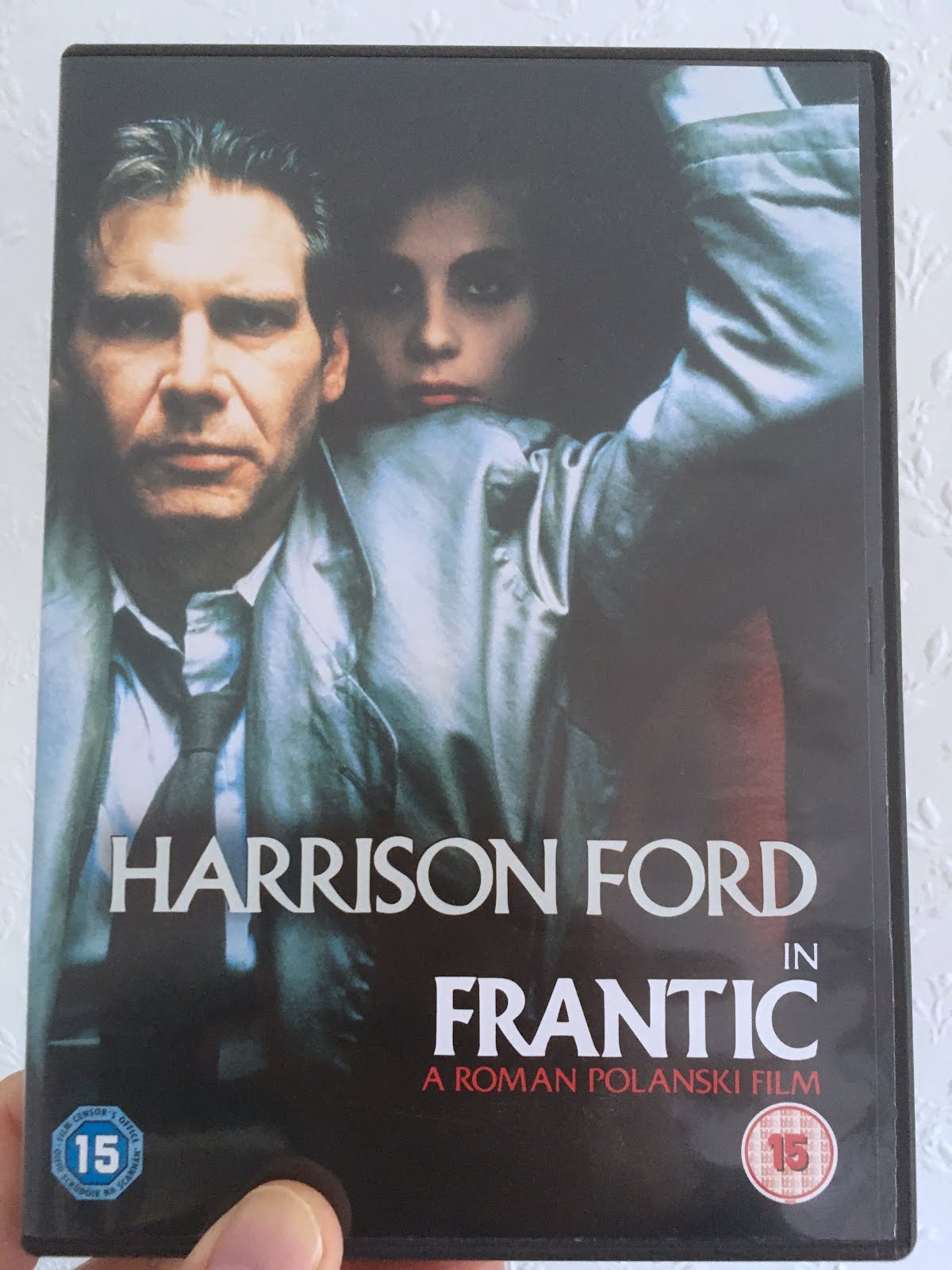
Frantic (1988)


Tense, constantly gripping thriller directed by Roman Polanski. Harrison Ford plays an American doctor in Paris whose wife is kidnapped from their hotel. In the absence of any help from the police or the US embassy he sets out to find her himself, aided only by a pretty young drug smuggler called Michelle (Emmanuelle Seigner).

It’s a taut and exciting narrative, with the mystery steadily deepening as Ford's character begins to learn what’s happening. There are moments of black humour, too, as his situation becomes more and more dire. The scene in which he scrabbles around on a slippery rooftop is a highlight.

Music is by Ennio Morricone, excellently judged as ever, with additional tracks by Grace Jones.

The Naked Gun (1988)


Satisfyingly silly slapstick. It’s a satire of James Bond, TV cop shows and Chandleresque detective stories. Leslie Nielson is lovable as the utterly buffoonish Frank Drebin and Priscilla Presley is excellent as his girlfriend. The jokes are extremely childish and basic, and all the more funny for it. Some of the baseball references passed me by, but that in no way reduced the enjoyment.

She’s Having a Baby (1988)


Romantic sort-of comedy-drama about a young couple (Kevin Bacon and Elizabeth McGovern) who get married and eventually embark on parenthood. It’s a strange film. There are several dream sequences/magic-realist interludes that don’t add a great deal (and which possibly confuse the narrative), although the scene in which a street of all-American dads mow their lawns in stylised formation is effective satire that would have been critically applauded if Dennis Potter had shot it.

The lead actors are OK if not spectacular in the two key roles, but the main problem with the film is that it doesn’t establish their relationship and what they mean to each other – until it’s too late. We meet them on their wedding day with Alec Baldwin trying to talk a nervous Kevin Bacon out of getting married because he doesn’t want to lose his best friend (this seems like a homo-erotic sub-plot, but the film is so muddled that you can’t be sure). It would have been far better to start with an establishing scene – a romantic walk along the beach, or whatever – that shows how the couple really feel about each other. Instead, it leaps into themes of social conformity and how Americans are expected to behave. When Kristy secretly stops taking the pill in order to get pregnant it comes as a total surprise because the character is so underwritten that we don’t know how she feels about anything, let alone contraception and parenting. And then it becomes a different sort of film in the last 45 minutes. John Hughes juggles many themes (peer pressure, our role in society, masculinity, etc.), but doesn’t satisfactorily address any of them.

It’s difficult to know who this film is for. Was it made for female Bacon fans (he’s topless a lot of the time)? And if so, how are they meant to feel about the women in the story?

Mystic Pizza (1988)


Two sisters (Julia Roberts and Annabeth Gish) plus their best friend (Lili Taylor) work in a pizza restaurant in a small Connecticut fishing town named Mystic. Each of them experiences a relationship that challenges and changes them in some way.

It’s a funny and emotional coming-of-age drama. The script is absolutely spot-on. The characters are extremely well drawn and so entirely believable that you laugh when they laugh and weep when they weep.

The three stories are so expertly woven together that it feels like one plot. And in fact there’s a fourth story, which is about the way of life in the town, and this too is handled brilliantly. There’s a strong sense of place, and you really feel drawn into this small community.

There’s nothing you could cut or add to make Mystic Pizza work any better. It’s a mini-masterpiece.

Working Girl (1988)


Intelligent and amusing Wall Street comedy-drama about a working-class stockbroker's secretary who dreams big. Like so many American films of this time, it is obsessed with social status and upward mobility. In many ways it’s a more sophisticated version of The Secret of My Success. Melanie Griffith, Sigourney Weaver and Harrison Ford are tremendous in the lead roles, really seeming to relish their parts. The script is nuanced enough that even the villain (Weaver) is likeable. It’s wonderfully 1980s – the hairspray, the shoulder pads, the pop soundtrack (Chris De Burgh’s "Lady in Red", the Pointer Sisters’ "I’m So Excited"), the New York scenes – but it has dated well because it taps into timeless themes of class, aspiration and identity. And while there are farcical elements, it resists cheap laughs and never descends into mere slapstick. The pacing is perfect, too: it builds and twists at just the right speed to keep you engaged.

In addition to the big trio of lead actors, there’s an all-star cast also featuring Alec Baldwin, Joan Cusack, Kevin Spacey and Olympia Dukakis. There are even brief appearances by David Duchovny and Ricki Lake. The theme song is the rousing but horribly overproduced "Let the River Run" by Carly Simon.