Showing posts with label Year: 1972. Show all posts

Joe Kidd (1972)

Western written by Elmore Leonard. 

Clint Eastwood stars as a former bounty hunter who helps a landowner (Robert Duvall) track down the Mexican revolutionary leader Luis Chama (John Saxon). 

The landscape cinematography by Bruce Surtees is extraordinary. You could turn almost any frame into a poster. The soundtrack by Lalo Schifrin is perfectly judged, mixing western motifs with funkier elements. 

Clint Eastwood is great, as ever. He’s essentially playing the same part he always plays, and you wouldn’t want it any other way.

Deliverance (1972)

A masterpiece. This is a survival thriller directed by John Boorman, and adapted by James Dickey from his 1970 novel. 

It stars Jon Voight, Burt Reynolds, Ned Beatty and Ronny Cox as four friends who take a disastrous canoe trip in the northern Georgia wilderness before the river is dammed and an entire community is erased. 

It works on multiple levels, like all great art. There’s a theme about poverty and the dispossessed – an entire band of society with no voice and no rights is abandoned and eradicated. Plus, there’s an ecological theme: we can never truly master the environment. There are also various moral questions that arise from their encounters with crazed locals. 

There’s a wonderful and poignant soundtrack. The film is beautifully shot. The characters are extremely well drawn. The dialogue is believable. The acting is uniformly strong. The storytelling is lucid. It’s moving, gripping and profound.

Cabaret (1972)

A stunning musical drama.

The rise of the Nazi party forms the backdrop to the relationship between a couple who meet at a boarding house in Berlin in 1931 during the Weimar Republic. She (Liza Minnelli) is a talented cabaret singer who dreams of becoming a film star. He (Michael York) is an English academic. Then they encounter a wealthy businessman (Helmut Griem), who changes their whole dynamic and sets them each on a different course. 

Minnelli is radiant and magnetic. She inhabits every scene so fully that it’s impossible to imagine anyone playing the part better than she does. 

It’s brilliantly directed by Bob Fosse, with the musical numbers often cleverly juxtaposed with jarring images – such as someone being beaten by Nazis. 

The characters are sympathetic and three-dimensional, and there's really nothing you could add or remove to make this film any better.

The Godfather (1972)

This came with all the baggage of being a celebrated “masterpiece”. Maybe that’s why I didn’t enjoy it as much as I was supposed to. The mafia plot threads are engrossing, if complicated, and Al Pacino is terrific as Michael. Also, James Caan, Robert Duvall and Diane Keaton are all persuasive in their roles. However, I found Marlon Brando slightly ridiculous as Vito Corleone. His almost indecipherable speech didn’t help (it’s obvious he has something stuffed inside his cheeks), and clarity is unnecessarily sacrificed for “character”. 

Surprisingly, Francis Ford Coppola’s direction doesn’t seem especially notable. I far, far prefer the vision he brings to Apocalypse Now and Peggy Sue Got Married

The drab, washed-out visuals are presumably deliberate, but these are another turn-off.

My loss, I know.

The Poseidon Adventure (1972)

The SS Poseidon is sailing from New York to Athens when an underwater earthquake creates a huge wave that turns the ship over. A small group of passengers do their best to survive, despite the water coming in and the fires breaking out.

I was curious to see this film, which I had often heard about. It’s trashier than I expected. There’s a shabby made-for-TV quality to it, and it has none of the big-budget grandeur of disaster classics such as The Towering Inferno. The characters are absurdly diverse “types”, including:
• a rogue preacher (Gene Hackman)
• an angry, bad-tempered cop (Ernest Borgnine) and his ex-prostitute wife (Stella Stevens)
• a gee-whiz American kid (Eric Shea) and his older sister (Pamela Sue Martin)
• a woman given no other function than to be “a fat lady” (Shelley Winters) and her thinner husband Jack Albertson (Grandpa Joe in Willy Wonka & the Chocolate Factory)
• a nervous singer (Carol Lynley) whose band of beardy blokes doesn’t make it
• a kindly, injured waiter (Roddy McDowall)
• an absurd-looking runner (he jogs like a parody of a Carry On character), who’s too shy to have any luck with women (Red Buttons)

Meanwhile, Leslie Nielsen plays the captain. After seeing him in Airplane! and The Naked Gun, it’s strange to see him in a straight role: I kept waiting for the gags that never arrived.

The concept is good, but it’s poorly executed and poorly written. There’s a lack of dramatic tension. Too much of the film becomes a logistical challenge of getting a group of people past an obstacle or from one room to another. The ship is meant to be upside down most of the time, but it rarely looks that way. You only see it in close-up, and the lack of contextual shots mean that what you do see looks like a set. It made me respect the action sequences in James Cameron’s Titanic even more than I did already. 

Character-wise, there are sections that are unintentionally comical – ridiculous, even. Often, one person is speaking and everyone else is holding a strange facial expression, such is the lack of dynamism in the group scenes. There’s a lot of unnecessary shouting, too. And you can tell when someone’s about to die because of the conversation they have beforehand. 

Gene Hackman makes the most of the sub-standard material, but he can only do so much. 

All these points aside, it’s entertaining enough.

Junior Bonner (1972)


Charming Sam Peckinpah film about a rodeo rider (Steve McQueen) hoping to make his fortune while juggling family problems. My copy came free with a newspaper a few years ago.

It’s shot in a remarkable way that juxtaposes fast, feel-good country tunes with insanely dangerous horse and bull manoeuvres.

The highlight is a surreal extended barroom brawl that gets out of hand while Junior quietly gets to know his new girlfriend Charmagne (Barbara Leigh). The scene is given a weirdly trippy feel with dubby sound effects mingling with the country band playing in the room – another striking juxtaposition.

The quirky narrative keeps you guessing until the end. Will Junior’s alcoholic dad get back with his mother? Or will he realise his dream of moving to Australia? And will Junior win the big prize money by lasting eight seconds on the most terrifying bull? And will he get the girl?

The ending isn’t obvious at all, but it is satisfying.

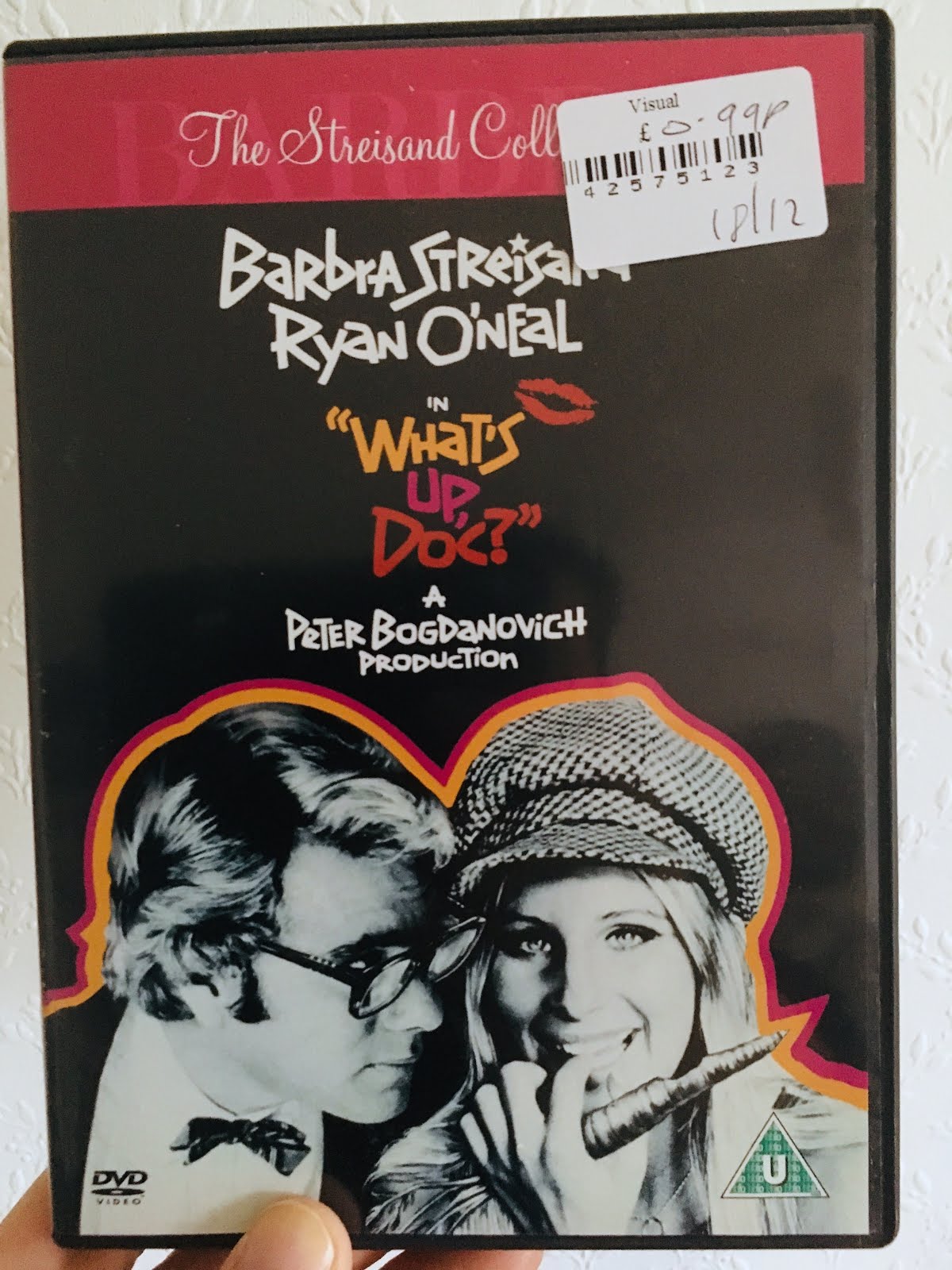
What’s Up, Doc? (1972)


Ingenious “screwball” comedy starring Barbra Streisand (as Judy Maxwell) and Ryan O’Neal (as Howard Bannister). The script is hilariously sharp. The slapstick is spot-on. Produced, written and directed by Peter Bogdanovich, it begins as farce and becomes increasingly ridiculous. Four identical-looking bags get mixed up in a San Francisco hotel. One contains top-secret documents, one contains expensive jewels, one contains rare igneous rocks and one contains Judy’s clothing and a dictionary. Endless mix-ups ensue, with Streisand and O’Neal eventually finding themselves being pursued by gangsters. There are countless laugh-out-loud moments. Streisand is as funny as she has ever been – an absolute delight. As a witty romp, with a dash of romance and plenty of absurdity, it’s pretty much unbeatable.