Showing posts sorted by relevance for query San Francisco. Sort by date Show all posts

Zodiac (2007)

David Fincher’s highly skilled dramatisation of the remarkable true story about the so-called “Zodiac killer”, who murdered at least five people in the San Francisco Bay Area in the 1960s and 1970s. 

Mark Ruffalo plays the cop investigating. Robert Downey Jr is a journalist for the San Francisco Chronicle. And Jake Gyllenhaal is Robert Graysmith, a cartoonist at the same paper who becomes obsessed with the case and intent on solving it, no matter what.

Ruffalo and Gyllenhaal are such sensitive performers that they build huge depth into their characters. Downey Jr. is less impressive. Nothing wrong with him as such, but he makes less of an impact.

I like the way the film charts the passing years, and keeps the narrative on the ongoing quest to resolve the case rather than veering off too much into the personal soap operas of the main characters' changing lives. 

A View to a Kill (1985)


Roger Moore plays James Bond for the seventh and final time. He looks too old for the role (Q and Moneypenny aren’t getting any younger, either), but despite that it’s a better film than I recalled.

Christopher Walken plays Max Zorin, a demented tycoon who plots to flood and destroy Silicon Valley in order to control the world market in microchips. Grace Jones is his right-hand woman. Unfortunately, she is given almost no dialogue and so spends most of the film merely looking fashionable and angry.

There is a genuinely tense and dramatic finale at San Francisco’s Golden Gate Bridge, involving Bond dangling by a rope from an airship, which is not for vertigo sufferers. There’s also a surprisingly brutal scene in which Zorin sprays miners with machine-gun fire while laughing his head off.

Tanya Roberts plays a slightly weedy geologist called Stacey. And Patrick Macnee plays a horse trainer named Sir Godfrey Tibbett.

There are plenty of ridiculous moments, as you’d expect. The most absurd is a motorised iceberg that Bond uses as a boudoir in Siberia. Or maybe it’s when Bond quickly cooks a quiche.

I’m a little saddened that I have now seen all of the films, but at least there’s the forthcoming (much delayed) No Time to Die to look forward to.

The Five-Year Engagement (2012)

A fairly intelligent rom-com – a silly but charming on-off love story boosted by a strong soundtrack and some funny lines. 

Violet (Emily Blunt) and Tom (Jason Segel) are a happy couple living in San Francisco. They get engaged and hope to marry. But when Violet begins a post-doctorate psychology course at the University of Michigan, the couple move away from their friends and family. Tom’s career as a chef suffers as Violet’s academic prospects improve. This puts strain on their relationship and their wedding is repeatedly delayed.

Emily and – in particular – Alison Brie, who plays her sister Suzie, are pretty good. Segel is less convincing, but then again it may just be that his character’s persistent unease makes him a little uncomfortable to watch.

The Five-Year Engagement starts with Dexys Midnight Runners singing Van Morrison’s “Jackie Wilson Said”, which puts you in a good mood from the beginning. In fact, most of the soundtrack is made up of Van Morrison songs – a smart choice. I was especially pleased to hear his “Sweet Thing”, as it’s not every day an Astral Weeks track gets used in a film.

One continuity point: Violet’s character’s childhood bedroom wall is covered in Wham! posters, but she would have been a baby when Wham! were popular. Did someone overlook this? 

Another oddity is a thread of violent humour running through the story. Tom’s boss at the restaurant slices part of her finger off. Violet is shot in the leg by a crossbow. And Tom jumps on a fire hydrant obscured by a snowdrift. I’m not sure why this was introduced, although it does add a sense of “real life”.

While it’s all fairly flimsy and forgettable, it does make you feel better about life for a couple of hours – which is presumably what rom-coms are for.

The Enforcer (1976)

The third Dirty Harry film sees Clint Eastwood once again working as a San Francisco cop. This time he’s trying to catch some rather ludicrous hippy terrorists who go under the name of the People's Revolutionary Strike Force. 

Tyne Daly of Cagney & Lacey fame plays Inspector Kate Moore and is wonderful in the role. She endures sexism and scepticism from Harry before eventually winning his respect. 

Directed by James Fargo, the film is very nicely shot, with clever, well-judged framing of scenes making for satisfying visuals throughout. The villains seem unnecessarily hammy and one-dimensional, but the real theme of the film is Harry’s developing relationship with Kate and that more than makes up for it.

The Dead Pool (1988)

Directed by Buddy Van Horn, the final part of the Dirty Harry series is unfortunately the weakest.

Harry (Clint Eastwood) investigates a series of murders linked to a bizarre game in which the players predict celebrity deaths. The theme of fame is an intriguing one, but it's not explored well. 

Liam Neeson awkwardly plays Peter Swan, a director of music videos. He's all over the place with a wobbly accent that could be part-English, part-New Zealand. 

The one highlight is the sequence involving a remote-control car carrying a bomb through the streets of San Francisco. But overall, it's a hammy, sad end to a great series. 

On the plus side, Lalo Schifrin’s soundtrack still sounds terrific – even though in terms of textures he's clearly enbraced the styles of the 1980s.

Copycat (1995)

An academic specialist on serial killers (Sigourney Weaver) lives a life of agoraphobic terror after being attacked by a psycho 13 months previously. But she has to face her worst fears when two San Francisco cops (Holly Hunter and Dermot Mulroney) seek her help in tracking down a brutal “copycat” killer. 

It’s tense and dramatic, and there’s a fairly major twist about two thirds in that I certainly didn’t see coming.

Weaver and Hunter are both excellent, but the latter is particularly strong and brings real depth to the role.

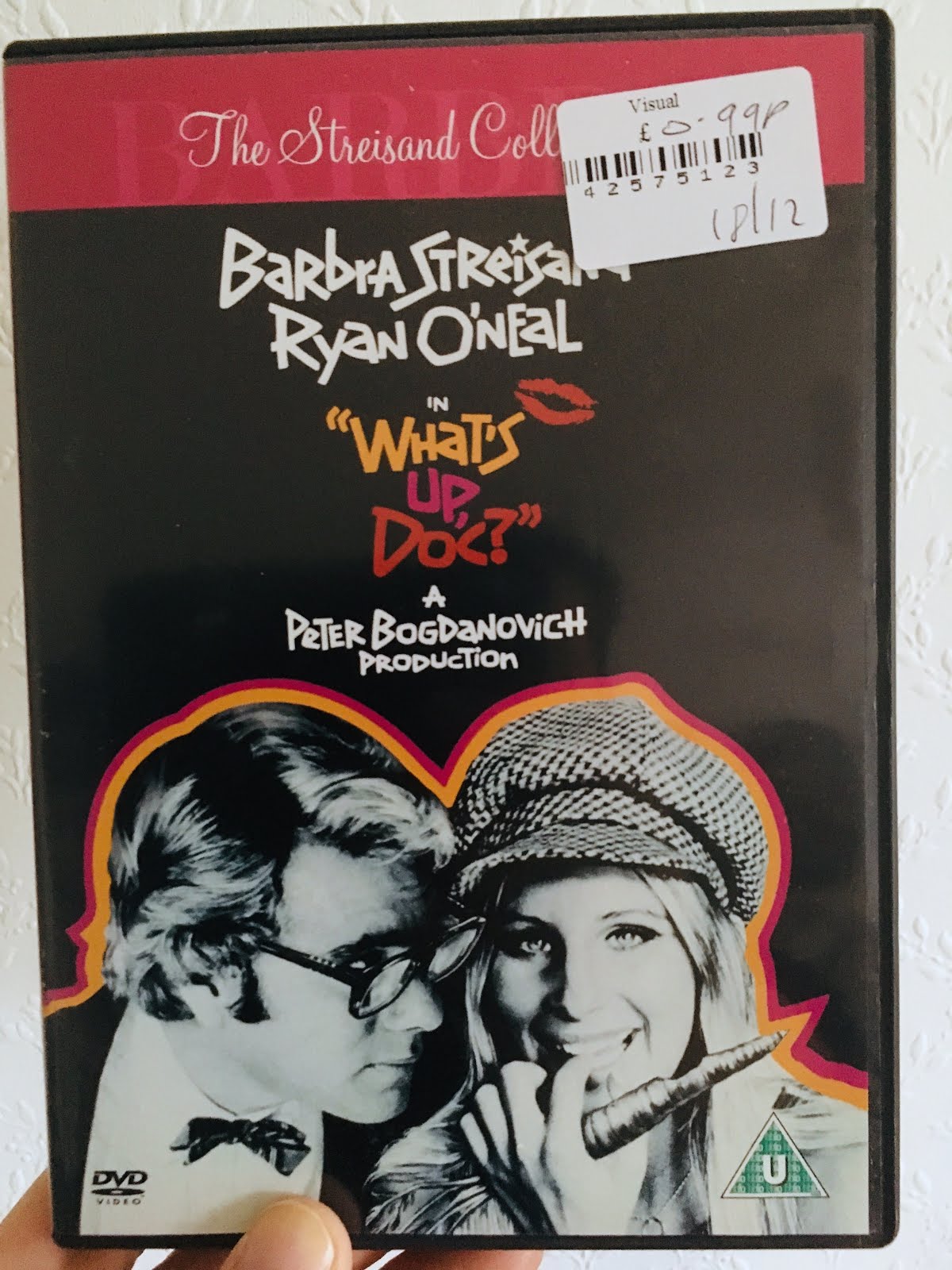
What’s Up, Doc? (1972)


Ingenious “screwball” comedy starring Barbra Streisand (as Judy Maxwell) and Ryan O’Neal (as Howard Bannister). The script is hilariously sharp. The slapstick is spot-on. Produced, written and directed by Peter Bogdanovich, it begins as farce and becomes increasingly ridiculous. Four identical-looking bags get mixed up in a San Francisco hotel. One contains top-secret documents, one contains expensive jewels, one contains rare igneous rocks and one contains Judy’s clothing and a dictionary. Endless mix-ups ensue, with Streisand and O’Neal eventually finding themselves being pursued by gangsters. There are countless laugh-out-loud moments. Streisand is as funny as she has ever been – an absolute delight. As a witty romp, with a dash of romance and plenty of absurdity, it’s pretty much unbeatable.

Bullitt (1968)


Steve McQueen is detective Lieutenant Frank Bullitt, tasked with protecting a witness for US Senator Walter Chalmers (Robert Vaughn). But of course things don’t go to plan. McQueen, as usual in his films, looks good and is a powerfully brooding presence without having to say much. He rarely seems to spark off other characters, and he never gets much dialogue.

I liked Jacqueline Bisset as his girlfriend Cathy and wished she had been in it more.

It’s a nice drama with a spectacular car chase in the streets of San Francisco, but the ending is oddly flat and disappointing with nothing really resolved. I understand that they wanted to keep it downbeat, but it felt very unsatisfactory.

Dirty Harry (1971)

Crime thriller directed by Don Segal. Clint Eastwood is at his best as the monosyllabic San Francisco cop who takes the law into his own hands to defeat a crazed murderer. 

The locations are perfectly chosen. Eastwood is effortlessly cool. The soundtrack by Lalo Schifrin is entirely suitable for the action but also works in its own right. The night scenes are atmospheric and suspenseful. And the psychopath Scorpio played by Andy Robinson is convincingly mad. 

Four sequels would follow.

Escape from Alcatraz (1979)

Superb escape drama directed by Don Siegel. 

Clint Eastwood plays Frank Morris, who plans to escape from the maximum-security prison island of Alcatraz in San Francisco Bay. 

It’s tense and atmospheric, but also compassionate. Eastwood doesn’t say much, as usual, but he conveys a lot with his eyes and face. Patrick McGoohan plays the sadistic warden.

It’s based on a true story, making it more fascinating. And I really like the open-ended nature of the ending.

48 Hrs. (1982)

Directed by Walter Hill, this is a superb hybrid of cop drama, crime thriller and comedy. 

Nick Nolte plays a San Francisco policeman trying to track down two murderers. Helping him is a convict played by the endlessly charming Eddie Murphy, with his own connection to the case. It could have turned into a silly “bromance”, but the tough, witty script is thankfully devoid of sentimentality. 

The cars look fantastic. The music soundtrack by James Horner is unusual and distinctive. And the offbeat chemistry between Nolte and Murphy is absolutely spot-on.

Magnum Force (1973)

Vigilante action thriller, with Clint Eastwood reprising the role of Harry Callahan from the original Dirty Harry film. This time he’s investigating a series of murders of criminals in San Francisco by a traffic cop (played by David Soul). 

Directed by Ted Post, it looks great, with imaginatively and intelligently framed shots. There are gorgeous old American cars and luxurious open spaces. 

There’s an excellent soundtrack by Lalo Schifrin.

Vertigo (1958)


Alfred Hitchcock classic. There’s a theme of how hard life is for women when men hold all the power. Worth seeing if only for the lovely San Francisco locations with no one in them. When are cities ever that empty? Also, Kim Novak and James Stewart are spectacular in the lead roles.

Milk (2008)

Biopic of Harvey Milk, who campaigned for gay rights in California until his assassination in 1978. 

Sean Penn is superb in the main role, with a fascinating twitchy energy and a set of mannerisms that make him incredibly watchable. Josh Brolin is excellent as Dan White, a San Francisco city supervisor and political rival. 

The assassination is referenced right at the start, so you know what’s going to happen. As such it’s painful to watch the film proceed to its inevitable conclusion.

Dawn of the Planet of the Apes (2014)


Despite the confusing title, this is the second film in the rebooted series. It’s incredibly intense. Ten years have passed and human civilisation has been decimated by the Simian Flu. The apes are living in the forest outside San Francisco in an advanced civilisation beyond that of cavemen, with buildings, developed relationships and basic language. Inevitably, this fragile human/ape coexistence is threatened when the humans intrude on the apes’ living space in their quest to restore a local power source at a hydroelectric dam. Before you know it, there’s all-out war.

As with Rise of the Planet of the Apes, the CGI is remarkably convincing. There are hefty themes about war, peace, trust, power, politics and social organisation. And there’s a lot of shooting. The film challenges the usual monsters-are-bad logic by letting the apes and humans be equally complex, with factions of both species intent on seeking conflict and peace. It’s gripping throughout, as well as strangely moving.

Hereafter (2010)

Drama directed by Clint Eastwood

Matt Damon stars as George Lonegan, a psychic who has chosen to no longer give readings. But then he’s brought into contact with a French journalist (Cécile de France) and a London schoolboy (played by the twins Frankie and George McLaren), both of whom have had close brushes with death. 

It’s an extremely unusual film that’s in no way typical of Clint Eastwood’s usual themes or narrative style. The three threads take a long time to join up. For most of the time we follow their stories in parallel, wondering how they can possibly come together. It’s oddly lit, too. Some of that is down to the poor English weather, but even the sections in San Francisco seem strangely washed out. It’s not clear if this was an aesthetic choice or some kind of technical failing.

Bryce Dallas Howard appears as a possible love interest for Matt Damon, while Derek Jacobi has a surprise cameo as himself doing a reading at the London Book Fair in Alexandra Palace. 

It’s strange and quirky, with neat details. Matt Damon is a Charles Dickens fan. Best of all, it doesn’t try to explain or glorify the supernatural gift. Instead, it’s a fact of life that Lonegan feels burdened by. And that makes it all so much more believable.

Blue Jasmine (2013)


The best Woody Allen film for a long time, although that may be damning it with faint praise, Blue Jasmine stars Cate Blanchett as a wealthy socialite whose life falls apart when her husband (Alec Baldwin) is imprisoned for fraud. Battling panic and depression, she goes to live with her sister in San Francisco (Sally Hawkins) in order to start a new life.

The premise sounds bleak, but there’s plenty of black comedy in this supremely well-observed study of class and downward mobility. Woody Allen’s pacing and construction are very solid, with expert handling of extended flashback sequences, and he really knows how to tell a story and reveal a character.

Blanchett gives one of her greatest ever performances. She’s twitchy and on the edge, but – as per the demands of her character – also elegant and hugely appealing. You can see the conflict and turmoil in every facial expression.