Showing posts with label Starring: Hugh Grant. Show all posts

Bridget Jones: The Edge of Reason (2004)

Shoddy sequel that’s simply not funny. The plot is a mess and it’s tonally all over the place. The worst crime, however, is that it’s simply not very funny. 

On the plus side, the three stars remain watchable no matter what – Renée Zellweger, Colin Firth and Hugh Grant all exude undeniable screen presence, but they can’t improve the wobbly script. There are long patches without any amusing lines at all. Loud music drowns out the dialogue in a few places. 

The film gets worse in the second half, seemingly just stringing out a weak premise to make up the full running time. Especially wretched was the gaggle of friends who make up the “Greek chorus” (a standard Richard Curtis tic) offering advice and commentary. Very old-fashioned gender politics, too, and we’re repeatedly told that life is worthless if you don’t have a handsome boyfriend.

Sense and Sensibility (1995)

Superb historical drama adapted by Ang Lee from Jane Austen’s classic 1811 novel.

Sisters Elinor and Marianne are played wonderfully by Emma Thompson and a young Kate Winslet. Hugh Grant, Greg Wise and Alan Rickman portray the men they fall in love with. As these relationships play out, in London and Devonshire, the story examines whether we should marry for love or for status.

It's hugely involving, with moments of wit and tenderness. Hugh Grant is incredibly charming as the shy and well-meaning Edward Ferrars. Alan Rickman, for once, doesn't seem typecast or obvious. He brings real subtlety to the role of Colonel Brandon. 

As well as the main leads, there are excellent performances by Imogen Stubbs, Gemma Jones, Hugh Laurie and Robert Hardy.

One of the greatest costumers.

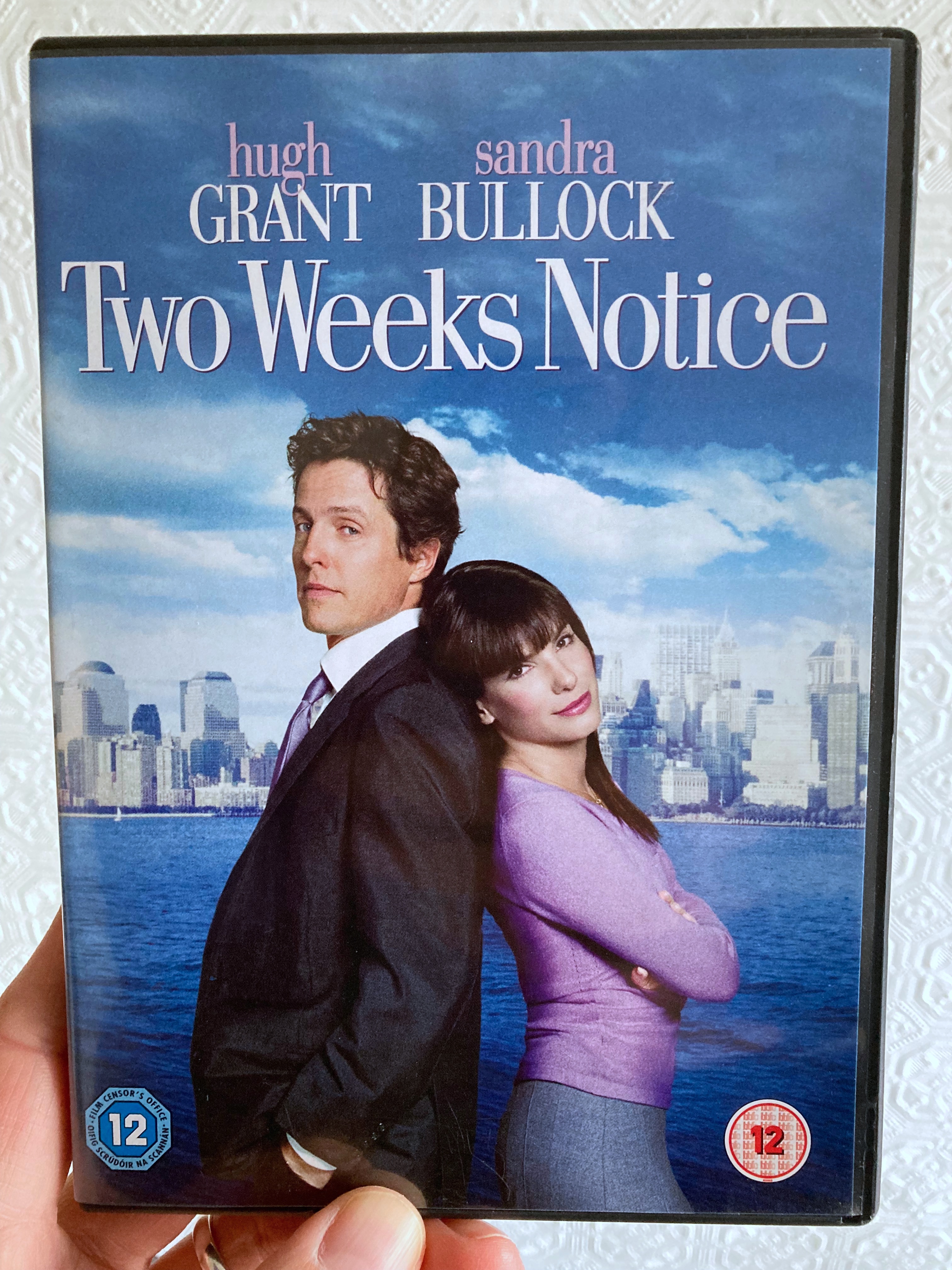
Two Weeks Notice (2002)

An idealistic liberal New York lawyer (Sandra Bullock) wants to protect a community centre. But her new boss – a womanising billionaire real estate developer (Hugh Grant) – wants to use the land for new property. The pair see the world differently, but soon hit it off. 

Troublingly, there’s no apostrophe in the title (which should be Two Weeks’ Notice). That aside, this is a charming rom-com. Hugh Grant and Sandra Bullock have great chemistry together, and a sharp script lets both of them deliver some funny lines. I like the fact that the pair have so much screen time together. Often in rom-coms the story is all about getting the couple together, leaving you feeling that you've missed out on enjoying their relationship. 

Donald Trump has a slightly bizarre cameo, and indeed Grant’s empire seems loosely based on Trump’s own. Singer Norah Jones also briefly pops up as herself.

Music and Lyrics (2007)

Enjoyable romantic comedy directed by Marc Lawrence. 

A 1980s pop idol named Alex (Hugh Grant) is tasked with writing a song for a Shakira-like pop star of the present day (Haley Bennett). To achieve this he ends up collaborating with Sophie (Drew Barrymore), the slightly eccentric woman who comes round to water his plants. 

Plot-wise it might sound silly (and indeed it is), but Hugh ’n’ Drew have real chemistry. Also, they get to reel off some genuinely funny lines. 

The film seems to lose its way a little about two thirds of the way through, with a couple of rather misjudged scenes. For example, why does Sophie take a box of biscuits to the party? It seems to be setting up a joke, but there’s no pay off. Was a vital bit of the script cut at the last minute?

Thankfully, the film recovers before the end. 

Kristen Johnston is easy to like as Rhonda, Sophie’s sister. Grant is surprisingly effective as a pop star, and his song and dance routines are all quirky and enjoyable.

Florence Foster Jenkins (2016)

Directed by Stephen Frears, this is the compelling true-life story of a wealthy New York heiress who was generally regarded as a terrible singer, yet who became a recording artist and even performed at Carnegie Hall because her social set encouraged and applauded her. 

Meryl Streep is excellent as Florence Foster Jenkins, singing technically challenging opera in a way that’s just about good enough to be credible but also strange enough to be surreally comic. 

Simon Helberg is ideally cast as Cosmé McMoon, a wildly talented pianist who – against his initial misgivings – agrees to work as her accompanist.

In what is perhaps his most fully rounded and satisfying role, Hugh Grant is remarkable as her lover and manager St. Clair Bayfield. The unusual nature of the couple's relationship and the depth of his feelings really came across. I was slightly wrong-footed because I thought the plot was leading to Bayfield being exposed for scamming Florence and promoting the whole "emperor's new clothes" circus around her efforts, but touchingly the film turns out to be a true love story after all.

Four Weddings & a Funeral (1994)

The best of the romantic comedies written by Richard Curtis. The script and narrative are tighter and sharper, so there’s not the messy sprawl of Love Actually

The story revolves around a group of friends, who we only meet via the sequence of formal rites-of-passage events alluded to in the title. It’s expertly constructed, with what seem like throwaway lines thrown in early on ending up having a neat pay-off later. 

Hugh Grant is extremely watchable – at his charming-but-nervous best. Has anyone ever done “flustered” better than him? Andie McDowell is suitably aloof and exotic as the mysterious American visitor who attracts his attention. 

The only character that doesn’t quite work is Scarlet (Charlotte Coleman). I assumed she was Charles’ sister but it turns out she’s only his flatmate. On the plus side, Kristin Scott Thomas, Simon Callow, John Hannah and Rowan Atkinson are all excellent.

Bridget Jones’s Diary (2001)

Romantic comedy directed by Sharon Maguire and starring Renée Zellweger, Hugh Grant and Colin Firth. It’s co-written by Richard Curtis and adapted from the popular 1996 novel by Helen Fielding. It’s also a sort of reinterpretation of Jane Austen’s Pride and Prejudice

It’s funny in places, although Hugh Grant is given all the best lines. Colin Firth seems less well catered for in terms of the script, with the unfortunate result that you aren’t rooting for him when the plot suggests that you should be. Zellweger has a bumbling charm, and is perfect as the heroine everyone can relate to, even if her English accent doesn’t sound quite right. 

Some of the references wouldn’t have made it to a modern-day film, which makes it all the more interesting now. 

Gemma Jones is absolutely awful as Bridget’s mother – a misconceived role, badly handled. Jim Broadbent is marginally better as her father, but he’s not given a great deal to go on.

The Remains of the Day (1993)

Masterful slow-burning drama based on Kazuo Ishiguro’s Booker Prize-winning novel. It was directed by James Ivory and produced by Ismail Merchant. 

The story focuses on a butler (Anthony Hopkins) and a housekeeper (Emma Thompson), who develop a deep love for one another but are unable to declare it. We see their story in two time periods – when they work at Darlington Hall in the late 1930s at a point when Lord Darlington (James Fox) begins entertaining fascist-sympathising aristocrats, and their attempt to meet up again in 1958.

The two lead performances are astonishing and perfectly nuanced. There’s so much feeling and power in what they don’t say. There’s passion and tenderness, too, even though it’s all held back behind the mask of duty. 

It’s a superbly shot film, too, becoming hypnotic where a lesser director would have made it merely dull.

Hugh Grant is excellent as Lord Darlington’s godson and Christopher Reeve adds gravitas as US Congressman Jack Lewis.

About a Boy (2002)

Uneven comedy/drama adapted from a novel by Nick Hornby. 

The clunkily named Will Freeman (Hugh Grant) is a moneyed-up consumer who lives a selfish life alone, protecting himself from commitments. He begins preying on single mothers in order to find a date (a quite disturbing trait that the film seems OK with) and ends up making friends with a 12-year-old boy with a suicidal mum (Toni Collette). The boy/man relationship, inevitably, teaches him to be less selfish and ultimately helps him to find a meaningful romance – with Rachel Weisz

Hugh Grant is as appealing as always but the big problem is the boy, Marcus (Nicholas Hoult), who is both unconvincing as a character and oddly difficult to like. Several elements in the story lack the all-important ring of truth. In particular, it’s never explained why Will is so disengaged from society. Is he depressed? Why? What’s the unresolved issue with his father that’s briefly alluded to but never explored? The script is too shallow to get inside these questions and make the characters three-dimensional and “real”. It seems like a fifth-rate imitation of a Richard Curtis film

The soundtrack is by Badly Drawn Boy and works well.

Notting Hill (1999)

Romantic comedy written by Richard Curtis

William Thacker (Hugh Grant) works in a travel bookshop in Notting Hill. One day a famous actress (played by Julia Roberts) walks in. They begin an unlikely romance, but fame and other matters complicate their relationship.

It’s a sweet and funny love story. Grant and Roberts are both excellent. As with other Curtis narratives, a bunch of friends and relatives act as a sort of Greek chorus, commenting on the action and helping to move it along. These are all excellent in their own right. 

Grant is particularly appealing in this role. He seems so relaxed and at ease that his scenes are just a pleasure to watch. 

Rhys Ifans is a little too silly as his flatmate, and you cannot believe that someone as sensitive and gentle as Thacker would like or tolerate him. 

Also on the down side, there’s conspicuous product placement. And the music (Boyzone, Ronan Keating) is often terrible enough to take you out of the story. 

But ultimately it’s slick and charming. The characters come alive and the romance is touching.

Love Actually (2003)

Comedy-drama written and directed by Richard Curtis. Utilising an all-star cast, it weaves together several narrative threads with a common theme of love set in the days leading up to Christmas. Some of them work better than others, but the problem with having so many stories running in parallel is that they all get merely superficial treatment. 

I would have liked more detail on the plots involving Colin Firth/Lúcia Moniz (couple fall in love but speak different languages), Hugh Grant/Martine McCutcheon (Prime Minister falls for junior member of staff) and Alan Rickman/Emma Thompson (married managing director is tempted by his secretary). The Bill Nighy story (past-his-prime rocker attempts comeback) is silly but occasionally amusing. However, the threads concerning Keira Knightley (new husband’s best friend is in love with her), Martin Freeman (acts in nude scenes with a girl but becomes paradoxically shy when asking her out) and Kris Marshall (goes to America to find a female who’ll sleep with him) could all have been ditched entirely to let the other parts breathe a little. 

The worst segments involve Liam Neeson’s precocious stepchild – a horribly self-conscious little know-all played by Thomas Sangster. This child is apparently unruffled by the recent death of his mother, but lectures his stepdad on the nature of relationships. There’s also a daft airport scene in which his antics would have probably got him shot by anti-terrorist security guards. 

It was also baffling that the same song (“Love Is All Around”) had to be revived from an earlier Richard Curtis film: Four Weddings and a Funeral. Maybe it was a self-referential joke, but couldn't they just have come up with another love song? There’s no shortage. 

I admire the ambition, and there were some genuinely funny moments, but it ended up being a sprawling mess. Woody Allen could have done much more with the raw material and handled the complex storytelling with greater skill.