Showing posts sorted by relevance for query Morricone. Sort by date Show all posts

For a Few Dollars More (1965)


In Sergio Leone’s spaghetti western sequel to A Fistful of Dollars (1964), Clint Eastwood is once again the “man with no name” – although confusingly he’s also now called Manco. This is a more sophisticated attempt to do something similar to that first film, with several of the same actors appearing in different roles.

This time, there’s a rival bounty hunter played by Lee Van Cleef. My favourite scene involves the two men shooting each other’s hats in a macho display of one-upmanship. But then they team up to defeat a ruthless band of bank robbers (led by the unconvincing Gian Maria Volonté and also including a hunchback played by Klaus Kinski), and we eventually learn that they have very different motivations...

The music is again brilliantly scored by Ennio Morricone.

On the down side, there are some “comedy” moments that don’t work at all. These add a surreal weirdness to a story that is actually fairly brutal.

The commentary by film historian Christopher Frayling is insightful and well worth watching.

The Good, the Bad and the Ugly (1966)

Extremely uneven spaghetti western. Sergio Leone directs and makes beautiful landscapes look even more beautiful. Ennio Morricone’s music is iconic and haunting. And Clint Eastwood is as magnetic as ever. But the tone of the film is really odd, and sometimes scenes intended to be slightly “comedic” simply fall flat. In particular, Eli Wallach (the “ugly”) seems strange with his sneering and grimacing. Plus, there’s a sadistic thread that runs through it. Deliberate moral ambiguity, perhaps. 

It’s more ambitious than A Fistful of Dollars and For a Few Dollars More (with which it’s often grouped as a loose trilogy), with an ongoing, parallel narrative about the US Civil War. There are spectacular battle scenes involving a huge number of extras. It’s unclear whether you are supposed to take it as an anti-war film, or whether it’s again being morally ambiguous on purpose. 

On the plus side, Lee Van Cleef (the “bad”) is charismatic as “Angel Eyes”. But the dubbed voices used for all of the actors – even the English-speaking ones – remain a barrier that prevents it from ever seeming even remotely real.

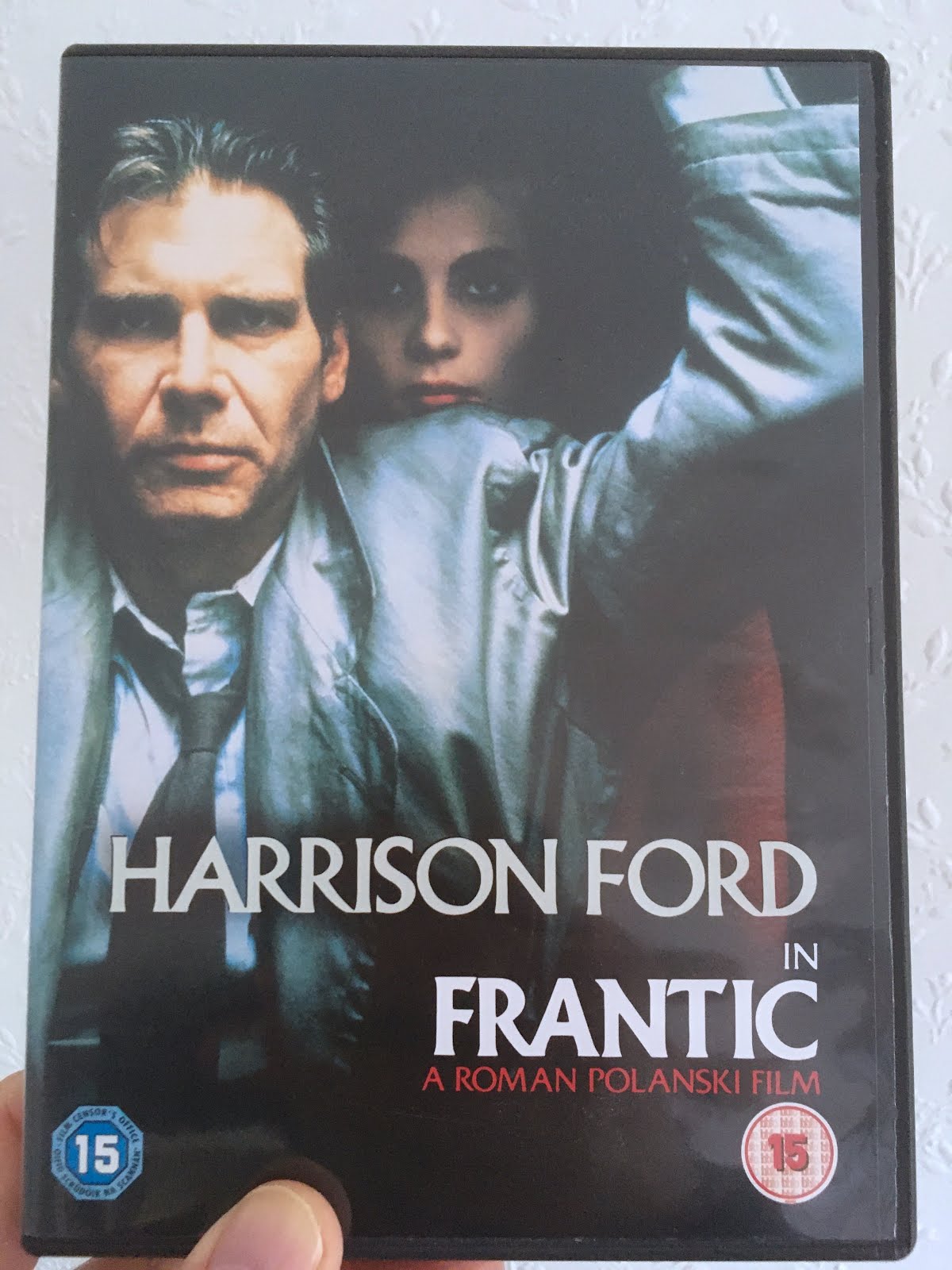
Frantic (1988)


Tense, constantly gripping thriller directed by Roman Polanski. Harrison Ford plays an American doctor in Paris whose wife is kidnapped from their hotel. In the absence of any help from the police or the US embassy he sets out to find her himself, aided only by a pretty young drug smuggler called Michelle (Emmanuelle Seigner).

It’s a taut and exciting narrative, with the mystery steadily deepening as Ford's character begins to learn what’s happening. There are moments of black humour, too, as his situation becomes more and more dire. The scene in which he scrabbles around on a slippery rooftop is a highlight.

Music is by Ennio Morricone, excellently judged as ever, with additional tracks by Grace Jones.

The Mission (1986)

A remarkable drama directed by Roland Joffé and written by Robert Bolt.

Plot (borrowed from online): "18th century Spanish Jesuits try to protect a remote South American Indian tribe in danger of falling under the rule of pro-slavery Portugal."

Robert De Niro and Jeremy Irons star. 

The jungle setting is visually stunning.

It's powerful and moving, especially given that it's based on true events.

The stirring music is by Ennio Morricone. 

The Outlaw Josey Wales (1976)

Western set during the US Civil War, starring and directed by Clint Eastwood. In some ways he is playing exactly the same character he did in Sergio Leoni’s “Man with No Name” trilogy, but the difference is that he inhabits the role with warmth, humour and humanity. 

Josey Wales sees his family killed and sets out to get revenge. Along the way he meets some colourful characters, who join him despite his “wanted man” status. As bounty hunters track and trail him, you wonder if he can ever truly be free. 

It’s superbly cast all round. Every character is perfectly drawn – especially Chief Dan George as Lone Watie. There’s a quietly comic aspect and a tenderness to his manner that makes him hugely appealing. 

I like the way Wales uses his spitting as a form of punctuation during his various encounters and conversations. That tic forms a sort of running joke that gets funnier as the film progresses.

The landscapes look beautiful and even the music is strong, although you do wish they had booked Ennio Morricone to compose the soundtrack.

While it starts out as a simplistic tale of revenge, the film goes on to become something so much broader and richer. I'm looking forward to watching it again.

A Fistful of Dollars (1964)


Spaghetti western directed by Sergio Leone and with music by Ennio Morricone. Clint Eastwood, the “man with no name”, rolls into town and discovers two warring family factions. He cleverly plays them off against each other, initiating a cycle of escalating violence.

The film is entertaining and enjoyable, despite the major distraction of all the dialogue (including Clint’s) being dubbed on afterwards. It’s visually striking and surprisingly gory for the time. Eastwood is effortlessly stylish as the poncho-wearing gunslinger, even after being badly beaten up.

The Untouchables (1987)

Brian De Palma’s historical crime drama is set in 1930 in Chicago, where gangster Al Capone (Robert De Niro) is running various illegal rackets during Prohibition. The cops are in on them, too. But federal treasury officer Eliot Ness (a handsome Kevin Costner) forms a tiny group of men he can trust (played by Sean Connery, Andy Garcia and Charles Martin Smith) to take on and stamp out corruption. 

It’s an engaging story, but a few flaws stop it being remarkable:

1. The very “1980s” music by Ennio Morricone is impressive in places, but is sometimes used jarringly. For example, a crucial encounter at the Canadian border is accompanied by “adventure” music that completely undercuts any dramatic tension that has been built up. I think of this as “Steven Spielberg syndrome” – see Jaws.

2. There are points at which it seems like an episode of The A-Team in the slightly sentimental way it assembles a gang of diverse “good guys against the world” – even though this apparently really did happen, albeit with a slightly larger gang. The fact that one of them is a nerdy accountant who conveniently happens to be handy with a shotgun makes it a little harder to take seriously. 

3. There’s something awkward and not-quite-right about Patricia Clarkson as Kevin Costner’s wife. Or maybe her role is just underwritten. Plus, the way the script (by David Mamet) focuses on Eliot’s loyalty to his wife and daughter leads you to think they will end up playing a greater part in the story (kidnapped or murdered) than they ever do. 

4. The motivation of Jimmy Malone (Connery) is unclear. Why does he risk everything to help Costner? Why is he so morally upstanding when all the other policemen are crooked? And what’s going on with his Irish-Scottish-American accent?

These points aside, it’s highly enjoyable. De Niro is reassuringly nasty as Capone, gaining weight especially for the role, and Kevin Costner surprises by being highly watchable. Plus, there’s a particularly dynamic scene set in Union Station that involves a mother with a pram being caught in a crossfire.

Casualties of War (1989)

Directed by Brian De Palma, this tells the story of an American soldier in the Vietnam War (Michael J. Fox) who reports the other members of his squad for kidnapping, raping and murdering a Vietnamese woman. It’s loosely based on the 1966 “incident on Hill 192”, although names have been changed. 

Fox turns out to be fairly convincing as the squeaky-clean Lutheran who resists his sergeant (a believably on-the-edge Sean Penn). He just looks a little too fresh and healthy, even when he’s sent to hospital, and his hair never seems to get ruffled. In contrast, the war scenes are scary and realistic. 

The music is by Ennio Morricone and – despite its appeal – seems a little too prominent for certain scenes.