Shine (1996)

Moving biographical drama about the life of pianist David Helfgott. 

A child prodigy, he struggles with an abusive, controlling father and mental illness problems that are presumably not unrelated to his difficult family life. 

We see him as a boy (played by Alex Rafalowicz), a teenager (Noah Taylor) and as an older man (Geoffrey Rush). Each of these three actors tackles a complicated role brilliantly. 

John Gielgud is funny and charismatic as his London tutor, guiding him through the seemingly impossible feat that is playing Rachmaninoff’s third concerto.

For a film about mental illness, it’s surprisingly uplifting and joyous – especially after he meets Gillian, played by Lynn Redgrave. If there’s a criticism it’s that this later part of his life is rushed through. A shame that the focus is on the unhappier times, although you can understand why his formative experiences would be prioritised. Plus, this is a pitfall of biopics in general: how do you cram a life into two hours without ignoring substantial amounts of it?

The Man with Two Brains (1983)

Absolutely daft comedy with hints of cartoonish sci-fi and horror homage. 

Steve Martin plays a brilliant but naive brain surgeon with the unpronounceable name Dr. Michael Hfuhruhurr. Kathleen Turner is Dolores Benedict, who marries him for his money. The doctor meets an eccentric scientist (David Warner), who is keeping human brains alive and may have found a way to transplant them into other bodies. He then falls in love with one of the brains (voiced by Sissy Spacek) and ends up running off with it. 

It sounds ridiculous and it is – deliberately. There are some funny moments and a few scenes that fall flat. It’s not quite as sharp as The Jerk (1979) or Lonely Guy (1984), but Martin and Turner are both hugely appealing and watchable throughout.

Cape Fear (1991)

Martin Scorsese’s remake of the 1962 film creates something bigger, louder and a lot more scary than the original. This time around the psychopath Max Cady is played by Robert De Niro, who is fuelled by his own version of religion as well as a desperate craving for revenge. The plot is very similar – ex-con terrorises lawyer and his family – except that Scorsese builds in more moral ambiguity. Sam Boden (Nick Nolte) is not a squeaky-clean lawyer. Instead, he has acted unprofessionally by concealing a report relating to Cady’s case and is unfaithful to his wife Leigh (Jessica Lange) with a legal clerk called Loti (Illeana Douglas). 

The biggest difference is that the Bodens’ daughter, Danielle (a particularly superb Juliette Lewis), is a 15-year-old who is drawn into an ambiguous understanding with Cady. He exploits her dawning sexuality as well as her feelings of being misunderstood by her parents. 

In many ways it’s a film about family and – like Cady himself – it cleverly explores the threads that tie them together as well as probing into the cracks that pull them apart. 

The music, based on Bernard Herrmann’s score for the original, has a high drama, helping to drive the dynamism and the tension on screen. 

There’s also the slight novelty of cameos from three of the original cast – Robert Mitchum, Gregory Peck and Martin Balsam all appear in minor roles. 

If there’s a criticism it’s that it’s a little overwrought at times, but I like that quality: Scorsese turns up the drama and makes it almost unbearable. Then he turns it up some more.

A Star Is Born (1976)

The third of the four filmed versions of this story. Kris Kristofferson is the drinking, drug-taking rock star whose career is on the wane. Barbra Streisand is the bright young talent he helps rise up the ladder to fame and who will quickly eclipse his own success. 

The music is lively and the concert scenes seem convincingly “real”. The couple have chemistry and charisma. It was a wise move to cast two genuine singers to play these two performers, as they seem so natural on stage. 

I like the fact that John Norman Howard’s untimely demise in a high/speed car crash can be interpreted as a reckless accident or a suicide, depending on how you choose to read the character and the emotional/chemical state he’s in. Unlike the 2018 Bradley Cooper/Lady Gaga film (in which there’s no doubt that he’s a tragic addict who kills himself), this more nuanced version has the confidence to allow some ambiguity – rather than spelling everything out for you – and I admire that quality. In the same way, the managers in this film (whose roles are handled well by Gary “Buddy Holly” Busey and Paul Mazursky) aren’t simplistically ruthless or exploitative. They seem much more like real people with real conflicts. 

Joan Didion had a hand in writing it, which may account for the refreshingly intelligent approach.

Cape Fear (1962)

Terrifying thriller. Robert Mitchum plays a bitter, crazed ex-con who tracks down the lawyer (Gregory Peck) who sent him to prison, then begins to stalk and terrorise him and his family. 

It’s highly suspenseful, pretty much from beginning to end, and the two leads are both ideal for the parts. Mitchum has just the right amount of wry, amused cool and psychopathic edginess. Peck is perfect as his stiff, somewhat uptight opposite. Polly Bergen and Lori Martin are both compelling as the wife and daughter who quickly get pulled into the escalating drama. And Telly Savalas (with hair) is likeable as the private detective. 

It’s edge-of-the-seat stuff and I like the way the somewhat downbeat closing seconds get you thinking.

The Outlaw Josey Wales (1976)

Western set during the US Civil War, starring and directed by Clint Eastwood. In some ways he is playing exactly the same character he did in Sergio Leoni’s “Man with No Name” trilogy, but the difference is that he inhabits the role with warmth, humour and humanity. 

Josey Wales sees his family killed and sets out to get revenge. Along the way he meets some colourful characters, who join him despite his “wanted man” status. As bounty hunters track and trail him, you wonder if he can ever truly be free. 

It’s superbly cast all round. Every character is perfectly drawn – especially Chief Dan George as Lone Watie. There’s a quietly comic aspect and a tenderness to his manner that makes him hugely appealing. 

I like the way Wales uses his spitting as a form of punctuation during his various encounters and conversations. That tic forms a sort of running joke that gets funnier as the film progresses.

The landscapes look beautiful and even the music is strong, although you do wish they had booked Ennio Morricone to compose the soundtrack.

While it starts out as a simplistic tale of revenge, the film goes on to become something so much broader and richer. I'm looking forward to watching it again.

Secretary (2002)

Lee Holloway (Maggie Gyllenhaal) comes from a troubled family and struggles with self-harm problems. She begins a new job working as a secretary for lawyer E. Edward Grey (James Spader), and begins an extreme relationship with him that’s based on discipline and control. This becomes an unlikely love story. 

It’s not for the prudish or the easily startled, but there’s a touching drama contained within this deliberately disturbing and very black comedy. Gyllenhaal is so expressive that she perfectly evokes her transformation from suffering victim to the liberated master of her own destiny. A slightly surreal, absurd aspect enhances the film rather than making it less believable. 

Adapted from a short story by Mary Gaitskill, Secretary covers themes that most films won't go near. It does so with wit and charm, so it doesn’t feel exploitative – even when exploitation is part of the subject matter.

The Heroes of Telemark (1965)

During World War II, members of the resistance sabotage the Germans’ attempts to create an atomic bomb at the Vemork Norsk Hydro plant in Telemark, Norway. 

Probably the worst lighting I’ve ever seen in a film. It lurches from dim and grainy, with a “glow” around objects on the screen, to brighter but still somehow “wrong”-looking, and then back again.

It’s supposedly based on real-world events, but it’s very difficult to believe some of these episodes are true, especially when cartoonishly stupid Nazis are so easy to evade and outwit. None of the guards ever seem to look round. 

Kirk Douglas does his best with the material, and his charm just about survives, but there’s no character for him to explore. 

Too many scenes consist of our heroes running about in the snow – and for far too long, with minimal dialogue – as if the script was never actually completed. Likewise, there are lingering, ponderous scenes of them setting up a bomb, fiddling with wires, applying tape and generally pottering around. These go on and on, without dramatic tension, and end up being unintentionally funny. 

Richard Harris is appallingly wooden as resistance leader Knut Straud. Michael Redgrave is completely unnecessary as a seemingly random uncle: I knew his character would die because he had no dramatic function in the story whatsoever. Ulla Jacobsson is passable as Kirk Douglas’s ex-wife, but she’s still given minimal personality and even less function in the narrative. 

Despite this somehow appearing on lists of the greatest war films, it’s a long way from essential. But it might give you a good chuckle.

The Thomas Crown Affair (1999)

Hugely enjoyable remake of the 1968 film, with Pierce Brosnan and Rene Russo in the Steve McQueen and Faye Dunaway roles. 

The plot is fairly similar, although Crown’s playful crimes take place with valuable paintings instead of him orchestrating a bank robbery.  

Brosnan is perfect for the role: a sort of clinical charm. He’s better here than he was as James Bond, perhaps simply because the script is superior. Russo also gets it spot-on as the insurance investigator who slowly begins to fall for the man she should be incriminating. She’s stylish, sharp and sexy, always just one step behind him in their perpetual cat-and-mouse game. 

As a neat little reference to the original, Faye Dunaway returns – but as Thomas Crown’s shrink. The only problem is that the film gives no inkling as to why a man so supremely confident and perfectly accomplished might need a shrink in the first place. Denis Leary is also impressive as the Detective Michael McCann, and the progression of his relationship with Russo’s character is developed nicely. 

Whereas the original has a slightly impressionistic element, this version is crisp and precise – tightly plotted and excellently done all round. Probably the best remake I have seen.

The Insider (1999)

A whistleblower thriller based on a true story. Russell Crowe plays Jeffrey Wigand, who – when fired from his job in the tobacco industry – shared secrets about the conduct of his firm, even though he and his family were threatened and intimidated for doing so. Al Pacino plays the TV producer responsible for the 60 Minutes documentary that will air Wigand’s revelations. Christopher Plummer is the presenter of the show, who has a conflict of interests in terms of honouring his ethics vs. protecting his TV career. 

It’s entertaining and fairly gripping, if a little too long at 158 minutes. Director Michael Mann turns in something more sophisticated and less trashy than Heat, which also featured Pacino and the actor playing Wigand’s wife, Diane Venora

Pacino is terrific, even if (or because) he plays the same character in all his films: a hardboiled-yet-sensitive tough guy with integrity. 

It’s a little thin on the topic of Wigand’s marriage and the strains placed upon it. That thread could have been explored better. Otherwise, it's difficult to fault.

The Hustler (1961)

Paul Newman is utterly terrific in this drama about a wildly talented pool player, “Fast” Eddie Felson, who lacks the wise judgement to capitalise on his gifts. Jackie Gleason plays his rival, Minnesota Fats. Piper Laurie is his troubled, heavy-drinking girlfriend Sarah. And George C. Scott is the manipulative, controlling Bert. 

Adapted from the novel by Walter Tevis, it feels closer to a play at times. There’s a gritty, low-key quality to the scenes, which are built around character and dialogue. Newman is wonderful, oozing an easy charm even when things start to go wrong for him.

Martin Scorsese filmed a sequel in 1986 called The Color of Money. Paul Newman reprised the role of Fast Eddie, but unfortunately his young protégé was played by Tom Cruise

Trivia: Bob Dylan borrowed these lines spoken by Piper Laurie for his 1985 song “Seeing the Real You at Last”

: “I've got troubles, and I think maybe you've got troubles. Maybe it'd be better if we just leave each other alone.”


Broken Flowers (2005)

Comic drama directed by Jim Jarmusch.

Don Johnston (played by Bill Murray and with a name that gets him deliberately confused with the Miami Vice actor) is a lonely, retired man who used to work in computers. On the day that his girlfriend Sherry (Julie Delpy) leaves him, he receives an anonymous letter that tells him he has a 19-year-old son. With the help of his neighbour Winston (Jeffrey Wright), a fan of detective stories, he sets off on an investigative trip to meet four women who might have been the mother of the child he never knew he had. 

The bulk of the film deals with these four encounters, which meet with varying degrees of success. One of the former lovers (Sharon Stone) spends the night with him. Another (Tilda Swinton) gets him beaten up. All of these four women (​​Frances Conroy and Jessica Lange play the other two parts) are convincingly portrayed.

It could have been funnier. Some of the deliberately “low-key”, contemplative scenes just fall flat, even though that’s probably the point. The detective aspect is a bit silly, which undercuts some of the power of the serious relationship material. And while I appreciate that it was deliberately left ambiguous, the final “twist” at the very end is an in-joke that slightly spoils the open-ended conclusion.  

It’s ultimately a third-rate Lost in Translation, but without as much originality, dry wit or warmth.

The Girl on the Train (2016)

A hysterically overwrought thriller adapted from Paula Hawkins’ bestselling novel. 

Emily Blunt plays an alcoholic divorcee who stares out of a train window and obsesses over two couples she passes. This obsession ultimately implicates her in a murder mystery for which she ends up the prime suspect. 

It’s a good idea, but it just doesn’t work. It’s excessively melodramatic, veering on the horror genre at points. Blunt walks around like a zombie, pale, trembling and rather frightening. While that makes sense in the light of her drink problem and the emotional state that caused it, it doesn’t make for a very appealing film and it adds to the ugly aesthetic all round. 

The “patchwork” approach to times and events is effective and just about comes together. The related device of only certain parts of the story being recalled owing to booze-induced blackouts also gives it a Hitchcockian dimension, allowing us to piece together what really happened at the same time as Blunt. But these elements are weakened by characters that just don’t convince. The behaviour of the bearded shrink (Édgar Ramírez) seems unlikely, somehow, and other characters’ motivations, such as those of Megan (Haley Bennett) are not fleshed out satisfactorily. 

The biggest flaw is this: of the four people she observes, Blunt is more obsessed with a pair of strangers than she is with her own ex and his new partner, who live two doors away. How could that be? She’s oddly oblivious to the interaction between the two couples, which is at the heart of the plot. 

But if you are seeking something trashy, gripping and escapist (and often I am), it will certainly keep you entertained.

The Jewel of the Nile (1985)

Michael Douglas, Kathleen Turner and Danny DeVito reprise their roles from 1984's Romancing the Stone. Six months have passed and the couple now embark on a new adventure in Africa, seeking the "Jewel of the Nile" and tackling a demented dictator. 

It’s just as daft as the original and I enjoyed it a lot, despite the common consensus that it was a disappointing sequel.

It’s spectacular, silly and fun. There’s a particularly strong scene in which Douglas drives a fighter jet around crowded streets, causing havoc.

On the down side, DeVito doesn't really need to be there and the plot sometimes struggles to accommodate him. But Turner is endlessly appealing – charming and funny enough to rise above the good-natured but sometimes less than sparkling material.

Moonraker (1979)

The usual plot: a bad man wants to take over the world, and James Bond – aided by weapons, gadgets and beautiful women – has to stop him. The “twist” this time is that some of the action takes place in space. 

It’s difficult to believe Roger Moore can be running around on a space shuttle and in a space station, but that’s exactly what we see.

The pros:

• There are some genuinely funny moments.

• Roger Moore is as charming as he ever was.

• Lois Chiles is appealing as space scientist as Holly Goodhead.

• The special effects are fairly good – especially when you see the shuttles taking off.

• The Shirley Bassey theme is one of the better Bond songs.

• M (Bernard Lee) and Q (Desmond Llewelyn) are reassuringly excellent.

• Jaws (Richard Kiel) is terrifying when he poses in costume at the Rio de Janeiro carnival.

The cons:

• It’s plain silly when Jaws gets a girlfriend (Blanche Ravalec as Dolly), falls in love at first sight and instantly changes personality.

• The moment when the film briefly becomes a western (Bond wearing a poncho and riding a horse to silly music) seems misjudged.

• It’s not clear why any of this needs to have taken place in space. Surely the billionaire villain Drax (Michael Lonsdale) could have just protected his “master race” specimens in some kind of bunker and poisoned Earth from ground level. It suggests that the success of Star Wars (1977) meant they just wanted to make a film with sci-fi elements, no matter how far-fetched.

Das Boot (1981)

This masterpiece, written and directed by Wolfgang Petersen, details the experiences of the captain and crew of a German U-boat in 1941. 

Hugely atmospheric, it perfectly captures the claustrophobia of being on a submarine for weeks on end. It’s incredibly tense, too. Interludes of boredom for the crew alternative with highly charged action sequences. The seemingly endless moments in which the sub prowls the sea listening for movement and avoiding enemy depth charges are quite terrifying. 

The interior set is entirely convincing, and the scenes in which they run the length of the submarine are brilliantly shot. The external shots are noticeably less “real”-looking, but they still work.

Jürgen Prochnow is superb as the captain, bringing out a multi-dimensional aspect to his character. Herbert Grönemeyer as great as Werner, who has been sent to observe and document the mission. Klaus Wennemann is perfectly cast as the chief engineer – a sympathetic character, whose relationship with the captain is explored with sensitivity. Their understated performances make them easy to believe in and relate to. 

There are poignant moments, too. It’s heartbreaking when you see how many letters one of the crew has written to his sweetheart and not been able to send.

This director’s cut runs to over 200 minutes and is probably the best war film I have seen.

Sideways (2004)

Comedy drama that’s rather lacking on the comedy front. 

Miles (Paul Giamatti) and Jack (Thomas Haden Church) are friends who go on a wine-tasting trip around California. Miles is divorced and Jack is about to marry. Then they meet Maya (Virginia Madsen) and Stephanie (Sandra Oh), and things become much more complicated.

It reminded me a little of a Woody Allen film, not least because of the light jazz soundtrack, but it’s not as well plotted or well-written and there’s definitely something missing. Plus, the music is annoyingly intrusive throughout. I found it difficult to believe that the two friends were actually friends, so little chemistry did they display. 

Things improve a little when they begin their new relationships, but it’s difficult to warm to characters who have been deliberately shown in such an unappealing light. And it just needed more laughs.

2001: A Space Odyssey (1968)

Mind-bending sci-fi masterpiece produced and directed by Stanley Kubrick, with a screenplay written by Kubrick with Arthur C. Clarke. 

The plot”, what there is of one, concerns the presence of an enigmatic monolith found on Earth in early human times, on the Moon and near Jupiter in the present day – presumably an artefact of extraterrestrial life. And a manned mission to Jupiter becomes increasingly precarious as the onboard computer, HAL (voiced by Douglas Rain), increasingly takes control of life-and-death decisions involving Bowman (Keir Dullea) and the rest of the crew. 

The film becomes increasingly abstract as it progresses. It’s impossible to say how it ends or what happens”. It insists on you interpreting what you see.

Visually, it’s ridiculously ahead of its time. It still looks stunning now. Musically, it’s also awe-inspiring, with the classic “Also Sprach Zarathustra” being the perfect choice to express the epic, visionary quality of the film. The same goes for every piece of music chosen. It couldn’t be better matched to the visuals and the narrative. 

I also love the audacious slowness of 2001. Unlike so many films made now, it has the complete confidence and assurance to unfold at a glacial pace – often very quietly. And yet it’s never less than captivating. Let’s hope no one is ever silly enough to remake it.

Pixie (2020)

Plot: “Pixie Hardy sets out to avenge her mother's death and attempts a heist that will give her the means to leave her small-town life behind. When the plan goes horribly wrong, she's forced to team up with a pair of misfits who are clearly in over their heads. On the run from a criminal gang of priests and nuns, the trio tries to scheme and swindle anyone they come across.

Superb comedy crime thriller set in Ireland. It’s funny, perfectly scripted and surprisingly violent. Olivia Cooke is fantastic in the role of the charming, intelligent and resourceful Pixie. Ben Hardy, so hopeless in Bohemian Rhapsody, is also excellent. Even Alec Baldwin, a disaster in It’s Complicated, is spot-on as the ruthless Father Hector McGrath. 

The road-trip and shoot-out elements owe something of a debt to Quentin Tarantino, especially his True Romance, but Pixie feels so fresh that it doesn’t matter at all. 

The scenery looks great, too.

Man of Steel (2013)

Found on a wall. 

This Superman reboot starring Henry Cavill is faster, noisier and slicker than the 1978 version with Christopher Reeve, but it has none of that film’s charm. Nothing seems remotely real, either. This is partly because of the excessive CGI (it looks like a slick computer game) and partly because of the fast edits. There are no “rules” in terms of the powers we see the heroes and villains use: anything can happen and anything does happen, but none of it carries any real “weight” or actually adds up to anything. The thrown-through-a-building effect is used again and again and ultimately becomes completely mind-numbing – partly because, despite all the endless scenes of destruction, no one ever seems to get hurt

Michael Shannon underwhelms as the evil General Zod. Certainly he’s no Terence Stamp. Amy Adams does her best as Lois Lane, although she’s not given much of a character to develop. Diane Lane is credible as Superman’s Earth mum, while Russell Crowe and Kevin Costner are both watchable as Superman’s Krypton dad and Earth dad respectively

In visual terms, it’s excessively filtered – another distraction.

The joy of Christopher Reeve’s Superman was watching him save lives again and again. Man of Steel has surprisingly little of that. Also, the relationship with Lois Lane – so integral to the Reeve films starring Margot Kidder as Lois – is completely and coldly undeveloped here. There’s virtually no romance. 

All in all it’s an expertly made yet completely empty experience.

The Good, the Bad and the Ugly (1966)

Extremely uneven spaghetti western. Sergio Leone directs and makes beautiful landscapes look even more beautiful. Ennio Morricone’s music is iconic and haunting. And Clint Eastwood is as magnetic as ever. But the tone of the film is really odd, and sometimes scenes intended to be slightly “comedic” simply fall flat. In particular, Eli Wallach (the “ugly”) seems strange with his sneering and grimacing. Plus, there’s a sadistic thread that runs through it. Deliberate moral ambiguity, perhaps. 

It’s more ambitious than A Fistful of Dollars and For a Few Dollars More (with which it’s often grouped as a loose trilogy), with an ongoing, parallel narrative about the US Civil War. There are spectacular battle scenes involving a huge number of extras. It’s unclear whether you are supposed to take it as an anti-war film, or whether it’s again being morally ambiguous on purpose. 

On the plus side, Lee Van Cleef (the “bad”) is charismatic as “Angel Eyes”. But the dubbed voices used for all of the actors – even the English-speaking ones – remain a barrier that prevents it from ever seeming even remotely real.

Bohemian Rhapsody (2018)

Awkward, hugely disappointing, almost childish biopic of Queen. The story has been dumbed down and sanitised (hardly anyone seems to drink or take drugs) and other than Freddie Mercury – whose bisexuality is touched upon – none of the characters have any depth whatsoever. The dialogue is poor. Some of the scenes are like a Spinal Tap-esque parody sketch. You keep waiting for the punchline, but it never arrives. You wouldn’t know from this film that they were an interesting group at all. The songs remain remarkable, and it’s always nice to hear them again, but even the scene showing the group pulling together “Bohemian Rhapsody” falls flat. We get the nuts and bolts of them recording the piano part, the guitar part, the harmonies and so on, but there’s nothing about how something so unusual was composed or what inspired it. 

Freddie Mercury is rendered without subtlety by Rami Malek. He somehow overplays the flamboyance while forgetting the all-important charisma. There are too many scenes showing his cats, and I like cats. 

By the time the film climaxes at the 1985 Live Aid show it appears to have completely given up with the various plot threads. Instead, it contrives to go out on a high note without having to resolve anything. 

Ultimately, you wonder why this film got made and who it was made for. There’s no real story to reveal, because the basics of their story is already so universally known. I was left wishing I had seen a comprehensive Queen documentary with concert footage and interview clips. That would have been so much more engaging.

Leaving Las Vegas (1995)

Adaptation of John O’Brien’s novel, written and directed by Mike Figgis. 

Nicolas Cage is perfectly cast as an alcoholic who leaves Hollywood and travels to Las Vegas to drink himself to death. He meets a prostitute (Elisabeth Shue), who is also at a low ebb. (It certainly isn’t Pretty Woman.) 

The film suggests the possibility that the couple might somehow save each other from their fates, but it’s also intelligent enough not to present any easy solutions. It’s harrowing and heartbreaking to watch the situation unfold.

Cage and Shue are both stunning. I was completely convinced by them, together and apart. Their relationship is complex but believable, and the film follows it through to its logical conclusion without sentimentality or compromise.

Hope and Glory (1987)

Written, produced and directed by John Boorman, this is a poignant and gently hilarious view of wartime as seen through the eyes of a young boy. 

When Britain declares war on Germany on 1st September 1939, everything changes for Billy Rowan (Sebastian Rice-Edwards) and his family. His father Clive (David Hayman) signs up, leaving his mother Grace (Sarah Miles) struggling to come to terms with her new circumstances. Meanwhile, his older sister Dawn (Sammi Davis) gets involved with a Canadian soldier (Jean-Marc Barr). For Billy, the war is a thrilling adventure that excites and troubles him at the same time. 

The details are beautifully observed. Billy joins a gang of boys who go through the bomb wreckage taking delight in breaking things. His grandfather (Ian Bannen) is appealingly eccentric, and his role in a game of cricket is one of the highlights. Most moving is probably the moment when one of the children loses a parent in the bombings, only for the other children to leap on this piece of information as valuable gossip/currency to exchange. It seems inevitable that the film is semi-autobiographical. I especially like the way it presents the strange freedoms that the war offers – suddenly the old rules no longer apply – but doesn’t sentimentalise or romanticise the horrors either. 

As good a film about WWII and its effects as any I have seen.

Yesterday (2019)

Comedy drama written by Richard Curtis and directed by Danny Boyle.

Jack Malik (Himesh Patel) is a struggling singer who – owing to a mysterious electrical event it’s best not to ask too many questions about – suddenly finds himself in a world in which no one has heard of The Beatles. In fact, it appears that they never existed. He begins performing their songs, is recognised as a genius, and swiftly finds himself on the path to fame and fortune. But there are problems. He’s clearly not cut out for the life of a rock star – especially one whose success is built on a lie. And he also happens to be in love with his friend and former manager Ellie (Lily James).

It’s a sweet and touching story. The songs are wonderful, too, as you’d expect. The joy of the film is that through people’s stunned reactions it feels as if you get to hear The Beatles’ songs for the first time.

Patel and James are extremely endearing. You are rooting for them from the very beginning, able to identify with the pair in every scene.

Ed Sheeran appears as himself and is a feasible enough character in his own right rather than merely a walk-on famous-person role. Kate McKinnon is also fairly strong as Jack's ruthless new manager, who makes no secret of her desire to make a fortune out of the singer.

Fun and rewarding.

Drive (2011)

A disturbing thriller.

Ryan Gosling plays a getaway driver who becomes mixed up in a crime involving the husband of his neighbour (Oscar Isaac and Carey Mulligan respectively). After a brooding, menacing start, it turns very, very violent indeed. Gosling seems superbly intense in the lead, initially, but his character development takes him down a path that means you can no longer identify with him.

I found the violence somewhat gratuitous. I know that violence was in many ways the subject of the film, but a couple of the scenes were horrifically drawn out in a way that they really didn’t need to be. It was difficult to know what I was supposed to take away from it.

On the plus side, the driving sequences were exciting and the locations were well chosen. Gosling and Mulligan had a certain chemistry, too. There are echoes of Taxi Driver, but it doesn’t have the consistent logic or magnetic pull of that masterpiece.

Pretty Woman (1990)

Excellent romance starring Richard Gere as a ruthless businessman and Julia Roberts as the prostitute he initially hires and ultimately falls for. 

I’d heard a lot about this film but somehow never seen it until now. And what a gem it is. Gere’s acting seems to have improved exponentially since An Officer and a Gentleman. He has real presence. And Roberts has an effortless charm. Together, they have plenty of chemistry. 

The story is simple but expertly told. It’s subtle, too, where it could have been obvious: Gere’s transformation is slow and realistically gradual, rather than a character U-turn. 

There are two criticisms I would make. Firstly, it idealises Vivian's profession. She makes one reference to men always hitting her, but it gives little impression of the true dangers of her work. Secondly, it has the usual tropes of US 80s/90s films in that upward mobility is presented as the only real option to aspire towards.

Those points aside, it’s a pleasure to watch.

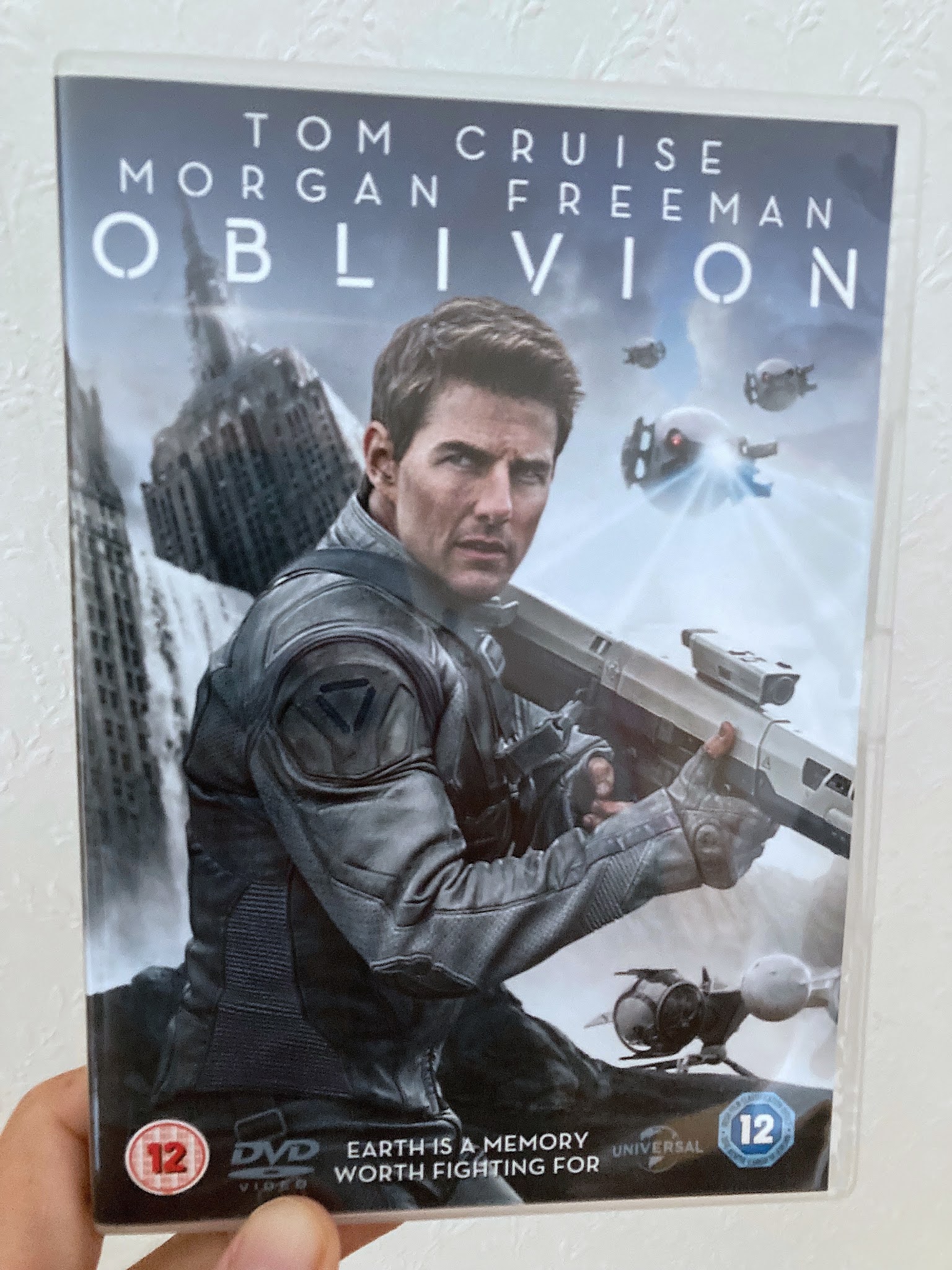
Oblivion (2013)

Derivative, shallow sci-fi starring Tom Cruise. I probably wouldn’t have bought this DVD, but I watched it because I found it being given away on a wall. 

The plot is rather confused, but Google usefully summarises it as follows: “Jack Harper, a drone repairman stationed on Earth that has been ravaged by war with extraterrestrials, questions his identity after rescuing the woman who keeps appearing in his dreams.”

That woman is Olga Kurylenko, who, like Cruise, hardly gets any dialogue at all. Another barely filled-in, completely thrown-away character is played by Morgan Freeman, who struggles to convey the grizzled leader of a band of human survivors. 

There are so many things wrong with Oblivion:

• As usual, Tom Cruise is a good-at-everything action-hero dullard who manages to save the world single-handedly. It’s Top Gun all over again. 

• In the absence of dialogue – or any kind of personality – Tom spends much of the film staring moodily yet conveying little emotion.

• Almost every element is borrowed from another sci-fi film. 

• We visit the remains of what used to be New York, but it’s nothing but lush, clean and green vistas. Where’s all the rubble and filth? Could it be transformed that thoroughly in just 60 years?

• There are plot holes aplenty. Best not to ask many questions. 

• Attempts to be “philosophical” end up hollow and self-conscious. 

• When we finally meet the alien presence, it’s a huge let-down. 

• The title has absolutely nothing to do with anything in the film. It's like they wanted a high-impact, single-word title, but all of the relevant words had already been taken.

Passchendaele (2008)

Gruelling depiction of two battles in 1917. Paul Gross wrote, produced and directed, as well as starring as Canadian soldier Michael Dunne. 

The middle section details a love story involving Dunne and a nurse called Sarah (Caroline Dhavernas). Their relationship is complicated by her troubled brother David (Joe Dinicol), who Dunne vows to protect. The narrative wrestles with notions of responsibility and duty set against the redemptive possibilities offered by love. 

It’s moving and harrowing. The film faithfully depicts the gruesome mud bath/bloodbath that saw 5,000 soldiers killed in 16 days, and the battle scenes look all too real. Only one thing doesn’t quite convince: you can see sunny skies in the background, even though it’s permanently raining. I wondered if that was an aesthetic choice, but the “making-of” feature on the DVD confirms that it was filmed in Canada and that the “rain” was just water being sprayed over the set.

It’s Complicated (2009)

Rom-com with little rom and and even less com. It’s not even very complicated.

Divorcee Jane (Meryl Streep) begins an “affair” with her own ex-husband (Alec Baldwin). But she’s also drawn to the architect she hired to make her huge home even bigger (Steve Martin). 

The film is directed by Nancy Meyers, who was responsible for Something’s Gotta Give, and very much follows the formula of that earlier film. But whereas that was just about salvaged by the talents of Jack Nicholson and Diane Keaton, this film has to survive on the abilities of Streep alone. Baldwin is oddly repulsive (it’s not clear how much of that is intentional), while Martin seems bland and underwritten. 

These smug, wealthy people are difficult to like. That’s not helped by the shallow way the film addresses a potentially interesting web of relationships. But it’s not a story about how people actually are. Instead, it seems to be an aspirational exercise about how you too can be wealthy, have a huge home, have lots of friends, be loved by everyone and have a top-quality job that’s both well-paid and endlessly rewarding. 

There’s a bottom line of watchability with Streep, but that’s not enough this time.

The Fifth Element (1997)

I hated this film. I don’t think it’s rubbish, necessarily (I’m sure it turned out the way director Luc Besson intended), but I hated it. It’s irritating on so many levels: the aesthetic is ugly, the characters are completely uninteresting and even the sci-fi elements lack the all-important “wow” factor. Bruce Willis runs around in a vest, shooting a lot and looking like he’d rather be in a different sort of film. Gary Oldman hams it up as a daft villain. And Milla Jovovich plays a sort of super-human “perfect” woman with orange hair. 

It has some of the pantomime silliness of Flash Gordon, but absolutely none of the charm. And it steals from Blade Runner (there’s Vangelis-like music at one point, and Jovovich seems modelled on Daryl Hannah’s Pris at others), but it has none of that film’s vision or innovation. It’s played for comedy, but it’s never funny. It falls flat. The crass talk-show host Ruby Rhod (Chris Tucker) is just embarrassing – possibly the most annoying film character I’ve ever encountered. 

Absolutely nothing about this film appeals.

Spellbound (1945)

Alfred Hitchcock thriller that unfortunately doesn’t rank up there with his best work. 

The new head of Green Manors, a Vermont-based mental asylum (Gregory Peck) turns out to be an imposter and possibly a dangerous killer. But psychoanalyst Dr. Constance Petersen (Ingrid Bergman) falls in love with him and wants to unpick the mysteries of his past to clear his name.

It’s stylish and visually intriguing, like all of Hitchcock’s work. There’s plenty of tension and excitement, too, but the plot suffers because it hinges – somewhat ridiculously – on the interpretation of a dream. The dream itself was devised by Salvador Dalí and is full of that artist’s familiar imagery. 

Peck seems a little wooden, but Bergman is terrific.

Sleepers (1996)

Four friends growing up in New York in the 1960s end up in a youth detention centre, where they are brutalised by the staff. We then meet them again, 13 years later, in 1981, and find out how those harrowing experiences have defined every aspect of their adult lives. 

The first half is compelling. Director Barry Levinson brilliantly sets the scene and evokes both time and place perfectly. But in the second half, the film seems to lose its way. A lengthy courtroom segment takes the focus away from the themes of friendship and community that initially made the film so watchable. And something about that plot – the convoluted account of a faked legal hearing – just doesn’t ring true. 

The cast is excellent, with memorable performances by Robert De Niro (reliably brilliant as a priest who befriends the boys), Minnie Driver (who falls in love with three of them), Dustin Hoffman (an alcoholic lawyer) and Kevin Bacon (one of the abusive staff at the Wilkinson Home for Boys). Brad Pitt is less convincing as the grown-up version of Michael Sullivan. 

There’s overbearing music by John Williams

The film is often disturbing, as you’d imagine from the subject matter – and all the more so because the 1995 novel it’s drawn from (by Lorenzo Carcaterra) is semi-autobiographical. It makes some profound points about how cruelty shapes and damages us, but somehow it still misses the mark.

Fair Game (2010)

Superb thriller. Adapted from the memoirs of the two protagonists, it tells the story of CIA operative Valerie Plane and her diplomat husband Joseph C. Wilson. The pair were responsible for exposing the US government’s fabrication of the evidence about Weapons of Mass Destruction that was used to justify the invasion of Iraq. 

Naomi Watts and Sean Penn deliver remarkably convincing performances in the lead roles. There’s the political saga, but also the story of their marriage and family, and the strain that these events put on them. 

I admire the realism of it, such as the way that every scene featuring the couple’s children had them constantly asking questions and demanding attention. I also respect the film for delving into the moral ambiguities of the topic – should you tell the truth even if it puts loved ones at risk? – and not providing any simplistic answers.

Heat (1995)

Cop tries to catch criminal gang causing havoc in Los Angeles. Al Pacino is the cop. Robert De Niro leads the gang. 

Heat is a complex film that introduces multiple threads. At its worst it’s in danger of becoming an episode of Miami Vice or even The A-Team. At its best, it’s like a cut-price Scorsese imitation, albeit without the elegance and sophistication. The script is reasonable enough, but there are casting problems. Val Kilmer is jarringly woeful as one of the gang members. Furthermore, the gang guys have no chemistry whatsoever. Even De Niro seems to be struggling a little with the material. Plus, some of the music is intrusive. And the threads about the stand-in getaway driver and Natalie Portman as a troubled teen could both have been removed in the interests of tightening up the narrative.

On the plus side – and it's a big plus – Pacino rises to the challenge of his role and is every bit as cool as usual. The scenes featuring him and his wife (Diane Venora) are convincing, and there’s a depth to him that the other characters lack.

The Place Beyond the Pines (2012)

Remarkable drama that seems to consist of several films elegantly woven into one. It begins with a story about motorcycle stunt rider (excellently portrayed by Ryan Gosling), whose discovery that he has a son with his ex-girlfriend (a passable Eva Mendes) leads him into a spate of bank robberies. That, in turn, introduces a story about the cop (superb-as-ever Bradley Cooper) who tries to apprehend him. The consequences of their brief meeting ripple out across the years and affect the lives of several others. 

I love the way the film keeps surprising you with its various sideways turns. It’s also encouraging that rather than simply glorifying guns, there's an intelligent exploration of the ethics around them.

Bradley Cooper perfectly conveys a good man who makes mistakes that will always trouble him.

This is a multi-part tale that never sacrifices clarity to realise its ambition.

Ad Astra (2019)

Brad Pitt stars in an existential sci-fi mind-bender. He’s an astronaut who leaves Earth in search of his father (Tommy Lee Jones), who is fixated on seeking intelligent life elsewhere in the universe. But that search has deadly repercussions for Earth and needs to be stopped.

The film asks intelligent questions about what’s important in life. It looks remarkably “realistic”, and there are moments of great beauty – especially around Jupiter. Pitt has never particularly impressed me with his acting, but he’s excellent here. He conveys the desperately lonely experience of being on your own in the vastness of space. 

Liv Tyler and Donald Sutherland play supporting roles.

Dirty Harry (1971)

Crime thriller directed by Don Segal. Clint Eastwood is at his best as the monosyllabic San Francisco cop who takes the law into his own hands to defeat a crazed murderer. 

The locations are perfectly chosen. Eastwood is effortlessly cool. The soundtrack by Lalo Schifrin is entirely suitable for the action but also works in its own right. The night scenes are atmospheric and suspenseful. And the psychopath Scorpio played by Andy Robinson is convincingly mad. 

Four sequels would follow.

The Hours (2002)

The lives of three women from different eras form intriguing parallels. In Richmond in the 1920s, we see Virginia Woolf (Nicole Kidman) writing Mrs Dalloway and dealing with suicidal thoughts. In 1950s California, Laura Brown (Julianne Moore) reads Mrs Dalloway and faces her own fears and insecurities. And in New York in 2001, Clarissa Vaughan (Meryl Streep) wrestles with her feelings for an old flame who is dying of AIDS. 

Kidman, Moore and Streep are all fantastic in emotionally complex and challenging roles. Kidman looks absolutely nothing like herself – it’s difficult to believe it’s her – owing to a prosthetic nose. 

There are also strong performances from Miranda Richardson, Jeff Daniels and Ed Harris. 

In many ways it’s a depressing film, and it deals with painful topics. But it also addresses the value of life. 

Intense, sweeping, music by Philip Glass adds emotional depth.

Sea of Love (1989)

Brilliant, noirish thriller. Al Pacino is a New York cop investigating a series of murders. But unfortunately he’s falling in love with the main suspect. 

Pacino is effortlessly and endlessly charming in the main role. Ellen Barkin plays his girlfriend and handles the nuances well. Is she or isn’t she the killer? Even John Goodman, usually guaranteed to ruin a film, judges it about right as Detective Sherman Touhey.

A couple of plot holes keep it from being perfect. There’s something not quite tied up about the “Sea of Love” single that the killer plays – and Ellen Barkin’s relationship with the song. Also, the attempt on Pacino’s life comes too late in relation to the killer’s attacks on previous victims. Why does the killer wait so long to strike?

Those points aside, it’s hugely enjoyable.

Raging Bull (1980)

Martin Scorsese directs Robert De Niro again. This time, De Niro plays real-life boxer Jake LaMotta in an adaptation of the latter’s 1970 memoir. It works as a biopic, tracing his career and personal life from the early 1940s to the mid-1960s. 

It’s beautifully shot in black and white. 

Joe Pesci is superb as LaMotta’s brother and trainer. Brilliantly, we never find out whether he’s having an affair with the boxer’s wife (Cathy Moriarty) or whether this is merely LaMotta’s jealousy and paranoia.

It’s brutally violent and every one of those punches looks like it really hurts. It’s excellently shot, in that sense. Being totally “method” about it, De Niro famously gained weight to depict LaMotta in his later years.

Eternal Sunshine of the Spotless Mind (2004)

A man and woman undergo special treatment to have their painful memories of each other erased so that they can forget the suffering they endured when their relationship broke down. But, mid-procedure, the man realises he’s making a mistake and tries to hang on to what remains of his precious recollections of the person he still loves. 

Jim Carrey and Kate Winslet are endearing in the lead roles, and their opposites-attract romance is offbeat and believable. What spoils the film is that the visual representation of memory – much of the story takes place in Jim Carrey’s mind – seems gimmicky and over-stylised. I appreciate that they were looking for a cinematic style that could resemble the way memories appear to us, but the fast-cut visuals are so full-on and relentless that they get in the way of the story. It could have been a far stronger film if the narrative and the editing allowed for some slower scenes that gave us the space to get to know the couple better. Indeed, the rare moments when they are simply talking or enjoying being together make up the best parts of the story. 

Oddly enough, a sub-plot about the boss of the company offering memory removal (Tom Wilkinson) and a woman who works for him (Kirsten Dunst) is better handled because it unfolds at a more natural pace. 

It’s so nearly brilliant, but the execution gets in the way. It’s a shame because the idea is a great one, and it enables the film to consider all sorts of ethical and even spiritual issues about identity and how much our pasts define who we are.

An Officer and a Gentleman (1982)

Zack Mayo (Richard Gere) is training to be a naval officer. Debra Winger plays his girlfriend Paula. They both take their clothes off a fair bit, but – beyond a detailed look at the training itself – there’s not a great deal more going on until the drama suddenly ramps up for the closing minutes. 

Winger is one of the strongest actresses of this era, but she isn’t really given enough to get her teeth into. Likewise Gere, who is perfectly acceptable. More impressive than either of them is Louis Gossett Jr. as the drill instructor who teaches Zack discipline. 

It’s entertaining and the final third certainly pulls you in as the sub-plots about the secondary couple (Sid and Lynette) are developed. It would have been stronger if Zack’s father had either been made more of or ditched entirely. And a few laughs would have helped. 

The soundtrack is a little intrusive at times. One of the love scenes has what sounds like lift music playing all the way through it. At the end we get the big hit song, “Up Where We Belong” by Joe Cocker and Jennifer Warnes.

Taxi Driver (1976)

A masterpiece. Robert De Niro is utterly transfixing as Travis Bickle, a New York cabbie who becomes obsessed with cleaning up the city – whatever the cost. 

Cybil Shepherd and Jodie Foster are excellent as Betsy (the campaign volunteer for a presidential candidate) and Iris (a child prostitute), while Harvey Keitel is suitably creepy as Iris’s long-haired pimp. 

It’s beautifully filmed: you could freeze almost any frame and make a poster of it. And Martin Scorsese’s subtle handling of tension was never better judged. 

The original score by Bernard Herrmann makes a compelling, noirish film even more so. 

You can interpret it as a film about PTSD or a story about isolation and loneliness. 

Disturbingly, this classic was an influence on John Hinckley Jr., who in 1981 attempted to assassinate Ronald Reagan in order to impress Jodie Foster.

Terms of Endearment (1983)

Melodrama with moments of comedy. 

Shirley MacLaine and Debra Winger play a mother and daughter who share an intense connection. We follow the evolution of that relationship, along with their couplings with Jack Nicholson and Jeff Daniels respectively. Then the plot takes a sideways turn and everything becomes a lot more serious. 

What makes this an absolute gem is the quality of the acting. All four leads are remarkable, but MacLaine and Winger are quite extraordinary. They convey such a strong sense of personality for their complex, fully rounded characters that it’s difficult to imagine they aren’t real people.

Mean Streets (1973)

Brilliant drama by Martin Scorsese. Harvey Keitel plays Charlie Cappa, a small-time criminal in New York who gets into trouble because his friend Johnny Boy (Robert De Niro) owes money and is something of a loose cannon. 

De Niro is fantastic: genuinely unpredictable and hugely watchable. Keitel is sympathetic: you can relate to him because he seems to want to do the right thing, but he’s out of his depth. His epileptic girlfriend Teresa (Amy Robinson) is also likeable and convincing. 

While it’s a lower-budget, earlier film than most of the classics in his catalogue, Scorsese’s usual tricks and tics are all in place: the wall-to-wall use of music (including Phil Spector hits and the Rolling Stones), the distinctive dialogue and framing of shots, and the expert ramping up of dramatic tension.