Showing posts sorted by relevance for query California. Sort by date Show all posts

Erin Brockovich (2000)

Superb biographical whistleblower thriller/human drama starring Julia Roberts as the young legal clerk who took on Pacific Gas and Electric Company (PG&E) and sued them for water contamination in Hinkley, California. 

Roberts is remarkable in this role – she makes every moment of every scene count. It’s such a vivid and entirely believable performance that it's difficult to imagine anyone else doing it better. Albert Finney is excellent, too. He plays her boss, a lawyer nearing retirement, whose cynicism is challenged by Erin’s refreshingly unorthodox approach. 

Directed by Steven Soderbergh, it looks good too. He really captures the beauty of the dusty California landscapes that contain an ugly secret. It’s a long film, but every detail matters and contributes something to the unfolding drama. Character and story are kept central throughout.

Lady Bird (2017)

Greta Gerwig’s sweet and compassionate drama about a teenage girl’s coming of age in Sacramento, California. 

Saoirse Ronan plays Christine, a.k.a. Lady Bird, who has a complicated relationship with her mother (Laurie Metcalf) and indeed with herself. It’s beautifully observed, with moments of comedy and pathos. I was reminded of Woody Allen at his best. 

Beanie Feldstein is especially likeable as Lady Bird’s best friend Julie. 

The mother/daughter topic somehow recalls the Susan Sarandon/Natalie Portman pair-up in Anywhere but Here (1999), although this is a more nuanced and subtle treatment of that subject matter.

Easy A (2010)

Emma Stone stars in a witty, postmodern teen comedy that references the John Hughes films of the 1980s, Nathaniel Hawthorne’s novel The Scarlet Letter from 1850 and the Demi Moore film adaptation of that book from 1995. 

Olive is a smart, fast-talking 17-year-old student in California who makes up a story about sleeping with a boy. It becomes a rumour that spreads around the school, and this in turn transforms her reputation and leads to a sequence of escalating fictions that threaten the wellbeing of Olive and many others.

It’s extremely clever. Some of the lines are so fast that you miss them. You almost need the script in front of you. Stone is magnetic and vibrant. Stanley Tucci and Patricia Clarkson are funny as Olive’s warm, ultra-liberal parents. Lisa Kudrow has an awkward energy as the school guidance counsellor who only makes Olive’s problems worse. 

On the down side, there are some plot issues. Olive appears to have a happy, stable family life with understanding parents, so nothing explains why she would go to such lengths to derail her entire existence. Also, it’s unclear why the rumour becomes such a major scandal anyway. In a mixed school, with teens of that age, in that part of the USA, was it really such a big deal that someone lost their virginity?

Also, there’s very little in the way of emotion. That’s surely intentional, but it does mean the film makes less of an impact than it might.

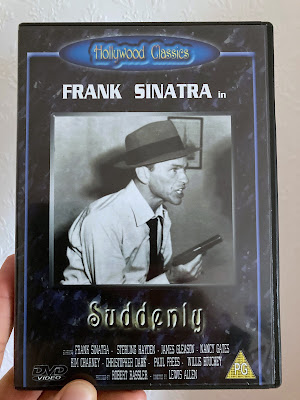
Suddenly (1954)

Rather unexceptional drama about a fake FBI agent (played by Frank Sinatra) who attempts to kill the US President. He and his henchmen take over the Benson family’s house in the town of Suddenly, California, in order to aim their gun at the railway station where the President is shortly due to arrive. 

Although there’s some excitement in the ticking-clock countdown to the planned assassination at 5pm, the performances are mainly wooden and/or half-baked. Sinatra has a definite magnetism and out-performs everyone else, but there’s a B-movie feel that it cannot rise above. 

It’s mostly interesting for its attitudes. Ellen (Nancy Gates) wants to prevent her son playing with a toy gun, but her boyfriend, the sheriff (Sterling Hayden) tells her “Stop being a woman!” Shocking stuff. The “moral” seems to be that guns are great – unless a psychopath happens to get hold of one – and that masculinity is incomplete without them. 

The most remarkable aspect of the film is explained by Wikipedia: “Sinatra asked United Artists to withdraw Suddenly from circulation because he heard the rumor that Lee Harvey Oswald had seen it before shooting President Kennedy. According to Hollywood legend, Sinatra bought up all remaining copies of Suddenly and had them destroyed, but this was not true.”

How Green Was My Valley (1941)


Slightly childish melodrama set in a Welsh mining village circa 1900. A local man, played by Roddy McDowall as a child, recalls his childhood growing up in a strict family united by their strong faith and work ethic. There’s life, death, forbidden romance, singing and (inevitably) mine-based tragedy.

While all of the dramatic elements in themselves are engrossing, there’s something extremely stilted about the way the film is made. There’s almost an am-dram quality to it. Not only can you see where the set ends and the painted backdrop begins, but there’s also a slowness and an unreal quality to most of the scenes. It clearly wasn’t filmed in Wales, either. The California sun beats down on the cast, and some of the accents are utterly absurd – often sounding Indian, Irish or even Dutch.

While it’s not exactly a great film, or even a good one, Maureen O’Hara is loveable as Angharad Morgan and Walter Pidgeon is impressive as the tormented priest in love with her. This romance is a thread running through the film and is far more interesting than the narrator’s digressions into authoritarian family life and awkward schooling.

Unresolved threads:
• Huw being in love with Bronwyn. Did he ever tell her or do anything about it?
• Huw being inexplicably unable to walk after falling in some cold water, then miraculously being able to walk again. How?
• Huw being bullied at school and learning to fight. Did his colleagues accept him?
• The school teacher being beaten up. What happened next? Were there really no repercussions?
• The invitation for the choir to sing before the queen? Did they ever do it?
• Two of the brothers going off to America. Were they ever heard from again?
• Two other brothers leaving home. Were they ever heard from again?
• Nasty deacon. Did he get his comeuppance?
• Angharad’s unexplained divorce. What happened?
...and most of all...
• Angharad and the priest. Did they get together or not?!

Café Society (2016)

Engaging comedy-drama written and directed by Woody Allen. 

It’s the 1930s. Bobby Dorfman (Jesse Eisenberg) goes to Hollywood and gets a job working for his Uncle Phil (Steve Carell). He falls in love with Phil’s secretary Veronica/Vonnie (Kristen Stewart), not realising that she’s already dating someone else – a married man Bobby knows all too well…

The various plot threads play out in a satisfying manner. The film is a slow-burning romance that sensitively explores the “what ifs” of love. 

It’s a fairly low-key film. There are some funny moments, often relating to Bobby’s gangster brother Ben (Corey Stoll). It’s good at showing the contrast between the cultures of California and New York. As always, Woody Allen does an expert job with the nuts and bolts of storytelling, pacing, characterisation and dialogue. 

Kristen Stewart is absolutely spot on as the much-in-demand and conflicted Vonnie.

Anywhere but Here (1999)

Impulsive, restless Adele August (Susan Sarandon) drags her teenage daughter Ann (Natalie Portman) from Bay City, Wisconsin, to Beverly Hills, California, to begin a new life. It soon becomes clear that Ann is the more sensible of the pair, and her resentment builds as she considers the friends and family she’s been forced to leave behind. 

The film begins with a road trip and I would have liked more of that, but ultimately it’s not about their travels. The focus is primarily on the mother-daughter relationship and how that develops under increasingly strained circumstances. There are a few laughs, too, which emerge from a strong, character-driven script. 

Sarandon sparkles as the maddening but hugely appealing Adele. Portman gives a performance that unlike other films (Star Wars prequels, Garden State), suggests she’s a pretty solid actor who hasn’t always chosen the right roles. 

The conclusion is satisfying and emotional without being mawkish.

Sideways (2004)

Comedy drama that’s rather lacking on the comedy front. 

Miles (Paul Giamatti) and Jack (Thomas Haden Church) are friends who go on a wine-tasting trip around California. Miles is divorced and Jack is about to marry. Then they meet Maya (Virginia Madsen) and Stephanie (Sandra Oh), and things become much more complicated.

It reminded me a little of a Woody Allen film, not least because of the light jazz soundtrack, but it’s not as well plotted or well-written and there’s definitely something missing. Plus, the music is annoyingly intrusive throughout. I found it difficult to believe that the two friends were actually friends, so little chemistry did they display. 

Things improve a little when they begin their new relationships, but it’s difficult to warm to characters who have been deliberately shown in such an unappealing light. And it just needed more laughs.

The Hours (2002)

The lives of three women from different eras form intriguing parallels. In Richmond in the 1920s, we see Virginia Woolf (Nicole Kidman) writing Mrs Dalloway and dealing with suicidal thoughts. In 1950s California, Laura Brown (Julianne Moore) reads Mrs Dalloway and faces her own fears and insecurities. And in New York in 2001, Clarissa Vaughan (Meryl Streep) wrestles with her feelings for an old flame who is dying of AIDS. 

Kidman, Moore and Streep are all fantastic in emotionally complex and challenging roles. Kidman looks absolutely nothing like herself – it’s difficult to believe it’s her – owing to a prosthetic nose. 

There are also strong performances from Miranda Richardson, Jeff Daniels and Ed Harris. 

In many ways it’s a depressing film, and it deals with painful topics. But it also addresses the value of life. 

Intense, sweeping, music by Philip Glass adds emotional depth.

The Birds (1963)

Following Rebecca (1940), this was another Daphne du Maurier adaptation by Alfred Hitchcock. It’s a sort of horror story, set in Bodega Bay, California, where birds begin to attack humans for no apparent reason. 

It’s to Hitchcock’s credit that he never explains away the cause of these bizarre events. You can interpret them any number of ways. Is it a Cold War allegory? Is it about repressed sexuality? Or is it simply a horror story? 

It’s strange in other ways, too. The relationship between Melanie (Tippi Hedren) and Mitch (Rod Taylor) doesn’t follow the usual love-story progression. And the age difference between Mitch and his younger sister is also striking. The widowed mother Lydia (Jessica Tandy) is also deeply odd. Initially, I thought the natural disturbance was a reflection of her grief manifested in nature – and it's possible that this is another of the many intended interpretations. 

The ending satisfies because it’s ambiguous and doesn’t offer any easy solutions.

Play Misty for Me (1971)

Psychological thriller with the emphasis on the “psycho”. A radio DJ in Carmel-by-the-Sea, California, is stalked by an obsessive fan, endangering his career, his relationships and ultimately his life. 

It’s absolutely terrifying. Clint Eastwood is superb as the DJ who doesn’t grasp the gravity of the situation quickly enough. Donna Mills plays his girlfriend Tobie (“the foxiest chick on the peninsula”). And Jessica Walter plays the stalker Evelyn, who is convincingly mad throughout. 

The scenery is terrific. The music played on the radio – popular jazz of the time – is wonderful. “Misty” itself is a song by Erroll Garner that features prominently.  The film also includes “The First Time Ever I Saw Your Face” by Roberta Flack, plus actual in-concert scenes shot at the Monterey Jazz Festival.

Milk (2008)

Biopic of Harvey Milk, who campaigned for gay rights in California until his assassination in 1978. 

Sean Penn is superb in the main role, with a fascinating twitchy energy and a set of mannerisms that make him incredibly watchable. Josh Brolin is excellent as Dan White, a San Francisco city supervisor and political rival. 

The assassination is referenced right at the start, so you know what’s going to happen. As such it’s painful to watch the film proceed to its inevitable conclusion.

The Graduate (1967)

Classic romantic comedy-drama directed by Mike Nichols and adapted from the 1963 novel by Charles Webb. It was the most successful film of 1967.

Dustin Hoffman stars as the graduate of the title. He returns to his family’s California home after completing his college degree but is uncomfortable with his parents’ expectations for him. He’s bored, too, and begins an affair with one of their friends (Anne Bancroft). This becomes more complicated when he then starts to fall for her daughter (Katharine Ross).

It’s an intelligent script that satirises the wealthy middle-class lifestyles of the time and makes the most of the social awkwardness Hoffman delivers so well.

The music, by Simon & Garfunkel, is extremely pretty and somehow suits the narrative perfectly, even though only ‘Mrs. Robinson’ was specifically written for the film.

I always liked the closing seconds, which are downbeat and not at all what you might have expected.