Showing posts sorted by relevance for query president. Sort by date Show all posts

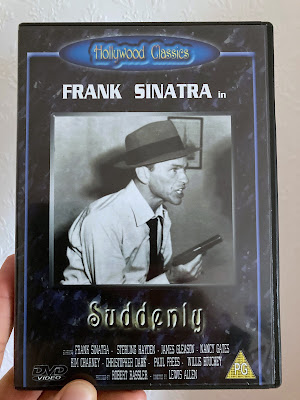
Suddenly (1954)

Rather unexceptional drama about a fake FBI agent (played by Frank Sinatra) who attempts to kill the US President. He and his henchmen take over the Benson family’s house in the town of Suddenly, California, in order to aim their gun at the railway station where the President is shortly due to arrive. 

Although there’s some excitement in the ticking-clock countdown to the planned assassination at 5pm, the performances are mainly wooden and/or half-baked. Sinatra has a definite magnetism and out-performs everyone else, but there’s a B-movie feel that it cannot rise above. 

It’s mostly interesting for its attitudes. Ellen (Nancy Gates) wants to prevent her son playing with a toy gun, but her boyfriend, the sheriff (Sterling Hayden) tells her “Stop being a woman!” Shocking stuff. The “moral” seems to be that guns are great – unless a psychopath happens to get hold of one – and that masculinity is incomplete without them. 

The most remarkable aspect of the film is explained by Wikipedia: “Sinatra asked United Artists to withdraw Suddenly from circulation because he heard the rumor that Lee Harvey Oswald had seen it before shooting President Kennedy. According to Hollywood legend, Sinatra bought up all remaining copies of Suddenly and had them destroyed, but this was not true.”

Absolute Power (1997)

Above-average political thriller. 

While robbing a billionaire’s mansion, a skilled burglar named Luther Whitney (Clint Eastwood) witnesses a crime involving the US President (Gene Hackman) and his secret service operatives. Because of the President’s careless actions in an affair with the billionaire’s wife, his mistress ends up getting shot. Detective Seth Frank (Ed Harris) begins to investigate the death, for which Whitney now finds himself the main suspect. 

All three male leads are charismatic and appealing. The secret service team are less impressive, although there’s a funny and clever scene in which the President dances with his Chief of Staff (Judy Davis). It’s moments like this – and a scene in which Ed Harris shows his attraction to the burglar’s estranged daughter Kate (Laura Linney) – that exhibit the warmth and intelligence that make the film so enjoyable. There’s also fun to be had in Whitney’s skill as a master of disguises, and there’s a fairly touching thread in which – despite everything – Luther and Kate begin to re-connect.

Air Force One (1997)


Edge-of-the-seat thriller in which Harrison Ford plays the US president. His plane is hijacked by a Russian baddie (Gary Oldman). Ford appears to make a break for safety in an escape pod. But of course he chooses to stay on board to save his family, his crew and democracy itself.

Meanwhile the vice president (a reasonably convincing Glenn Close) leads the operation from the White House and there are some interesting discussions of protocol, i.e., are the president’s instructions legally binding if he is incapacitated? What if you don’t know whether he’s incapacitated?

The film maintains the tension expertly and Ford is as watchable as ever. There are only two corny lines (“Get off my plane” being one of them) and it’s to the film’s credit that the villain is well developed as a character.

There’s lots of shooting, and the violence seems real and painful rather than cartoonish. You know the good guys will win, of course, but it’s exciting to find out how they go about it.

The American President (1995)

Directed by Rob Reiner, this is a charming film about the US President (Michael Douglas) attempting to balance the challenges of his job and his personal life. Annette Bening plays an environmental lobbyist who he falls in love with. Martin Sheen and Michael J. Fox play members of the presidential staff. And Richard Dreyfuss is the political opponent who tries to build a scandal around the new couple and their unexpected relationship. 

It works as drama and romance, with flashes of comedy. It’s also gently political and makes you wish that politics was that simple and idealistic today. 

All of the leads are on top form, and Douglas demonstrates once again that he's more versatile than people might think.

Geostorm (2017)

Disaster film. 

The world has been saved from environmental disaster by a hi-tech space station (the actual science isn’t explained), but when it malfunctions extreme weather takes a deadly hit on Earth. It turns out that the tech has been sabotaged – with suspicion going all the way up to the US President – and it takes the station’s creator Jake (Gerard Butler) to save the world from total climate meltdown. 

The film is utterly ludicrous but quite entertaining if you don’t ask any questions. Jim Sturgess is laughable as Jake’s sweaty, anxious brother Max, who has family “issues” (and looks a bit like Chris de Burgh). Abbie Cornish plays his tough, secret-service girlfriend. Alexandra Maria Lara is the sensitive and appealing space station commander who becomes Jake’s love interest. Ed Harris is the U.S. Secretary of State serving the president, who is played by Andy Garcia. 

The script is wooden and the plotting is entirely predictable. But the CGI scenes of extreme weather are exciting and the action rattles along so quickly that you don’t have time to assess whether any of it makes sense.

In the Line of Fire (1993)

Thriller starring Clint Eastwood as a Secret Service agent who tries to protect the US president from a crazed assassin (John Malkovich). He has a troubling history in that early in his career he failed to save John F. Kennedy when he was shot in 1963. Clint is assisted by his timid partner (Dylan McDermott) and by a female agent he’s initially disrespectful to (Rene Russo). 

It’s a superb and gripping drama. Eastwood delivers all of the usual tough-guy moments, but there’s a welcome sense of (self-deprecating) humour that gives this an edge. It also plays around with the notion of him being too old for this sort of work – rather than shying away from it – and extracts material from that. For example, we see him getting out of breath when he runs alongside the president’s car and that becomes a plot thread. 

Malkovich, who I really can’t stand, is his usual deeply creepy self, but it works this time because he’s playing a psychopath. Russo is excellent: her understated charm works well alongside that of the film’s star.  

Plus, it has the funniest last line of any film I’ve ever watched.

All the President’s Men (1976)

Adapted from the 1974 non-fiction book by Carl Bernstein and Bob Woodward, this tells the story of how two Washington Post journalists broke news of the Watergate scandal that ultimately brought down US president Richard Nixon. 

Dustin Hoffman and Robert Redford are both at their very best playing the journalists. It’s a fascinating glimpse into another era. In this pre-internet world, they spend most of their time talking to people, phoning people, typing, scrawling in notebooks, chain-smoking and drinking coffee. In our current period of misinformation politics and double-think social media, the 1970s seem relatively straightforward and innocent. 

You wonder if this film could even have been made now: there are no tech giants, no billionaires dictating how people communicate, no car chases, no shootings and no “love interest” – just two writers trying to uncover the truth.

Dr. Strangelove or: How I Learned to Stop Worrying and Love the Bomb (1964)

Cold War black comedy.

Apparently losing his mind, a US Air Force general (Sterling Hayden) orders a nuclear attack on the Soviets. This, we learn, will trigger a “doomsday machine” response so vast that will render Earth uninhabitable. With the clock ticking to call off the strike, we follow the story in three related threads – the struggle to retract the order from within the air base where the general is stationed, the progress of the B-52 plane that’s on the way to drop its bombs, and the discussions in the war room where the US president considers the options. 

Stanley Kubrick directs, and there’s a beauty to some of the black and white shots. Unfortunately, the film is constructed around Peter Sellers, who – for no apparent reason – plays three different roles. If you don’t find him hilarious (I don’t), you’re in trouble. Some of the satire hits the spot (a British RAF exchange officer not being able to call the president and avoid Armageddon because he doesn’t have sufficient spare change in his pocket), but a lot of it falls flat. It taps into a potentially rich seam of material regarding the futility of war and mutually assured destruction, but it’s too uneven and simply not funny enough to make those points in a satisfactory manner.

The Sentinel (2006)

Michael Douglas stars as Pete Garrison, a secret service agent who is both protecting the US president and having an affair with the First Lady (Kim Basinger). But when an assassination plot emerges, Garrison ends up being the chief suspect – investigated and pursued by his colleagues Kiefer Sutherland and Eva Longoria. 

It’s a fairly exciting thriller with a few surprises. On a technical note it was odd that certain outside scenes were heavily filtered in the way that the bulk of the film wasn’t. In terms of the plot, it was difficult to believe that someone as old as Michael Douglas could still be doing a job so dependent on physical strength, coordination and reaction times. But then Clint Eastwood was even older in In the Line of Fire, which is a far superior treatment of similar themes. Also, the motives behind the assassination plot aren’t really explained and the characters aren’t really developed. The flawed presidential marriage isn’t explored. If the First Lady is unhappy enough to have an affair with her bodyguard, wouldn’t the president be at least aware that there were cracks in the relationship? And Keifer Sutherland’s initial dislike/distrust of Eva Longoria isn’t really referenced again after it’s first introduced.

The Ides of March (2011)

Political drama adapted from Beau Willimon’s play Farragut North. It’s directed by George Clooney, who plays a liberal-minded governor running for president. Stephen Meyers (Ryan Gosling) is his junior campaign manager, reporting to the skilled but cynical Paul Zara (Philip Seymour Hoffman). And Evan Rachel Wood is the young intern whose affair with the governor threatens to bring down the entire campaign. 

It’s a fascinating insight into the politics behind the politics. Because it’s from a play, it’s strong on dialogue and character. There’s an escalating tension that’s brilliantly handled by everyone involved. There’s a theme about idealism being eroded by the cynical realities of the political system, and Gosling is superb as a representation of that conflict. Also at their best are Paul Giamatti as a rival campaign manager, Marisa Tomei as a reporter for the New York Times and Jeffrey Wright as the Democratic Senator from North Carolina.

Escape from New York (1981)

It’s 1997 and Manhattan has been turned into a maximum-security prison because crime has risen by 400%. A convict named Snake Plissken (Kurt Russell) is recruited by Lee Van Cleef to rescue the US President (Donald Pleasence), who is trapped there by a gangland boss (Isaac Hayes). 

It’s an exciting romp, blending action-thriller and sci- fi. The “futuristic” sets are generally impressive and the pace never lets up. Script-wise it’s fairly underwhelming, but then you probably wouldn’t watch it for the dialogue. 

Ernest Borgnine plays an irritating cabbie, while Harry Dean Stanton plays an engineer nicknamed "Brain".

Director John Carpenter provides the music himself, and it’s pretty good.

Vantage Point (2008)

A so-so political thriller that’s built around an interesting idea. We see the events leading up to (and away from) an assassination attempt on the US president at an engagement in Salamanca, Spain. The film adopts various perspectives, and we see the same action played out again and again from the "vantage point" of different characters.

Dennis Quaid, Matthew Fox, Forest Whitaker, William Hurt and Sigourney Weaver all feature, but there’s too little character development and too little dialogue for us to get much of a sense of any of them. Weaver in particular is underused, as if she only had a day available for filming and did it as a favour to the director (Pete Travis). 

I was expecting a mind-bending plot twist that never arrived, and overall it’s oddly unsatisfying.

Invictus (2009)

Directed by Clint Eastwood, this film tells the story of the Springbok rugby team in South Africa and how their profile was boosted with the support and encouragement of Nelson Mandela. They went on to win the 1995 Rugby World Cup, boosting notions of racial harmony in the process. 

Matt Damon plays the team captain and Morgan Freeman plays Mandela.

While Freeman’s impersonation of the president may be accurate, there’s something about this old man playing another old man that ends up being ponderous and extremely dull. It could be his slow speaking manner or the rather flat way the scenes are directed, but the first half feels slow and laboured. Also, Matt Damon’s character is hardly developed at all. He’s highly watchable, but he doesn’t have much to get behind in terms of the role. His girlfriend and family are even sketchier. Also, the racial stuff seems simplistically handled. 

On the plus side, things improve a lot once the actual rugby begins. The final is exciting and dynamic in a way that little else in the film is.

Election (1999)

Excellent comedy set in a high school in Omaha, Nebraska. 

Matthew Broderick plays a popular school teacher whose life unravels when he gets involved with running the election for the student body president. Reese Witherspoon plays the ambitious Tracy Flick, who is determined to win it – whoever the cost. And Chris Klein and Jessica Campbell are the siblings who run against Flick. 

It’s fresh and funny, and you can easily relate to the characters and their predicaments.

Spaceballs (1987)

Daft and sometimes very funny parody of Star Wars, written and directed by Mel Brooks. The humour is so silly that it’s difficult to resist. For example, Rick Moranis plays the Darth Vader character, but he’s so weedy that anything he does seems utterly ridiculous. There are parodies of Princess Leia (Daphne Zuniga as Princess Vespa), Han Solo (Bill Pullman as the Winnebago-driving Lone Starr), Chewbacca (John Candy as the half-man half-dog Barf) and C-3PO (Joan Rivers voicing he droid Dot Matrix). Mel Brooks himself plays the Emperor Palpatine-influenced President Skroob and the Yoda-like Yogurt. There are also references to Star Trek, Alien and Planet of the Apes. 

It’s extremely self-referential and post-modern. At one point the characters have to watch Spaceballs itself to find out what happens next. 

The "story" is largely irrelevant. You just wait for the gags – some of them so basic and obvious that they can’t fail.

The Assassination of Richard Nixon (2004)

Based on a true story, this is a gripping and desperately sad drama starring Sean Penn. He plays Samuel Bicke, a furniture salesman who is suffering at work and in his personal life and who – amid a mental breakdown – decides to kill the president. 

Penn is absolutely superb, making you feel his utter isolation and his heartbreaking descent through a series of personal tragedies. He is estranged from his wife (Naomi Watts) and children, is bullied by professional colleagues and sees his plans to set up his own business rejected. 

Nixon himself is cleverly woven into the story through the use of archive footage shown on news broadcasts. 

When Bicke finally undertakes his assassination attempt we really feel for him. It’s not that you’re rooting for him to succeed – history already tells us that he will fail – but you yearn for him to be happier and to find peace.

Vice (2018)

Punningly titled biopic of Dick Cheney, the US vice president in 2001–2009, during the period that George W. Bush was in power. 

There is a fascinating story to be told here, but director Adam McKay chooses a gimmicky, tricksy approach, breaking the fourth wall, adding text on screen and inserting surreal skits that constantly remind you you’re watching a film, rather than allowing you to become absorbed in it. There’s even a “false ending” about halfway through, with the production credits rolling up the screen. 

Cheney emerges as a complete enigma and the film cannot get inside his character enough to explain the motivations behind his various abuses of power. In reality he was an extreme figure, responsible for introducing torture, abolishing the FCC fairness doctrine (leading to the rise of biased, politicised TV news reporting), rebranding “global warming” as “climate change” to make it more palatable to the masses, and focus-grouping reactions to September 11th in order to further America’s geopolitical interests. It’s all especially relevant in the era of Donald Trump.

There’s no shortage of strong material, and the key performances by Christian Bale, Amy Adams and Steve Carell are outstanding. But Vice is hugely frustrating nonetheless.

WarGames (1983)


Genuinely exciting thriller about a teenager (Matthew Broderick) who accidentally triggers the countdown to nuclear armageddon by hacking into US military computers. It’s fascinating to watch now, given how things have changed in terms of technology.

There are some unbelievable moments – hacker left alone in a room in a high-security military installation with access to a computer – but overall the story is surprisingly timely and plausible. In 2019 we are at the mercy of automated systems. And with Donald Trump as president, this sort of crisis seems all too possible.

It’s highly entertaining, with more of a nail-biting escalation than most James Bond films. The pacing is excellent too: it never lets up.

Apart from Matthew Broderick’s distinctly odd parents, the film is well cast. Ally Sheedy is appealing as Jennifer Mack, the hero’s school-chum-turned-girlfriend, and John Wood is effective as the eccentric, damaged Dr. Stephen Falken, who invented the WOPR (War Operation Plan Response) supercomputer.

There’s a happy ending, of course, but not before the moral – the futility of mutually assured destruction – has been firmly established.

Selma (2014)

Historical drama dealing with the 1965 Selma-to-Montgomery voting rights marches led by Martin Luther King. 

David Oyelowo stars as King, Tom Wilkinson is President Lyndon B. Johnson, and Tim Roth is George Wallace. 

It’s slow to get going and I wasn’t especially engaged until the second half. I would have liked more about MLK’s family – the kids are barely seen or mentioned, and even the scenes with his wife Coretta (Carmen Ejogo) seem to lack dynamism. There's too much of King the legend and not enough about the man, who must have felt so conflicted as he surely knew he wouldn’t be around for long.

Frost/Nixon (2008)

Historical drama detailing a celebrated set of 1977 TV interviews between David Frost (Michael Sheen) and US President Richard Nixon (Frank Langella). Adapted from a play by Peter Morgan, it’s directed by Ron Howard. 

The film focuses on the relationship between the two men, who undertake a sort of psychological boxing match as Frost tries to get Nixon to acknowledge his wrong-doing and law-breaking during the events that famously became known as Watergate. 

It has character and depth, with both men emerging as more complex figures than they first appear to be. 

One major anachronism is a character using the phrase “comfort zone”, which – according to the internet, was not coined until 2009. 

The only other flaw is that Frost’s girlfriend (played by Rebecca Hall) has very little to do. But maybe that’s intended as a comment on gender roles in what was clearly still meant to be a men’s world.