The Towering Inferno (1974)


A big Hollywood blockbuster disaster film about a fire breaking out in a state-of-the-art skyscraper. Paul Newman (the architect) and Steve McQueen (the chief fireman) lead an all-star cast that includes Fred Astaire, Richard Chamberlain, Faye Dunaway, William Holden, O.J. Simpson, Robert Vaughn and Robert Wagner.

At 165 minutes it’s long indeed, but surprisingly it doesn’t feel slow or laboured. I last saw it as a child and I enjoyed it then, which wouldn’t have been the case if it was a stodgy, ponderous epic.

In places it’s trashy, and there were a few unintentionally funny moments. But there was also real drama and tension. At times it was truly horrifying – such as when Jennifer Jones falls out of the exterior lift and then bounces off the sides on the building on her way down.

The cast is strong. Paul Newman makes for a very likeable hero and manages to rise above the material he’s given. Faye Dunaway does the same, with a cool, restrained intelligence. Richard Chamberlain is just right as the edgy, selfish electrical engineer and son-in-law of the builder. You know it’s not going to end well for him and sure enough he comes to a sticky end.

Only Fred Astaire – playing a doddery old conman who unexpectedly falls in love – seems wrong for his role.  He loses the woman but inherits her cat, which O.J. Simpson has kindly rescued.

I’m not sure this film could have been made now, post-9/11 and post-Grenfell Tower. Intriguingly, it’s adapted from two novels (with both plots and climaxes woven together), but although it’s a work of fiction there’s a dedication at the beginning to all the real-life firemen who died in the course of their duties.

Flash Gordon (1980)


Highly entertaining adaptation of the comic-book hero’s exploits, wisely playing up the outlandish, cartoonish aspects of the story. The colours are super-bright, the costumes are wonderfully extravagant and everything is over-egged to the nth degree. It’s pure pantomime and it’s enormous fun. 

Sam J. Jones plays the hero as an almost blandly all-American beefcake football star. Melody Anderson is tremendous as Dale Arden, the travel agent who accompanies Flash to Mongo and falls in love with him. Topol is Dr. Hans Zarkov, the batty scientist who kidnaps the pair to investigate the extreme-weather peril Earth is enduring. Max von Sydow is perfect as evil Emperor Ming the Merciless, as is Ornella Muti as his sultry and traitorous daughter Princess Aura. Timothy Dalton (as Prince Barin) and Brian Blessed (as Prince Vultan) are the resistance leaders who join up to help Flash and his friends fight Ming’s empire. Blessed is a joy to watch – a constantly guffawing warrior “hawkman” kitted out in big wings. 

It’s made all the more thrilling and exciting by the soundtrack by Queen. The band contributed not only the famous theme tune, but also all of the incidental music as well. 

Peter Wyngarde plays the Darth Vader-like General Klytus. And Blue Peter presenter Peter Duncan has a cameo as a man who has to put his hand in a hole in a tree without being stung by a tree monster. 

Although it’s deliberately daft and cheesy, there’s an uplifting message in there about the power of humanity to display kindness and overcome the forces of evil.

A glorious celebration of silliness.

Saturday Night and Sunday Morning (1960)


Kitchen-sink drama, written as a novel and then adapted for film by Alan Sillitoe, starring Albert Finney as Arthur Seaton. A smooth-talking factory worker who is dating two women, including the wife of a work colleague, Arthur lives life to the full until events begin to catch up with him.

It’s superbly scripted, with sharp, rapid-fire dialogue bringing the characters to life. There’s plenty of wit and pathos throughout. The fairground sequence – in which Seaton fails to evade two soldiers intent on beating him up – is especially dynamic.

It’s also an amazingly vivid portrait of industrial England in the post-war years – a grey and grim world that would soon undergo modernisation.

Edge of Love (2008)


Fairly compelling drama set during World War II. When young Welsh singer Vera (Keira Knightley) meets her old friend Dylan Thomas (Matthew Rhys), their youthful attraction is rekindled. But Thomas is now married to Caitlin (Sienna Miller), and Vera is courted by a soldier (Cillian Murphy) soon to be sent back into battle.

The film wisely keeps its focus on the relationship between the two women, the real subject of the story, with the famous poet creating both a bond and a tension between them. Unlike Sylvia and Iris, it’s certainly not a writer biopic.

Knightley’s Welsh accent is surprisingly convincing, although people from Wales might not agree. Her singing is credible, too. She’s charismatic, as is Murphy as her troubled lover, psychologically damaged by the war. Sienna Miller is also impressive, communicating a huge range of emotions with subtle grace. Rhys, meanwhile, struggles somewhat to convey the magnetism that the plot needs to hinge upon. Poetry aside, exactly what was it that these two women loved so much about him?

The film is occasionally a little over-stylised and there are some unrealistic moments (a view of St. Paul’s Cathedral amid bomb wreckage just looked like a painting), but it’s never predictable and it makes you fully engage with all four of the main characters. In terms of mood and tone it flits oddly all over the place, but I rather like that.

There are cameos by Suggs of Madness and Lisa Stansfield.

Keira Knightley’s mother wrote the screenplay.

An incredible number of cigarettes are smoked.

It’s not clear why it’s called Edge of Love – a title that would work for almost any film with a romantic storyline.

Gattaca (1997)


Quietly profound thriller set in a near-future world where genetics are everything. People are graded as “valids” or “in-valids”, depending on their genetic profile. Ethan Hawke plays Vincent Freeman – a man whose “defects” (a weak heart) prevent him realising his dream to go to space. He impersonates Jerome Morrow (Jude Law), a valid who was paralysed in a self-inflicted accident. Uma Thurman plays a work colleague who falls in love with “Jerome”, not realising he is really an imposter. Gore Vidal plays their boss – the mission director with a dangerous agenda of his own.

The film asks complicated questions about the ethics of genetic engineering. It also looks at ambition, human identity, nature vs. nurture and brotherly love.

The “sci-fi” premise is nicely offset by the visuals, which are 1950s-themed. The retro-futuristic look is stylish and believable.

It builds to a surprisingly emotional ending.

The Terminator (1984)


Arnold Schwarzenegger plays a cyborg sent back in time from 2029 to 1984 to kill Sarah Connor (Linda Hamilton), who will give birth to a resistance leader of the future. Sarah is helped by Kyle Reese, another soldier from the future (Michael Biehn), in an attempt to stop the seemingly unstoppable.

James Cameron’s film is both trashy and, given the expert storytelling, strangely sophisticated. The special effects look basic by modern standards, but they are still highly effective.

Schwarzenegger is entirely convincing as the android with astonishing strength. The film is unashamedly violent and seems to fetishise guns.

It’s fascinating to see what we didn’t know about the future in 1984. When the Terminator arrives in 1984, he looks up Sarah Connor in the phone directory. So in 2029, there seems to be no equivalent of the internet or GPS tracking software. Surely they could have sent back something more advanced than a tough-guy robot dependent on a printed phone book?

That small point aside, it’s a highly entertaining romp.

“I’ll be back,” says Arnie, famously, at one point – and he was, in numerous Terminator sequels.

Back to the Future Part III (1990)


The concluding part of the saga is so much stronger than the second instalment. Marty McFly (Michael J. Fox) travels back to the Old West of 1885 to prevent his friend Doc Brown (Christopher Lloyd) from being shot by the local cowboy Buford “Mad Dog” Tannen (Thomas F. Wilson), who just so happens to be the great-grandfather of Marty’s old enemy Biff.

The DeLorean is damaged and they have to devise a new way of getting back to the future. But all this is complicated when Doc falls in love with a schoolteacher (Mary Steenburgen), and instead of Doc being shot it’s suddenly Marty who’s at risk.

This has all the laughs, thrills and romance of the first part, but none of the misjudged bleakness or over-the-top pantomime of the second. It’s once again extremely clever without being confusing, so well planned and executed are the intricate plot twists. And the piling up of reference points and jokes from the first two films makes it a real pleasure to watch.

It’s lovely that Doc has his own story and it’s nice that they found room for his character to be developed further. The high-speed climax is genuinely nail-biting and the coda is both absurd and satisfying. A truly joyous end to the trilogy.

Don't Look Now (1973)

Based on the story by Daphne du Maurier, Nicolas Roeg’s psychological thriller verges on horror and is genuinely terrifying. 

Donald Sutherland and Julie Christie are in Venice, trying to come to terms with the death (by drowning) of their young daughter. But when they meet a woman who appears to have the gift of second sight, their lives are changed all over again. 

Roeg is brilliant at building tension. Visually, it’s striking too: recurring motifs come to carry great significance as the inevitability of the conclusion draws closer. 

Sutherland and Christie are all-too-believably “real” as the grieving parents. In some ways this is a film about bereavement and what it does to the mind and soul. 

The closing moments are unbearably tense and chilling, leaving you with an enduring feeling of being deeply unsettled and disturbed.

Deepwater Horizon (2016)


Disaster film depicting the true-life events of the 2010 BP oil-rig explosion leading to 11 deaths and one of the world’s worst environmental disasters. As the closing text puts it: “The blowout lasted for 87 days, spilling an estimated 210 million gallons of oil into the Gulf of Mexico.”

It’s to the film’s credit that it doesn’t sensationalise these events. Mark Wahlberg plays the Chief Electronics Technician, with admirable restraint. Likewise, Kurt Russell as “Mr. Jimmy”, the Offshore Installation Manager. John Malkovich plays Donald Vidrine, one of the BP managers keen to cut corners despite the risk of compromising the rig’s safety. Gina Rodriguez is the likeable Dynamic Position Operator, who has to dive with Wahlberg over the burning ocean oil to safety. And Kate Hudson plays Wahlberg’s worried wife back home.

It’s a tense drama that also makes some good points about technical expertise coming into conflict with corporate might, but without getting bogged down in engineering detail or industry politics. An efficient, intelligent script builds character, offers flashes of wit and keeps the emphasis on the human side of the tragedy.

The Invention of Lying (2009)


Ricky Gervais stars as Mark Bellison in an offbeat but flawed comedy in which people are incapable of speaking nothing but the truth. When Bellison finds out that he can lie, he discovers that he has the means to change the world.

The concept is brilliant (imagine a world in which there’s no fiction of any kind), but somehow the film never develops its full potential. It’s especially intriguing as a critique of religion: when Bellison is overheard fibbing to his dying, frightened mother that she’ll have a wonderful afterlife, he accidentally creates a whole new belief system. But the anticipated satire on religion – a topic Gervais has strong opinions on – never really arrives.

There’s also a confusion between honesty and unkindness. Just because people speak the truth doesn’t mean they have to be rude and unpleasant. Wouldn’t kind people speak kind truths? We never find out because most of the characters are so obnoxious. This issue is complicated by the “love interest”, played by Jennifer Garner, who grows fond of Bellison but won’t marry him because he’s “fat” with “a snub nose”. She’d rather be with the callous, shallow egotist played by Rob Lowe because he apparently has better genes. It’s difficult to see why Bellison likes her.

Cameos by Christopher Guest and Philip Seymour Hoffman seem thrown away.

There are some funny moments, and the central premise is a fascinating one, but it just feels like a missed opportunity.

Cemetery Junction (2010)


Written and directed by Ricky Gervais and Stephen Merchant, this film has all the pathos, humour and drama that made The Office so special. The romance story at its heart is also very similar to that of Tim and Dawn in that show – even down to the idea of a girl wanting to pursue a creative urge (painting/photography) despite a heartless boyfriend standing in her way.

The film tells the story of three working-class friends (Christian Cooke, Tom Hughes and Jack Doolan) coming of age in Cemetery Junction, Reading, in 1973. Each of them struggles with the limits imposed by a backward-looking English community. When one of them starts to think outside of the small-town confines, he finds his family and colleagues are less than open-minded about his ambitions.

Felicity Jones plays Julie, a glamorous photographer who wants to travel and live a more fulfilling life than the one her nasty, selfish father (Ralph Fiennes) and boyfriend (Matthew Goode) have planned for her. Ricky Gervais plays a racist, unpleasant father bickering with his family, while Steve Merchant has only a brief walk-on cameo.

The period detail is well-observed, although sometimes things look a little too clean and bright.

There’s an unbeatable soundtrack (David Bowie, Led Zeppelin, Roxy Music, T.Rex – even Elton John sounds good in this context) and a powerful sense of yearning.  Plenty of laughs, too, amid some serious points about class and social aspirations.

Trivia: Emily Watson plays Felicity Jones’ mother, just as she did in the Stephen Hawkins biopic The Theory of Everything (2014).

Arrival (2016)


Denis Villeneuve's philosophical sci-fi mind-bender has an emotional core that you might not expect from this genre.

Aliens arrive and park their huge egg-like ships at 12 strategic points hovering over the Earth. No one knows what they want nor why they are here. An army colonel (Forest Whitaker) recruits a world-class linguist (Amy Adams) and scientist (Jeremy Renner) to help the US military team understand the visitors’ motives and, ideally, communicate with them. That communication begins and a remarkable interchange is set in motion.

As if this wasn’t exciting enough, world tensions escalate as various nations panic about what’s generally considered to be a hostile invasion. But it transpires that the aliens are bringing something altogether different to humanity...

The film is extremely moving, with an interwoven plot about bereavement. It looks stunning, too. The aliens resemble tree-like creatures, but – unusually for a sci-fi film – the attempt to visualise the unimaginable doesn’t disappoint.

Adams and Renner had already worked together in American Hustle. They make for a good team.

The ending is sad but surprisingly satisfying.

Back to the Future Part II (1989)


This sequel is sillier than the first film and not as enjoyable, for various reasons:
• There are fewer laughs.
• Without the romance, some of the warmth is missing.
• The plot is more complicated, with events building up in parallel in different chronologies and talk of time paradoxes. It would make little sense if you hadn’t seen the 1985 original.
• Thomas F. Wilson as Biff Tannen isn’t really charismatic enough to be fleshed-out from local bully to major villain.
• The “darker” moments feel misjudged, such as when we see Marty’s mother Lorraine (Lea Thompson) reduced to a hopeless, broken alcoholic.
• The make-up used to age characters looks horrible.
• The future they visit (2015) is sketchy at best and we learn little beyond the facts that Jaws 19 is now showing in cinemas and that cars and skateboards can fly.
• Musically, there’s nothing in the soundtrack as punchy as “The Power of Love”.

All that said, there are many good things about Part II. Michael J. Fox and Christopher Lloyd reprise their roles effectively and the film is at its best when the pair are in scenes together and able to play off each other. There are some nice jokes based on our knowledge of the previous film. And once again, there are some extremely clever twists.

Weirdly, Marty’s girlfriend is replaced by a different actor: Elisabeth Shue plays Jennifer instead of Claudia Wells. Weirder still, Crispin Glover is barely present as George McFly owing to a dispute over what he was paid. Given that this film recreates entire scenes from the first film – many of the key events are seen again, from different angles – building in his absence must have been even more challenging. For example, you see the Enchantment Under the Sea Ball from a different perspective, painstakingly re-enacted amid the new scenes, with George played by a not-quite-in-focus stand-in.

It ends with previews of Part III, which looks as if it will be even more ridiculous. Looking forward to seeing that.

Iris (2001)


A biopic of Iris Murdoch, a love story and a study of the great writer’s decline into Alzheimer’s, this is a gripping and sad drama.

Adapted from John Bayley’s book about his dying wife, Iris: A Memoir of Iris Murdoch (1998), it cleverly flits between young Iris (Kate Winslet) and old Iris (Judi Dench) in order to show you the strength of talent and personality being eroded by the disease. The two eras dovetail perfectly, often connected by visual signifiers (such as the couple swimming “then” and “now”) that make them flow together seamlessly.

Jim Broadbent plays Bayley as a bumbling figure who remains deeply in love with the brilliant, unconventional woman he met in Oxford. My only criticism of the film is that this almost comically awkward characterisation gives little sense that he also had a remarkable intellect of his own.

Winslet and Dench are both highly convincing as the celebrated writer – painfully so in the case of the latter. It’s almost unbearable to watch her “sailing into darkness”, as she puts it, as she slowly but steadily forgets everything she ever knew and even who she is.

I also found it deeply uncomfortable to see the appalling mess in the couple’s home. They were truly living in squalor with no outside support.

Penelope Wilton (of Ever Decreasing Circles fame) is excellent as Iris’s friend Janet Stone.

Intermezzo (1939)

Tepid and mostly uninvolving drama about a celebrated violinist (Leslie Howard) who falls for his young daughter’s piano teacher (Ingrid Bergman). It’s only an hour and nine minutes long, racing through scenes and events in a way that seems unsubtle and even childish.

Bergman is believable enough as a young woman getting out of her depth. She had already appeared in a Swedish version of the same film in 1936, and she appears entirely comfortable reprising the role. Leslie Howard, however, completely fails to convey the passion or confusion he is supposed to be experiencing. There’s a lack of nuance throughout and this prevents you engaging with the characters. Indeed, the family dog is given more personality than the violinist’s wife Margit (Edna Best).

Everything is resolved far too easily, suggesting that the emotional stakes were never very high. Even the one moment of true drama – a car accident – is quickly dealt with and made as unremarkable as all the other events.

Room (2015)

Extremely moving drama about a mother, Joy (Brie Larson), and her son, Jack (Jacob Tremblay), who are held captive in a tiny outhouse by an abductor. Joy was kidnapped seven years previously and later impregnated by her captor. This room is Jack’s entire world as a result of his being born and confined there. It is his only reality, but – thanks to Joy’s ingenious efforts to protect him from the true horror of their situation – it has become a sealed universe of play and learning. Every object in the room (or “Room”, as he calls it) takes on huge significance because space is so limited but time is so abundant. This is the opposite of the world beyond, of which Jack later observes: “I guess the time gets spread very thin like butter over all the world, the roads and houses and playgrounds and stores, so there’s only a little smear of time on each place, then everyone has to hurry on to the next bit.”

Room was adapted from the brilliant novel of the same name by Emma Donoghue, who also wrote the screenplay. The transition to screen is skilfully handled. The book is narrated by Jack, so we learn via his youthful perceptions how abusively they are being treated, and the child’s view of a miniature world is enthralling. The film doesn’t have this option, generally opting to show rather than tell, although you do hear occasional sections of Jack’s narration. Surprisingly, however, it does manage to recreate the oppressive feel of the novel.

Room is unbearably sad, especially since Jack demands so little from life beyond the love of his mother. You find yourself desperately rooting for the pair.

Ultimately, their story is both life-affirming and profound.

Back to the Future (1985)


Absolutely wonderful time-travel comedy starring Michael J. Fox as Marty McFly. He is accidentally sent 30 years into the past in a DeLorean modified by his friend Doc Brown (Christopher Lloyd). He then has two major problems to resolve. Not only does the car lack the plutonium it needs to get him “back to the future”, but also his presence in 1955 leads to wide-reaching ripples in the fabric of time itself. For example, instead of his mother (Lea Thompson) meeting his father (Crispin Glover), she falls for Marty instead. As events start heading towards an outcome in which the couple never date and marry, Marty and his siblings begin to fade from his family photograph. That’s silly and makes little sense (they would either have existed or not existed), but pretty much all of the clever plotting works perfectly if you accept a few basic leaps of faith.

The direction by Robert Zemeckis is lively and precise. Every detail matters and the dovetailing of events in 1955 and 1985 is ingenious indeed. The storytelling is so clear and uncluttered that a potentially complex and tangled narrative really works. It's both an exciting adventure and a warm-hearted love story. Plus, there are plenty of laughs.

Denial (2016)

Gripping account of the high-profile London court case between US historian Deborah Lipstandt and David Irving, the Holocaust denier who filed a libel suit against her.

Based on Lipstandt's memoir, History on Trial: My Day in Court with David Irving, this film is presented from her point of view. She’s played, fairly convincingly, by Rachel Weisz. Irving is played by Timothy Spall, who – in a transfixing performance – alternates between character traits that seem almost charming, a bit mad and quite terrifying. Both of these actors do wonders with what must have been extremely difficult material. Tom Wilkinson and Andrew Scott (who was “C” in the Bond film Spectre) play her heavy-drinking barrister and clinical-but-brilliant solicitor.

It’s a taut legal drama in which the stakes are incredibly high: if Irving had won, it would have given Holocaust denial far greater cultural weight. It’s also a personal drama about a writer who has to let go of what she believes most strongly and place all her trust in her team to seek justice.

Marie Antoinette (2006)


A stunningly vivid masterpiece written and directed by Sofia Coppola. Kirsten Dunst is absolutely excellent in the title role. It begins with her portraying the 14-year-old Archduchess of Austria being sent to marry the Dauphin of France (Jason Schwartzman), who would become Louis XVI. It ends during the French Revolution, with the royal couple being taken away from the Palace of Versailles to be executed. Admirably it doesn’t need to show those grisly last moments because the suggestion of them is powerful enough.

The film presents a surprisingly sympathetic and non-judgemental portrait of a young woman in an impossible situation, while skilfully building up the wider context that led to her downfall.

Visually, it’s remarkable. There’s a vivid quality to the colours and every scene could be freeze-framed as a poster. It’s richly sumptuous without merely looking pretty.

In keeping with Marie Antoinette’s “unconventional” ways, the film has an urgency that’s boosted by the prominent new-wave and post-punk soundtrack (Siouxsie & The Banshees, Bow Wow Wow, Adam & The Ants, The Cure, New Order, The Strokes). This refreshing, edgy vitality really brings it alive. It’s about as far from the stilted, fusty tropes of a Merchant Ivory-type costumer as it’s possible to get.

Steve Coogan judges it perfectly as Austrian diplomat Florimond Claude, comte de Mercy-Argenteau. Marianne Faithfull has gravitas as Empress Maria-Theresa. Rose Byrne is terrific as the garrulous Yolande de Polastron, Duchess of Polignac.

It’s a joy from start to finish.

Inside Llewyn Davis (2013)


I really disliked this Coen Brothers so-called “comedy drama” about a folk singer in New York in 1961.
1. It looks horrible: washed-out and grey – just not a visual treatment I can enjoy. I understand that this was meant to mirror a washed-out and grey existence, but it felt heavy-handed and self-conscious.
2. Everyone and everything was made as ugly as possible. Why?
3. With the exception of Oscar Isaac as the character in the film title, no one was likeable in any way.
4. There’s an entirely superfluous sub-plot about a road trip to Chicago that promises lots and goes absolutely nowhere.
5. I have an aversion to John Goodman. He’s always the same in everything he does and he’s never as funny as he’s meant to be. Just the same annoying tics. 
6. The comedy in general was extremely weak. No laughs, or even wry smiles, and opportunities to satirise were overlooked.
7. Unfortunately, the drama was weak also – mainly because of point 3, above.
8. Carey Mulligan’s character was so objectionable that you couldn’t care in the slightest about her problems.
9. There’s something deeply soporific about it – the long, ponderous performance scenes and the consistently unsparkling dialogue. Even the endless swearing lacked impact.
10. The directors take a fascinating time and place in American history and crush all the life out of it. Or as Suzanne Vega stated: “I feel they took a vibrant, crackling, competitive, romantic, communal, crazy, drunken, brawling scene and crumpled it into a slow brown sad movie.” The arrival of Bob Dylan at the end to usher in a new era was too little too late.

A Bigger Splash (2015)


Superb drama in which Tilda Swinton plays a pop star recovering from a throat operation in seclusion on an Italian island. Matthias Schoenaerts is her partner, a recovered alcoholic who survived a suicide attempt. Their lives are turned upside down again when the singer's former lover and promoter (Ralph Fiennes) arrives and moves in, bringing with him a girl who may or may not be his 22-year-old daughter (Dakota Johnson). Tensions soon develop, with far-reaching consequences for all four of them.

Ralph Fiennes’ performance is astonishing. Incredibly charismatic and bursting with energy in every frame, he absolutely nails it and never lets up. There’s a perfect scene in which he dances to “Emotional Rescue” by the Rolling Stones.

The film is beautifully and strikingly shot, with an unusual visual flair. Director Luca Guadagnino knows exactly what to linger on, when and for how long. It’s full of nuance. The diverse music is remarkable, too, throwing you into unexpected moods.

My only criticism is that I was never convinced by Tilda Swinton as a rock star. She doesn’t look right and she doesn’t project the kind of magnetism you would expect. You do see her in flashback, and there’s even a moment when she’s seen on stage, but you never learn what made her famous. The fact that she can only speak in rasping whispers, owing to her recent surgery, adds to the problem. She has little to project beyond contorted facial expressions. She’s certainly not a Chrissie Hynde. She’s not even an Annie Lennox.

Almost Famous (2000)


Cameron Crowe wrote and directed this account of his time as a young journalist on tour with a rock band. It’s a sentimental and sanitised portrait of the music industry, but that makes for a hugely entertaining film. I love it.

Patrick Fugit is perfect as the wide-eyed, 15-year-old writer William, mentored by Creem journalist Lester Bangs (Philip Seymour Hoffman) and desperate to follow his dreams as he takes off with the up-and-coming (fictional) rockers Stillwater. Kate Hudson is expressive and sympathetic as Penny Lane, a 16-year-old groupie who also follows the band and learns too late that she’s being used by them. Frances McDormand is amusing and compelling as the overbearing mother who’s convinced her son will be lost to a world of drugs and decadence.

The soundtrack features Led Zeppelin, The Seeds, Simon & Garfunkel, Yes and Neil Young among others. I’m not a fan of Elton John, but the scene in which everyone sings along to his “Tiny Dancer” is warm and touching. The music by Stillwater sounds authentically 1973, if a little generic.

“I have to go home,” says William, at one point.
“You are home,” replies Penny Lane.

Wall Street (1987)


There’s something not quite right about Oliver Stone’s stock-market thriller. Michael Douglas is actually fairly compelling as the corrupt Gordon Gecko and his much-discussed “Greed is good” speech remains an iconic bit of cinema. But Charlie Sheen is woeful as the young upstart who initially wants to be Gecko and ultimately wants to ruin him. Can Charlie Sheen act? Seemingly charmless, humourless and lacking emotional range, he’s almost exactly the same here as he was in Platoon. He simply does not convince and it's unclear whether or not you are meant to be on his side.

Daryl Hannah is oddly underwritten as Sheen’s interior-designer girlfriend. James Spader isn’t given enough of a role, either. He would have been a better choice for the main part. But the script is slightly clichéd all round.

The best things about the film are Martin Sheen, the on-screen and real-life father of Charlie, and the New York skylines and scenery. Terence Stamp is OK, but – absurdly – he’s made to say “mate” and “bloke” to accentuate his Englishness.

There’s a good film in there somewhere, but Oliver Stone – as usual, intent on making a Big Statement – cannot tease it out.

Cosmopolis (2012)


A super-rich, super-powerful businessman in search of a haircut travels across New York City in a hi-tech limousine. Strange, scary, violent things happen. He’s joined at various points by expert advisors – on financial markets, on modern theoretical thinking, and (by Juliette Binoche) on buying art.

This disturbing film is David Cronenberg’s adaptation of Don DeLillo’s short novel from 2003. It’s difficult to work out if it’s more Cronenbergian than DeLillo-esque. The former’s deliberately ugly visuals and horror elements are distinctive. The latter’s ultra-dry, play-like dialogue is also prominent, although it’s less funny here than it is on the page – even though (or perhaps because) the film adaptation is fairly faithful to the novel.

Robert Pattinson stars as Eric Packer and Sarah Gadon plays his “wife”, although their marriage is more of a farcical abstraction than a reality – another of the deliberately absurd elements that push the narrative into surreal and existential territory.

The problem with the film is that it succeeds so well in its aim to be cold and cerebral that you wonder what you might actually gain from watching it. If the characters don’t care about anything, why should we care about them? And therefore it starts to feel as shallow and empty as its subject matter.

Silver Linings Playbook (2012)


Adapted by David O. Russell from a novel by Matthew Quick, Silver Linings Playbook is a warm-hearted drama that somehow finds comedy and romance in mental illness without trivialising it.

Pat (Bradley Cooper) is a bipolar man who was placed in a psychiatric hospital for assaulting the teacher having an affair with his wife. Released to live at home with his mother (Jacki Weaver) and father (Robert De Niro), he’s intent on getting back with his wife, which you sadly learn is a delusion, and when he meets Tiffany (Jennifer Lawrence) he believes he’s found a way to engineer a reunion. His father wrestles with OCD and superstitions, which are brought into focus by his love of the Philadelphia Eagles and his work in illegal bookmaking. Plus, he’s had his own violent episodes. You soon realise where Pat’s troubles stem from.

The plot progresses in various threads and resolves them all wonderfully. There’s sparking dialogue, considerable wit and remarkable acting.

It’s a treat to hear "Girl from the North Country" sung by Bob Dylan and Johnny Cash, accompanying a tender collage scene in which Cooper and Lawrence learn to dance together. The strong soundtrack also includes the White Stripes.

How amazing that you can feel moved by a film in which the main character goes jogging in a black bin liner, but Silver Linings Playbook is something very special. I’ve seen it three or four times now and it never fails to move and amuse.

American Hustle (2013)


If you like the novels of Elmore Leonard, you will almost certainly enjoy this neatly plotted crime thriller. A couple of con-artists and an FBI agent try to out-con one another amid an emerging love triangle that complicates matters further. The lead actors are so good that they are a joy to watch. Amy Adams has sparkly chemistry alongside both Christian Bale and Bradley Cooper. Jennifer Lawrence is a treat, as ever – especially in the scene in which she sings along to “Live and Let Die” in a manner that seems genuinely unhinged. Jeremy Renner is compelling as the corrupt mayor regretfully framed by Bale, who has become great friends with him. The 1970s fashions and music are expertly chosen and the period detail feels perfectly done. It’s funny, too, but the comedy is as black as it gets.

There’s not a single scene or line that doesn’t move the plot forwards or deepen the characterisation. It’s funny, too. The team of director David O. Russell plus Cooper, Lawrence and Robert De Niro also made The Silver Linings Playbook and Joy. These people truly know what they are doing.

Hannah and Her Sisters (1986)


Charming New York comedy written and directed by Woody Allen. It examines the lives and relationships of three sisters, played by Mia Farrow, Barbara Hershey and Dianne Wiest. Their husbands (or ex-husbands) are played by Michael Caine, Max von Sydow and Woody Allen, while Carrie Fisher is woefully underused as a family friend.

As with most Woody Allen films it’s intricately plotted, with wit, sophistication and emotion, but unusually for his work a few things seemed slightly unresolved. What happened to the architect that Dianne Wiest and Carrie Fisher were both going to the opera with? Did they both decide not to date him? It felt like a scene was missing. Also, there’s a moment in which Barbara Hershey’s character Lee is heading to an AA meeting. Then later she is seen dancing with Michael Caine and enjoying a glass of wine. Did he get her back on the booze and, if so, shouldn’t the story have picked up on this? Or was that a continuity mistake? These points aside, it’s a thought-provoking drama that’s resolved in a very satisfactory way.

A View to a Kill (1985)


Roger Moore plays James Bond for the seventh and final time. He looks too old for the role (Q and Moneypenny aren’t getting any younger, either), but despite that it’s a better film than I recalled.

Christopher Walken plays Max Zorin, a demented tycoon who plots to flood and destroy Silicon Valley in order to control the world market in microchips. Grace Jones is his right-hand woman. Unfortunately, she is given almost no dialogue and so spends most of the film merely looking fashionable and angry.

There is a genuinely tense and dramatic finale at San Francisco’s Golden Gate Bridge, involving Bond dangling by a rope from an airship, which is not for vertigo sufferers. There’s also a surprisingly brutal scene in which Zorin sprays miners with machine-gun fire while laughing his head off.

Tanya Roberts plays a slightly weedy geologist called Stacey. And Patrick Macnee plays a horse trainer named Sir Godfrey Tibbett.

There are plenty of ridiculous moments, as you’d expect. The most absurd is a motorised iceberg that Bond uses as a boudoir in Siberia. Or maybe it’s when Bond quickly cooks a quiche.

I’m a little saddened that I have now seen all of the films, but at least there’s the forthcoming (much delayed) No Time to Die to look forward to.

Blue Jasmine (2013)


The best Woody Allen film for a long time, although that may be damning it with faint praise, Blue Jasmine stars Cate Blanchett as a wealthy socialite whose life falls apart when her husband (Alec Baldwin) is imprisoned for fraud. Battling panic and depression, she goes to live with her sister in San Francisco (Sally Hawkins) in order to start a new life.

The premise sounds bleak, but there’s plenty of black comedy in this supremely well-observed study of class and downward mobility. Woody Allen’s pacing and construction are very solid, with expert handling of extended flashback sequences, and he really knows how to tell a story and reveal a character.

Blanchett gives one of her greatest ever performances. She’s twitchy and on the edge, but – as per the demands of her character – also elegant and hugely appealing. You can see the conflict and turmoil in every facial expression.

Blade Runner: The Final Cut (2007)


Ridley Scott’s masterpiece (originally released in 1982) is also Harrison Ford’s greatest film. In the Los Angeles of 2019, a cop has to track down and terminate four “more human than human” robots (or “replicants”) who have turned murderous as their four-year lifespan is about to expire. It’s wonderful on so many levels:
• The super-atmospheric soundtrack by Vangelis.
• The dark, dank visuals that so convincingly create a world and which have proved so influential on other films.
• The way it plays with genre. Is it sci-fi, horror, film noir, existential drama or a detective story? It’s all of those.
• The perfect cast: Rutger Hauer and Daryl Hannah are so convincing that you never once doubt that they are synthetic beings. Sean Young is also perfectly not-quite-right as the replicant who believes she’s human until all her illusions are crushed.
• The philosophical depth of it. What is life? What is humanity? How should we best use the little time we have?
• The exciting plot that builds to a remarkable and unexpected resolution.
• The restraint of it. No one over-acts. And Harrison Ford looks genuinely frightened when he’s being pursued. It’s the opposite of a shoot-’em-up cop film, or rather an extremely sophisticated version of one.

This is the third version of Blade Runner I’ve seen and they are all valuable in their own ways.

Young Man with a Horn (1950)


Kirk Douglas stars as a gifted trumpet player in search of the mysterious “high note” of life that eludes him. It’s based on a novel by Dorothy Baker, which was inspired by the life of Bix Beiderbecke.

Hoagy Carmichael (who was real-life friends with Beiderbecke) and Doris Day play a pianist and singer who befriend him and also perform with him. And Lauren Bacall plays the trumpeter’s restless, troubled wife who cannot decide what she wants and envies his focus and sense of purpose.

It’s engaging and moving. On the down side, some important moments are glossed over: Douglas meets and marries Bacall so quickly that their mismatch seems inevitable from the beginning and it’s never clear what they saw in each other.

The ending feels particularly rushed and superficially resolved, but there’s still much that’s good about this drama. Harry James’ music is a delight. Doris Day may be as squeaky-clean as ever, but there’s a noir-ish element to the film that gives it an edgier dimension.

For a Few Dollars More (1965)


In Sergio Leone’s spaghetti western sequel to A Fistful of Dollars (1964), Clint Eastwood is once again the “man with no name” – although confusingly he’s also now called Manco. This is a more sophisticated attempt to do something similar to that first film, with several of the same actors appearing in different roles.

This time, there’s a rival bounty hunter played by Lee Van Cleef. My favourite scene involves the two men shooting each other’s hats in a macho display of one-upmanship. But then they team up to defeat a ruthless band of bank robbers (led by the unconvincing Gian Maria Volonté and also including a hunchback played by Klaus Kinski), and we eventually learn that they have very different motivations...

The music is again brilliantly scored by Ennio Morricone.

On the down side, there are some “comedy” moments that don’t work at all. These add a surreal weirdness to a story that is actually fairly brutal.

The commentary by film historian Christopher Frayling is insightful and well worth watching.

Cat on a Hot Tin Roof (1958)


Elizabeth Taylor and Paul Newman are both superb in this adaptation of the Tennessee Williams play. As you’d expect, there’s real dynamism in the script and these exceptional lead actors make the most of it.

Burl Ives plays “Big Daddy”, the father who never showed Brick enough love.

It’s moving and ultimately uplifting, with a strong thread of comedy and satire running through it as the various family relationships are examined and explored.

Thin Red Line (1998)


Ensemble film about WWII adapted from the 1962 James Jones novel. It presents multiple narrative perspectives. Unlike The Longest Day, it actually works. The all-star cast includes John Cusack, George Clooney, Nick Nolte, Sean Penn, John Travolta and Woody Harrelson, although Clooney and Travolta are barely there beyond brief cameos. Jim Caviezel and Ben Chaplin are especially strong.

It can be confusing at times, as the interior monologue switches between characters depending on who’s being shown on screen. Plus, the signposting of the wheres and whens of certain scenes can seem muddled.

It’s epic and expansive, also demonstrating a strong love of nature: there are long, lingering shots of wildlife and the long grass blowing in the wind. The action sequences are harrowing. And it builds up a philosophical depth as it goes along.

On Her Majesty's Secret Service (1969)


After five films of Sean Connery as James Bond, George Lazenby steps in as 007 – smugly confident but not especially sparkly – for one time only.

The story gets off to a slow start with a fair bit of pottering around before the action kicks off. What is great in this film, however, is the girl Bond ends up falling for and even marrying. Unlike most of the females cast in these films, Diana Rigg is given a properly written role and a developed personality.

There are ludicrous moments, as always. The most absurd of these must be Bond walking around Blofeld’s secret base wearing a kilt and carrying a book on heraldry.

Telly Savalas is excellent as the villain: creepy but also oddly likeable. He brainwashes a bunch of young women wearing psychedelic clothes. And the action scenes – ski chase with machine guns, bobsleigh  chase, car chase in stock car race track – are exciting.

The tragic ending is so un-Bond-like that it seemed genuinely shocking.

Platoon (1986)


Oliver Stone’s first Vietnam war film seems trashy in places (the script could have been stronger), but it does a good job of storytelling. There are three main threads: the young soldier who loses his innocence (Charlie Sheen), two feuding sergeants (Willem Dafoe and Tom Berenger), and a wider narrative about the US forces being out of their depth in a conflict that made no sense to them. It’s gory and harrowing at times. Watching it so soon after Apocalypse Now meant it was difficult not to compare them, and Platoon has none of that masterpiece’s poetry or visual flair. It’s rather surreal that the star of this film is the son of the star of that film, almost as if Platoon is the sequel.

If you believe Full Metal Jacket, all new soldiers had their heads shaved. Why, then, did Charlie Sheen have long, 1980s-style hair?

Despite its flaws, Platoon builds to a satisfying resolution, and as an anti-war film it very effectively shows you how desperate and horrible it was for these young men.

The Hurt Locker (2008)


Jeremy Renner stars in an extremely suspenseful tale of bomb disposal set during the Iraq War in 2004. Unlike his predecessor, he recklessly ignores the protocols of his role and puts his colleagues in even greater danger. But he appears to be a genius at his work, functioning under the most intense pressures imaginable.

I like the way the film features a couple of big-name stars (Guy Pearce and Ralph Fiennes), only for them to be quickly done away with. I certainly wasn’t expecting that.

Anthony Mackie and Brian Geraghty are both excellent as the other parts of the bomb-disposal unit. Seeing their fear and panic close-up adds to the hair-raising spectacle.

As the film unfolds it increasingly takes on deeper, more profound questions about life and death. Perhaps wisely, director Kathryn Bigelow refrains from passing moral judgements and lets the actions speak for themselves. That said, there’s an inevitable US bias to the storytelling.

An incredibly gripping film that won’t easily be forgotten.

Elizabeth: The Golden Age (2007)


The sequel to Elizabeth is both trashier and more entertaining than that first film. Cate Blanchett and Geoffrey Rush successfully reprise their roles as the queen and her spymaster. And again Shekhar Kapur directs, shooting several scenes from overhead for no apparent reason.

It’s very “loose” with the facts. Why make up events when the real story is so interesting? And if you do invent a new plot, make sure it works. You see an assassination attempt on the queen that was foiled because Anthony Babington (Eddie Redmayne) didn’t have bullets in his gun, but this failure is never explained. Had Walsingham removed the bullets? Was Babington just careless? In reality, he was just one of the plotters and he never pointed a gun at her. So they invented this plot strand only to leave it unresolved.

The other big flaw is Clive Owen as Sir Walter Rayleigh. His motivations are unclear. Is he there to impregnate the queen’s handmaiden (Bess Throckmorton, played by Abbie Cornish) or does he have some deep connection with the queen herself? Or, given his made-up importance in defeating the Spanish Armada, was it all “for England”? Again, bearing in mind that the truth has been embellished, the least they could have done is to make his character work. There’s a “Sunday night TV” quality about him, and I kept thinking of David Essex in some old programme or other.

These points aside, it’s an enjoyable romp. And Cate Blanchett is always worth watching.

Elizabeth (1998)


Biopic of Queen Elizabeth I of England (1533–1603) detailing her ascendance to the throne and the various challenges to it that she overcame. It also details the workings of her inner circle and her private life alongside the progression of her public face as she fends off an endless stream of potential suitors and ultimately becomes the “virgin queen” of legend.

Cate Blanchett has a commanding presence in the title role, while Geoffrey Rush has menacing charisma as her adviser and spymaster Francis Walsingham. The all-star cast also includes Lily Allen, Richard Attenborough, Kathy Burke, Eric Cantona, Christopher Eccleston, Joseph Fiennes and John Gielgud. And Daniel Craig shows up as a murdering monk.

It’s enjoyable, even if it does sometimes lack context. You will get more out of it if you know your history.

Shekhar Kapur’s direction was sometimes conspicuous. He has a thing for overhead shots and these were used too often.

Apocalypse Now Redux (2001)


Francis Ford Coppola’s astonishing film deserves all the acclaim it has received. Set during the Vietnam War, but not really about the conflict as such, it details a mission by Captain Benjamin L. Willard (Martin Sheen) to locate and kill a rogue officer named Colonel Walter E. Kurtz (Marlon Brando). Kurtz has built an entire religion around himself and is seen as a threat to US forces. The story picks up on Heart of Darkness by Joseph Conrad.

It’s a stunning piece of cinema. The visuals are remarkable – again and again I was left wondering how something was filmed and how it could look so realistic.

The acting is terrific. Sheen is great as the troubled captain becoming obsessed with tracking down Kurtz. Robert Duvall is fascinatingly bonkers as the lieutenant colonel who just wants to go surfing, despite the explosions going off around him that he doesn’t even seem to notice. His scenes have rightly become iconic, from “I love the smell of napalm in the morning” to the moments when his men blast out Wagner’s “Ride of the Valkyries” from their helicopters as they invade the Viet Cong.

The soundtrack is also remarkable: I love the spooky electronic sounds that so perfectly set the ominous tone of the trip upriver.

You get to see a young Harrison Ford as Colonel G. Lucas – a nod to George Lucas, who nearly ended up directing the film. Thank goodness he didn’t. And Dennis Hopper plays a photojournalist who has been inducted into Kurtz’s cult.

I haven’t seen the original 1979 edit of the film so I can’t tell how different the Redux version is. But you can see that certain scenes – such as meeting the French colonials – weren’t needed for narrative purposes. That said, I do like the way they further enrich the experience of the film. It’s so rich and compelling that there’s space for additional material.

Certainly the best war film I have seen. It hammers home the point that no one is left undamaged by conflict.

Sylvia (2003)


Engaging biopic of Sylvia Plath, mainly focusing on her relationship with Ted Hughes and the decline of her mental health. Gwyneth Paltrow is fairly strong as the American writer in the lead role. Daniel Craig is pretty good as her famous husband except that the Yorkshire accent tends to come and go and it’s difficult to see “James Bond” as a poet. Also, both film-stars are too good-looking to seem like struggling writers.

It’s appropriately grim and grimy in its depiction of England in the early 1960s. Everything seems dimly lit and rather grubby.

I like the way the film presents poetry as such a powerful force. The scenes in which they read out their work and are urged by their friends to do it even faster help to position it as a raw and vital pursuit that’s full of life and energy.

Hughes emerges as a major contributing factor in the depression that led to Plath’s suicide. I don’t know how fair or accurate that is, but the film certainly took Sylvia’s side.

As the story leads to its inevitable conclusion you are left feeling sorry for this young woman who simply needed help (the kindly neighbour played by Michael Gambon wasn’t enough) and for the two children she left behind.

Boyhood (2014)


Dazzling drama written and directed by Richard Linklater (who also made the excellent Before... films). It was filmed across 12 years, so you see a family literally growing and growing older before your eyes. It’s uncanny and very powerful.

Ellar Coltrane plays the boy, who we get to know at various points from ages six to 18. Lorelei Linklater (the director’s daughter) is his smart, pushy sister. Patricia Arquette and Ethan Hawke play their divorced parents, trying their best in life and love and finding that just as difficult as we all do. All four of them turn in stunningly believable performances.

It’s very touching indeed – heartbreaking, funny and enthralling. There are so many threads and it’s an incredibly rich narrative, although never complicated. Each time-snapshot segment works like a short story in its own right, but then we leap forward a few weeks, months or years and see how each episode feeds into the next.

I can’t imagine how a project this ambitious could have been planned and executed so skilfully, but Linklater pulls it off.

Gilda (1946)


Rita Hayworth is hugely charismatic in the title role of this noir-ish melodrama. Glenn Ford is the small-time gambler she shares a love/hate past with, while George Macready plays the sinister new husband who tells her “Hate is the only thing that has ever warmed me”. (His best “friend” is a dagger-tipped cane.) It’s an intense love triangle set against a backdrop of the wealthy Argentinean underworld.

The script is perfect, with characters often cleverly conveying double meanings in their lines.

Hayworth singing “Put the Blame on Mame” in a slinky black dress is seductive and almost disturbingly magnetic.

Carol (2015)


Compelling drama set in the 1950s and adapted from Patricia Highsmith’s 1952 novel The Price of Salt.

Carol is going through a divorce and becomes besotted with a young female shop assistant. The two become friends and then more than friends. After Carol is denied custody of her daughter over Christmas, the pair take off on a road trip. But Carol’s estranged husband has other ideas...

Cate Blanchett is mesmerising in the lead role, making every glance or smile or gesture count. Rooney Mara is perfectly cast as the slightly awkward object of her desires. It’s both romantic and uneasy.

Todd Haynes’ film is beautifully shot, with several moments filmed through glass or given a dreamy, luxurious quality. Despite that, it functions as a gritty drama.

Diana (2013)


Unfairly savaged biopic of the Princess of Wales, dealing with the last two years of her life. During this time she gave the famous BBC interview that spilled the beans on the royal family and how unhappy she’d been. This was also the period in which she had an intense relationship with heart surgeon Hasrat Khan, and their love story forms the main narrative thread.

Naomi Watts is believable as Diana, expertly replicating mannerisms such as the eyelash flutter and tilt of the head. She successfully depicts a ludicrously famous icon who is both insecure and cocky, willing to play with her position of power. Naveen Andrews is charismatic as her lover. And as a love story it works well. On the down side, the character of Dodi Fayed (her new boyfriend, who died with her in the Paris underpass on 31st August 1997) is entirely undeveloped. He barely gets a line of dialogue.

Critics were right to point out that there's a “Sunday night TV drama” aspect to it – mainly visually. It lacks “cinematic” qualities and doesn’t give off the lavish feel you would expect from a story about a princess. But it certainly doesn’t deserve the trashing it received.

Diana was directed by Oliver Hirschbiegel. I realise I’m in a tiny minority by far preferring this film to his more celebrated Downfall.

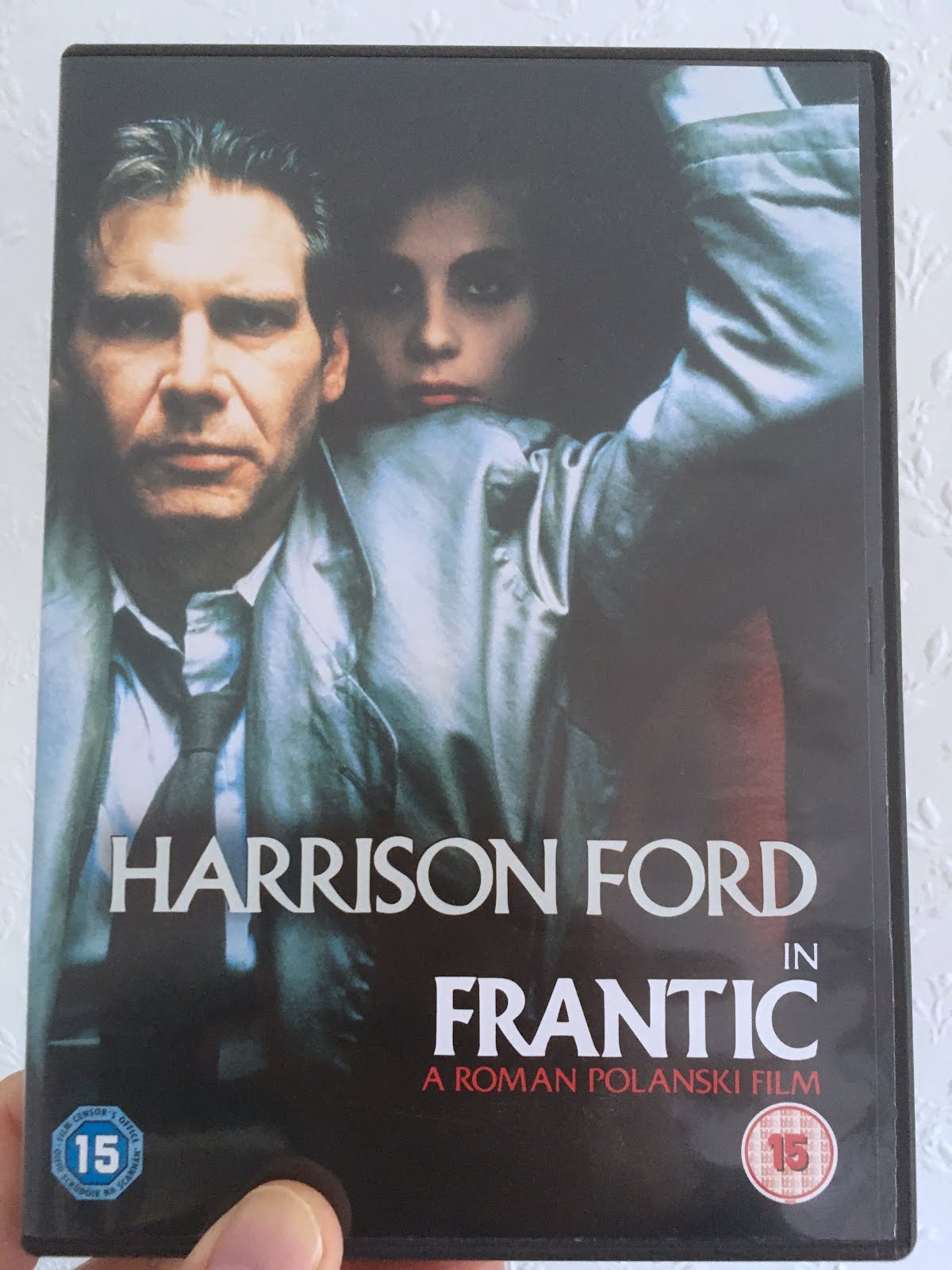
Frantic (1988)


Tense, constantly gripping thriller directed by Roman Polanski. Harrison Ford plays an American doctor in Paris whose wife is kidnapped from their hotel. In the absence of any help from the police or the US embassy he sets out to find her himself, aided only by a pretty young drug smuggler called Michelle (Emmanuelle Seigner).

It’s a taut and exciting narrative, with the mystery steadily deepening as Ford's character begins to learn what’s happening. There are moments of black humour, too, as his situation becomes more and more dire. The scene in which he scrabbles around on a slippery rooftop is a highlight.

Music is by Ennio Morricone, excellently judged as ever, with additional tracks by Grace Jones.

A Fistful of Dollars (1964)


Spaghetti western directed by Sergio Leone and with music by Ennio Morricone. Clint Eastwood, the “man with no name”, rolls into town and discovers two warring family factions. He cleverly plays them off against each other, initiating a cycle of escalating violence.

The film is entertaining and enjoyable, despite the major distraction of all the dialogue (including Clint’s) being dubbed on afterwards. It’s visually striking and surprisingly gory for the time. Eastwood is effortlessly stylish as the poncho-wearing gunslinger, even after being badly beaten up.

Bullitt (1968)


Steve McQueen is detective Lieutenant Frank Bullitt, tasked with protecting a witness for US Senator Walter Chalmers (Robert Vaughn). But of course things don’t go to plan. McQueen, as usual in his films, looks good and is a powerfully brooding presence without having to say much. He rarely seems to spark off other characters, and he never gets much dialogue.

I liked Jacqueline Bisset as his girlfriend Cathy and wished she had been in it more.

It’s a nice drama with a spectacular car chase in the streets of San Francisco, but the ending is oddly flat and disappointing with nothing really resolved. I understand that they wanted to keep it downbeat, but it felt very unsatisfactory.