Showing posts sorted by date for query earth. Sort by relevance Show all posts

Creation (2009)

An engaging biopic of Charles Darwin, directed by Jon Amiel. 

Darwin (Paul Bettany) attempts to complete On the Origin of Species while dealing with the grief of his daughter Annie’s death. He’s also semi-estranged from his wife Emma (Jennifer Connelly), and his theories about the beginnings of life on Earth are inflaming tensions in the God-fearing community. 

There are impressive scenes of nature, illustrating the idea of evolution as Darwin perceives it. 

Bettany’s compelling performance lifts the film and makes it highly watchable. Connelly brings a welcome complexity to her part as she tries to reconcile her love for her husband with her love of the God his life’s work debunks.

The Lovely Bones (2009)

A surprisingly moving story directed by Peter Jackson. 

In 1973, a girl named Susie Salmon (Saoirse Ronan) is murdered by a serial killer (Stanley Tucci). But rather than vanish from the story, Susie narrates what happens next from an “in-between” realm between Heaven and Earth. She explores the impact of her death on her family, who she seems able to reach and influence in subtle ways. That family is played, affectingly, by Rachel Weisz (Susie’s mother), Mark Wahlberg (her father), Susan Sarandon (her grandmother) and Rose McIver (her sister). 

It’s often an uneasy mix – and this is presumably deliberate – between the gruesome details of a serial killer at work and the almost whimsical dreamscapes that Susie now inhabits. She walks through psychedelic, oversaturated worlds that sometimes threaten to turn the film into a fantasy romp. But these sequences just about work because they can be seen to mirror the perceptions of a 14-year-old struggling to comprehend the enormity of what has happened to her. 

If you can get past the slightly jarring combination of gritty and fantastical, you can engage with some profound questions about life and death.

The Tree of Life (2011)

An amazing film directed by Terence Malick. On one level it’s a story of an American family and how they deal with a bereavement. But the film is also designed as a work of art, constructed to operate on multiple levels of symbolism and philosophical exploration. 

Early on it detours into a history of life on Earth (perhaps influenced by 2001), showing dinosaurs and the meteorite that forced their extinction. It then returns to the story of the family. Brad Pitt and Jessica Chastain play the parents of three boys, while Sean Penn plays one of those boys as an adult in the present day and struggling to come to terms with his past. 

There are so many impressionistic elements that you’re often unsure what to think and what, if anything, is actually happening in narrative terms. That can be frustrating if you are expecting anything close to a regular drama. Indeed, the dinosaur segment borders on the ludicrous. 

If the job of the film is to take you on an emotional journey, then it’s too muddled to succeed. But if you embrace the sheer ambition of the project – in terms of its visuals, music, editing techniques and production – it’s unlike anything else you will see.

Geostorm (2017)

Disaster film. 

The world has been saved from environmental disaster by a hi-tech space station (the actual science isn’t explained), but when it malfunctions extreme weather takes a deadly hit on Earth. It turns out that the tech has been sabotaged – with suspicion going all the way up to the US President – and it takes the station’s creator Jake (Gerard Butler) to save the world from total climate meltdown. 

The film is utterly ludicrous but quite entertaining if you don’t ask any questions. Jim Sturgess is laughable as Jake’s sweaty, anxious brother Max, who has family “issues” (and looks a bit like Chris de Burgh). Abbie Cornish plays his tough, secret-service girlfriend. Alexandra Maria Lara is the sensitive and appealing space station commander who becomes Jake’s love interest. Ed Harris is the U.S. Secretary of State serving the president, who is played by Andy Garcia. 

The script is wooden and the plotting is entirely predictable. But the CGI scenes of extreme weather are exciting and the action rattles along so quickly that you don’t have time to assess whether any of it makes sense.

The Lord of the Rings: The Two Towers (2002)

Second part of the trilogy. More running around Middle-earth uttering fairly ludicrous statements and looking serious. 

You simply need to take it at face value that this creature/thing can out-magic that creature thing, or that this mystic power can thwart that one. 

There’s little here that wasn’t done better in the first instalment, which had a more unified narrative. Also, the segments featuring the walking, talking living trees dragged and detracted from the dynamism of the big battle scenes. 

The best thing about the series is Viggo Mortensen as Aragorn Elessar. He’s fun to watch, unlike the loutish Gimli (John Rhys-Davies) and the silly baddie with hair like Cher (Christopher Lee). 

It suffers from “mid-trilogy” problems in that it has to build on or develop themes from the previous film without the luxury of being about to resolve any of them.

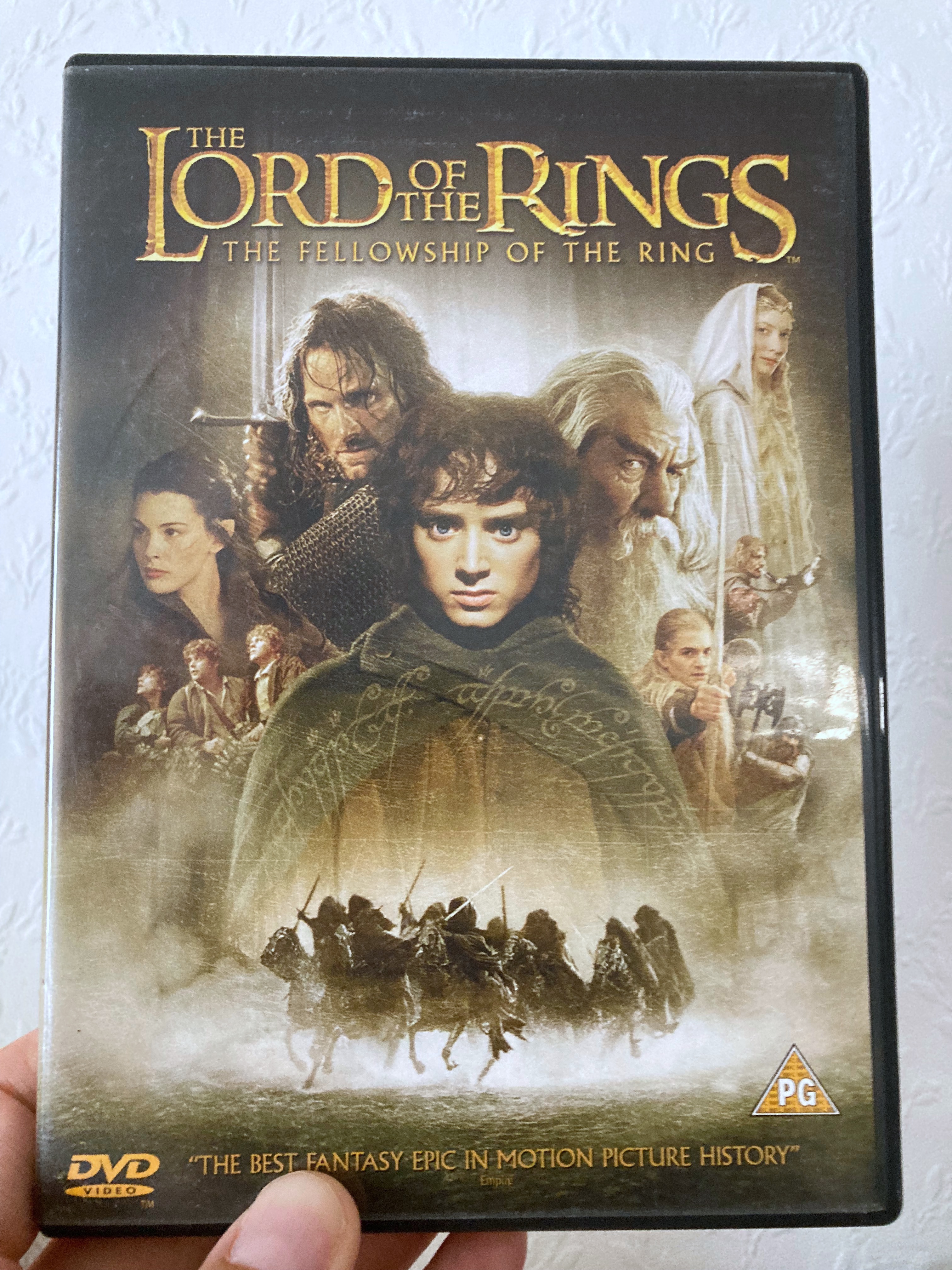
The Lord of the Rings: The Fellowship of the Ring (2001)

First part of Peter Jackson’s version of J. R. R. Tolkien’s fantasy epic. 

A hobbit called Frodo Baggins (Elijah Wood) journeys through Middle-earth to destroy a ring containing immense evil power. Along the way there are battles and mystical happenings that help and hinder his progress. 

I was somewhat dreading watching this – anything with wizards, elves, magic and beards is a big turn-off – but it was better than I thought. The storytelling is coherent and the acting is above par. 

Ian Holm, Ian McKellen, Liv Tyler, Cate Blanchett, Orlando Bloom, Christopher Lee, Sean Bean and Andy Serkis, among others, all do their bit. It’s ludicrous, but they take it seriously enough to make it just about hang together. 

My objection remains the arbitrary-seeming, make-it-up-as-you-go-along “rules” (i.e., this sword will glow blue when orcs or goblins are approaching) that typify fantasy. This thing has this power. That thing can defeat this thing. This other thing can destroy that other thing.

The Happening (2008)

Comically bad disaster film starring Mark Wahlberg and Zooey Deschanel as a couple on the run from a mysterious airborne virus that has something to do with wind and trees. 

The logic doesn’t really make sense. There’s a theme about planet Earth being angry at the way we’ve treated it. But the story can’t seem to tell the difference between the chemistry of trees and the weather that causes the wind that makes them move. 

The two stars are poorly directed and end up seeming laughable. It’s a shame because the premise – people in parks inexplicably kill themselves – could have been an interesting one. 

Somehow, The Happening grossed $163 million worldwide.

Moonraker (1979)

The usual plot: a bad man wants to take over the world, and James Bond – aided by weapons, gadgets and beautiful women – has to stop him. The “twist” this time is that some of the action takes place in space. 

It’s difficult to believe Roger Moore can be running around on a space shuttle and in a space station, but that’s exactly what we see.

The pros:

• There are some genuinely funny moments.

• Roger Moore is as charming as he ever was.

• Lois Chiles is appealing as space scientist as Holly Goodhead.

• The special effects are fairly good – especially when you see the shuttles taking off.

• The Shirley Bassey theme is one of the better Bond songs.

• M (Bernard Lee) and Q (Desmond Llewelyn) are reassuringly excellent.

• Jaws (Richard Kiel) is terrifying when he poses in costume at the Rio de Janeiro carnival.

The cons:

• It’s plain silly when Jaws gets a girlfriend (Blanche Ravalec as Dolly), falls in love at first sight and instantly changes personality.

• The moment when the film briefly becomes a western (Bond wearing a poncho and riding a horse to silly music) seems misjudged.

• It’s not clear why any of this needs to have taken place in space. Surely the billionaire villain Drax (Michael Lonsdale) could have just protected his “master race” specimens in some kind of bunker and poisoned Earth from ground level. It suggests that the success of Star Wars (1977) meant they just wanted to make a film with sci-fi elements, no matter how far-fetched.

2001: A Space Odyssey (1968)

Mind-bending sci-fi masterpiece produced and directed by Stanley Kubrick, with a screenplay written by Kubrick with Arthur C. Clarke. 

The “plot”, what there is of one, concerns the presence of an enigmatic monolith found on Earth in early human times, on the Moon and near Jupiter in the present day – presumably an artefact of extraterrestrial life. And a manned mission to Jupiter becomes increasingly precarious as the onboard computer, HAL (voiced by Douglas Rain), increasingly takes control of life-and-death decisions involving Bowman (Keir Dullea) and the rest of the crew. 

The film becomes increasingly abstract as it progresses. It’s impossible to say how it ends or “what happens”. It insists on you interpreting what you see.

Visually, it’s ridiculously ahead of its time. It still looks stunning now. Musically, it’s also awe-inspiring, with the classic “Also Sprach Zarathustra” being the perfect choice to express the epic, visionary quality of the film. The same goes for every piece of music chosen. It couldn’t be better matched to the visuals and the narrative. 

I also love the audacious slowness of 2001. Unlike so many films made now, it has the complete confidence and assurance to unfold at a glacial pace – often very quietly. And yet it’s never less than captivating. Let’s hope no one is ever silly enough to remake it.

Man of Steel (2013)

Found on a wall. 

This Superman reboot starring Henry Cavill is faster, noisier and slicker than the 1978 version with Christopher Reeve, but it has none of that film’s charm. Nothing seems remotely real, either. This is partly because of the excessive CGI (it looks like a slick computer game) and partly because of the fast edits. There are no “rules” in terms of the powers we see the heroes and villains use: anything can happen and anything does happen, but none of it carries any real “weight” or actually adds up to anything. The thrown-through-a-building effect is used again and again and ultimately becomes completely mind-numbing – partly because, despite all the endless scenes of destruction, no one ever seems to get hurt

Michael Shannon underwhelms as the evil General Zod. Certainly he’s no Terence Stamp. Amy Adams does her best as Lois Lane, although she’s not given much of a character to develop. Diane Lane is credible as Superman’s Earth mum, while Russell Crowe and Kevin Costner are both watchable as Superman’s Krypton dad and Earth dad respectively

In visual terms, it’s excessively filtered – another distraction.

The joy of Christopher Reeve’s Superman was watching him save lives again and again. Man of Steel has surprisingly little of that. Also, the relationship with Lois Lane – so integral to the Reeve films starring Margot Kidder as Lois – is completely and coldly undeveloped here. There’s virtually no romance. 

All in all it’s an expertly made yet completely empty experience.

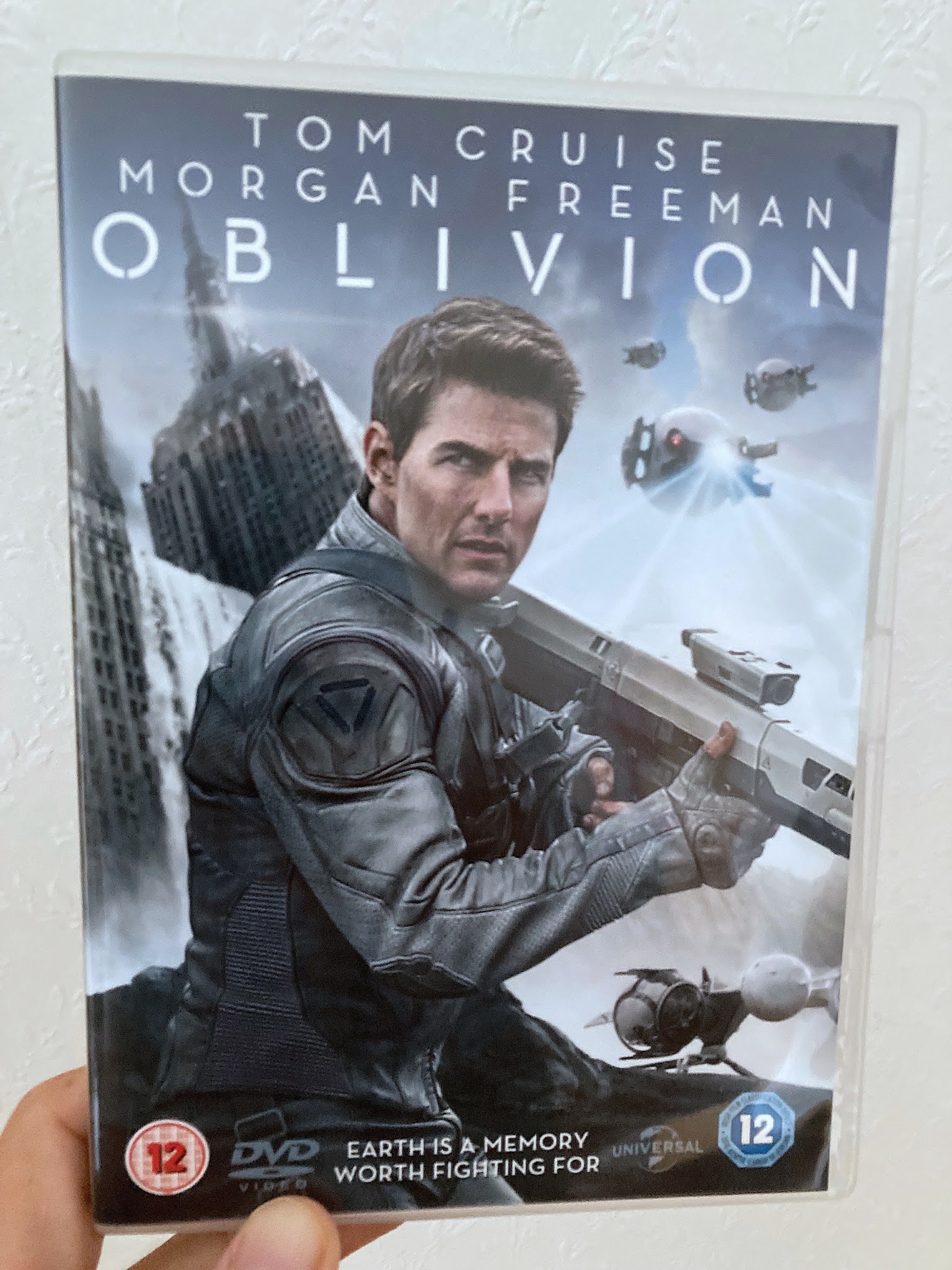
Oblivion (2013)

Derivative, shallow sci-fi starring Tom Cruise. I probably wouldn’t have bought this DVD, but I watched it because I found it being given away on a wall. 

The plot is rather confused, but Google usefully summarises it as follows: “Jack Harper, a drone repairman stationed on Earth that has been ravaged by war with extraterrestrials, questions his identity after rescuing the woman who keeps appearing in his dreams.”

That woman is Olga Kurylenko, who, like Cruise, hardly gets any dialogue at all. Another barely filled-in, completely thrown-away character is played by Morgan Freeman, who struggles to convey the grizzled leader of a band of human survivors. 

There are so many things wrong with Oblivion:

• As usual, Tom Cruise is a good-at-everything action-hero dullard who manages to save the world single-handedly. It’s Top Gun all over again. 

• In the absence of dialogue – or any kind of personality – Tom spends much of the film staring moodily yet conveying little emotion.

• Almost every element is borrowed from another sci-fi film. 

• We visit the remains of what used to be New York, but it’s nothing but lush, clean and green vistas. Where’s all the rubble and filth? Could it be transformed that thoroughly in just 60 years?

• There are plot holes aplenty. Best not to ask many questions. 

• Attempts to be “philosophical” end up hollow and self-conscious. 

• When we finally meet the alien presence, it’s a huge let-down. 

• The title has absolutely nothing to do with anything in the film. It's like they wanted a high-impact, single-word title, but all of the relevant words had already been taken.

Ad Astra (2019)

Brad Pitt stars in an existential sci-fi mind-bender. He’s an astronaut who leaves Earth in search of his father (Tommy Lee Jones), who is fixated on seeking intelligent life elsewhere in the universe. But that search has deadly repercussions for Earth and needs to be stopped.

The film asks intelligent questions about what’s important in life. It looks remarkably “realistic”, and there are moments of great beauty – especially around Jupiter. Pitt has never particularly impressed me with his acting, but he’s excellent here. He conveys the desperately lonely experience of being on your own in the vastness of space. 

Liv Tyler and Donald Sutherland play supporting roles.

Dr. Strangelove or: How I Learned to Stop Worrying and Love the Bomb (1964)

Cold War black comedy.

Apparently losing his mind, a US Air Force general (Sterling Hayden) orders a nuclear attack on the Soviets. This, we learn, will trigger a “doomsday machine” response so vast that will render Earth uninhabitable. With the clock ticking to call off the strike, we follow the story in three related threads – the struggle to retract the order from within the air base where the general is stationed, the progress of the B-52 plane that’s on the way to drop its bombs, and the discussions in the war room where the US president considers the options. 

Stanley Kubrick directs, and there’s a beauty to some of the black and white shots. Unfortunately, the film is constructed around Peter Sellers, who – for no apparent reason – plays three different roles. If you don’t find him hilarious (I don’t), you’re in trouble. Some of the satire hits the spot (a British RAF exchange officer not being able to call the president and avoid Armageddon because he doesn’t have sufficient spare change in his pocket), but a lot of it falls flat. It taps into a potentially rich seam of material regarding the futility of war and mutually assured destruction, but it’s too uneven and simply not funny enough to make those points in a satisfactory manner.

Starship Troopers (1997)

Stunning hybrid of sci-fi, horror and war film that cleverly masters those genres while simultaneously pastiching them. Directed by Paul Verhoeven, and based on Robert A. Heinlein's 1959 novel, it also works as ultra-black comedy in the way it satirises military propaganda. 

Earth is at war with a devastating species of bugs. A young soldier named Johnny Rico (Casper Van Dien) enlists to fight, and moves up through the ranks. He’s involved in different ways with two colleagues – “Dizzy” (Dina Meyer), who fights alongside him in the Mobile Infantry, and Carmen (Denise Richards), who is a gifted pilot. Blandly handsome and obedient, they perfectly epitomise the patriotic ideal. 

The effects are extraordinary, and they don't seem to have the slick veneer of CGI. It’s extremely violent, with plenty of bloody dismemberment presented in a semi-cartoonish manner, but it’s also a hugely entertaining romp that's both intelligent and memorable. I liked it even more on second and third viewings.

Ender’s Game (2013)

A sci-fi saga presumably aimed at 12-year-old boys, this version of Orson Scott Card's 1985 novel is entertaining and races along in an exciting way.

Ender Wiggin (Asa Butterfield) is an unusually talented child selected to join an orbiting military academy. He is one of many young people being trained to lead Earth’s defence against invading aliens named the Formic. Harrison Ford plays his mentor, Colonel Hyrum Graff, while Ben Kingsley is Mazer Rackham, a war hero from the aliens’ first attack.

For some reason the training segments of the film – complete with drill instructor – seem to deliberately pay homage to those in Full Metal Jacket, a film that the young audience won’t even be aware of.

The visuals are often remarkable, with seamless zero-gravity CGI and impressive videogame-like effects. 

In places it can all seem a little silly – a bunch of kids taking everything very seriously indeed – and although it attempts to introduce moral issues, these aren’t explored in great depth.

But ultimately it’s a well-paced romp, and the double twist of the ending certainly wasn’t predictable.

Apollo 13 (1995)

Ron Howard’s version of the events of April 1970 in which a planned Moon mission goes horribly wrong after an explosion loses vital fuel and oxygen from the craft. Instead of walking on the lunar surface, as they had hoped and dreamed, the three astronauts find themselves in a desperate struggle to return to Earth. 

It’s a taut drama that steadily builds tension. We know that disaster is on the way, so there’s added suspense in waiting for that moment. I especially liked the Mission Control sections, which showed how much of an ingenious team effort the rescue attempt was. 

The casting and acting is spot-on, and makes this film stand out:

• Tom Hanks plays Jim Lovell, from whose memoir this was adapted. Hanks does his usual thing, but it works. His almost bland demeanour seems to match the highly sought after brave-but-calm profile of that of a well-adjusted astronaut.
• Kevin Bacon is perfectly acceptable as backup Command Module pilot Jack Swigert even though this actor is often now seen as a figure of fun.
• Bill Paxton is solid as Lunar Module pilot Fred Haise.
• Kathleen Quinlan is Lovell’s wife, trying to hold it together at home with the kids. The “worried wife” role can’t be a rewarding one for any actor, and too often that part is underwritten (see Deepwater Horizon or The Untouchables), but Quinlan convincingly portrays someone whose personal nightmare becomes a drama watched by the entire world.
• Ed Harris is impressive as the tough but compassionate Flight Director Gene Kranz.
• Gary Sinise is excellent as pilot Ken Mattingly, who misses out on the mission itself but helps the crew by mirroring their predicament in a NASA flight simulator. 

I liked the fact that in the film, as in real life, it wasn’t about luck or heroism or faith or fate. It was science that saved them – a triumph of knowledge and rational thought. A lesson to be learned there for all of us.

Anna Karenina (2012)

When I first saw this lavish Joe Wright/Tom Stoppard adaptation of the Tolstoy novel, at the cinema in 2012, I wasn’t sure what to make of it at all. The radical decision to stage many of the scenes in a theatre set means that you never know quite what to believe – is the action really taking place or is it a stylised manifestation of a character’s feelings? On second viewing, I began to see it as a masterpiece that deliberately pulls apart the “reality” it constructs – perhaps to suggest that everything we do is a sort of fiction. It has a lot of fun with this – for example, switching from footage of a real train to a toy train and seeming to delight in the fact that it’s obviously a miniature model. In another scene, a letter is torn up and thrown into the air. The pieces keep falling because they have become snowflakes. Sometimes a door or window on the stage opens to another place entirely. There’s a sort of Escher logic to it, and you wonder how on Earth they planned it all so cleverly.  

The danger is that such a stylised approach might limit the film’s emotional impact, but if anything it works the other way, elevating simple scenes into works of art that magnify the characters’ situations. It would presumably have been so much easier to make the film as a standard costumer, but instead it operates on a higher level. 

Keira Knightley is appealing and convincing in the title role. Jude Law looks nothing like himself as her rigidly controlling husband. Aaron Taylor-Johnson plays the dangerous, icily charming Count Vronsky, who Anna has a devastating affair with. The love story is expertly told. There’s a parallel tale of what happens when passion and freedom conflict with social conformity. Should you follow your heart or do what’s expected of you by your peers and your class? For Anna, of course, neither option works out well.

Seeking a Friend for the End of the World (2012)


This was critically savaged and/or ignored at the time of release. In his one-star Guardian review, Peter Bradshaw wrote: “You will have had handfuls of wet sand in your swimsuit less irritating than this supremely irritating romantic dramedy.” But I liked the title and the concept – in three weeks the Earth will be destroyed by an asteroid. As society breaks down, everyone has to address the question of how they use the time they have left.

Penny (Keira Knightley) and Dodge (Steve Carell) are neighbours in the same apartment block. When looting and rioting hits their street, they take off together on what turns out to be a sort of road trip. They are opposites in many ways – she’s English, he’s American; she’s 28, he’s middle-aged; she’s giddily naive, he’s reliable, worldly and wise – but inevitably they begin to fall for each other as their time runs out. The blossoming love story points at bigger questions: what really matters in these extreme circumstances? Why does it matter? Who should you spend your last few hours with? Friends and family? A lover? Or a random stranger in the new climate of anything-goes lawlessness?

I can see why Peter Bradshaw was irritated, but I think Keira Knightley’s scatty, free-spirited persona is deliberately annoying. She needs to be, initially, because the film is partly about her character’s progression to maturity as she finally meets someone she really cares about.

One thing fails to ring true, though. She’s supposed to be a music fan and she saves a selection of records from her apartment during the riot. (There are prominent displays of LPs by Herb Alpert, John Cale, Leonard Cohen, Lou Reed and Scott Walker at various points in the film.) But there’s something oddly unconvincing about K.K. as a record buyer, even given the faddishness of vinyl in younger consumers. She even self-consciously says: “I love records. You really have to take care of vinyl.”

It’s not a masterpiece – it could certainly have been funnier, and some of the scenes could have worked better – but it seems more relevant than ever during these dark times of a global pandemic. And despite the unevenness, I was both moved and amused.

War for the Planet of the Apes (2017)


The third and final film in the reboot series significantly escalates the drama of the first two (Rise of... and Dawn of...), ramping it up to apocalyptic levels while retaining sharp focus and intelligence.

Apes and humans are now at war, with “Caesar” (Andy Serkis) and his companions being hunted down by army forces to determine the dominant species on Earth. These soldiers are led by Colonel J. Wesley McCullough (Woody Harrelson), a crazed messiah-like figure clearly modelled along the lines of Colonel Kurtz in Apocalypse Now. (Oddly enough, the film makes that connection explicit with graffiti in a tunnel that reads “Ape-pocalyse now”.) The showdown intensifies when the apes are enslaved and a rival human faction comes to the military facility to attack the Colonel and his men.

It’s an emotional story with a surprisingly satisfying ending. I had no idea how it could be resolved, but director Matt Reeves pulled it off as he did with the previous instalment.

As with the rest of the trilogy, this film asks profound questions about human behaviour. It repeatedly shows the apes as being more compassionate than the destructive humans intent on their self-defeating struggle for power. There’s a disturbing brutality for a “12”-certificate film, made all the more affecting because the CGI apes seem so uncannily real.

At a key moment close to the resolution, Caesar finds himself in a position to obliterate the Colonel but acts more “humanely” than any of the humans. It’s a sobering message for all of us that animals might actually be more sophisticated than we like to believe we are.

Flash Gordon (1980)


Highly entertaining adaptation of the comic-book hero’s exploits, wisely playing up the outlandish, cartoonish aspects of the story. The colours are super-bright, the costumes are wonderfully extravagant and everything is over-egged to the nth degree. It’s pure pantomime and it’s enormous fun. 

Sam J. Jones plays the hero as an almost blandly all-American beefcake football star. Melody Anderson is tremendous as Dale Arden, the travel agent who accompanies Flash to Mongo and falls in love with him. Topol is Dr. Hans Zarkov, the batty scientist who kidnaps the pair to investigate the extreme-weather peril Earth is enduring. Max von Sydow is perfect as evil Emperor Ming the Merciless, as is Ornella Muti as his sultry and traitorous daughter Princess Aura. Timothy Dalton (as Prince Barin) and Brian Blessed (as Prince Vultan) are the resistance leaders who join up to help Flash and his friends fight Ming’s empire. Blessed is a joy to watch – a constantly guffawing warrior “hawkman” kitted out in big wings. 

It’s made all the more thrilling and exciting by the soundtrack by Queen. The band contributed not only the famous theme tune, but also all of the incidental music as well. 

Peter Wyngarde plays the Darth Vader-like General Klytus. And Blue Peter presenter Peter Duncan has a cameo as a man who has to put his hand in a hole in a tree without being stung by a tree monster. 

Although it’s deliberately daft and cheesy, there’s an uplifting message in there about the power of humanity to display kindness and overcome the forces of evil.

A glorious celebration of silliness.