Showing posts with label Starring: Julia Roberts. Show all posts

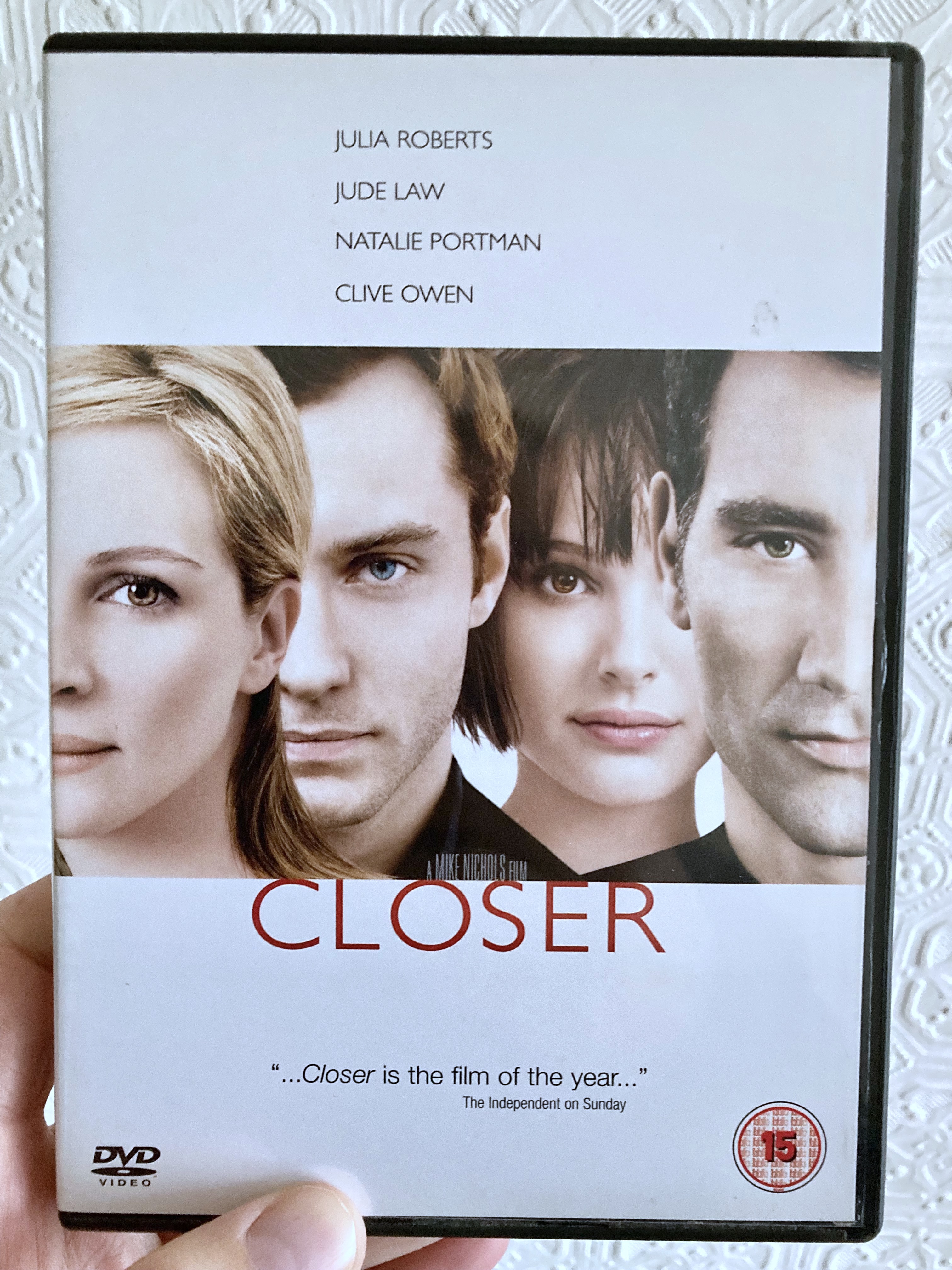
Closer (2004)

Drama directed and produced by Mike Nichols, based on a 1997 stage play by Patrick Marber. 

The story deals with the intersecting relationships of two men and two women. Clive Owen and Natalie Portman are both excellent at presenting complex, rounded characters. Jude Law just does his usual Jude Law thing. And Julia Roberts is oddly drippy and underwhelming with a character that’s barely there – to the extent that you have no idea why two men would be obsessed with her. 

It ends up a little overwrought, with lots of rather pompous statements about truth and honesty uttered by characters who are all over the place. You feel the writing tries too hard to be shocking and morally confrontational. As an account of intense human emotions it’s compelling but difficult to like.

Mona Lisa Smile (2003)

Drama set in the early 1950s, directed by Mike Newell.

A free-thinking art teacher named Katherine Watson (Julia Roberts) starts working at a private school where women are trained to be good wives who will obey their husbands. Watson encourages them to think beyond those boundaries and question the roles that have been selected for them. 

It’s nearly brilliant. The four main students are excellently played by Kirsten Dunst, Maggie Gyllenhaal, Julia Stiles and Ginnifer Goodwin. Roberts is somehow less convincing – a rather po-faced character, drawn in the broadest strokes. Also, Roberts somehow seems like she’s from the 1990s rather than the 1950s, so you can never quite believe in her. It’s almost like a time travel film in which she’s a social visionary from the future who comes to enlighten the girls of the past.

The film makes lots of points about social roles but it’s just too simplistic to carry any real weight. Instead, it ends up being a rather wishy-washy compromise about doing what’s right and following your heart. 

Tori Amos has a cameo as a wedding singer. Juliet Stevenson has an intriguing role as a rebellious lesbian, but she’s cast out of the school and the film too early.

Confessions of a Dangerous Mind (2002)

Biopic directed by George Clooney. That fact alone sets alarm bells ringing – I couldn’t finish his film Leatherheads (2008) and I barely got through The Monuments Men (2014), as they were simply too self-conscious and annoying. He’s fine at surface-level tricksiness, but there’s little emotional depth and his “funny” scenes fall flat. 

This film is marginally better. Chuck Barris (played by Sam Rockwell) is a successful TV producer who also kills people for the CIA. He’s recruited by George Clooney, works alongside Julia Roberts and is in a relationship with Drew Barrymore. 

The story is interesting, and Rockwell and Barrymore have real chemistry together, but Clooney’s direction is awkward and gimmicky. He regularly changes filters and keeps reminding you that you’re watching a film, rather than simply letting you become immersed in it. 

The film dodges perhaps the most interesting aspect of Rockwell’s life – the possibility that all of his CIA deeds were completely invented and never took place. That would have made for a whole extra dimension to the story, but it seems that Clooney is a hamfisted director who just couldn’t quite handle the material.

Michael Collins (1996)

Biopic of Michael Collins (played by Liam Neeson), the revolutionary Irishman who leads a guerilla force against the UK during the Irish War of Independence.

Neil Jordan directs, but it doesn’t feel like a Neil Jordan film. 

For some reason, I found it difficult to sustain interest. The narrative didn’t make a strong enough case for why these events were important or why we should care. And it doesn’t explain how Collins, out of so many people, rose to prominence. 

Liam Neeson wasn’t at his best. Julia Roberts has charm but was underused as his love interest. The accents were distracting – especially in the case of Alan Rickman’s awkward portrayal of Éamon de Valera. Only Stephen Rea, as Ned Broy, was truly convincing.

Money Monster (2016)

Tense and original thriller starring George Clooney as Lee Gates, the presenter of a finance-themed TV show. 

Gates is taken hostage, live on air, by a viewer who lost his money by following investment advice given on the programme. Julia Roberts, meanwhile, is the show’s producer, speaking into Lee’s ear and trying her best to keep him alive. 

Directed by Jodie Foster, this is a hugely entertaining film. Clooney and Roberts are at their best. The film does a good job of sustaining the tension, and the show-within-a-film device works extremely well.

Eat Pray Love (2010)

Extremely annoying adaptation of the popular memoir by Elizabeth Gilbert. 

Julia Roberts stars as an American who leaves her husband, finds a boyfriend, leaves her boyfriend and then travels to Italy, India and Indonesia to “discover” herself. There’s no explanation of why she was unhappy in either relationship, nor of how she can afford these open-ended wanderings. 

She comes across as a pampered, fairly self-obsessed individual. That would probably be fine – the film isn’t obliged to create a character you like or identify with – but for the shallow presentation of her journey to enlightenment. There are long, lingering shots that dwell on the foods she eats and the landscapes she passes through. The film fetishes food in a way that’s genuinely intrusive on the narrative. Italians are beautiful people eating beautiful food and speaking a beautiful language, the film suggests – in a woefully simplistic and two-dimensional manner. But if the character loves Italy so much, why does she move on to India? 

Most annoyingly of all, she’s forced to make a big decision at the end of the film and she makes the wrong one. It takes a man with no teeth to point out what she should stick with another man (Javier Bardem). So the film shows us that she still lacks wisdom and appears to need men to guide her. So much for being enlightened.

Sleeping with the Enemy (1991)

Thriller starring Julia Roberts as a woman married to the controlling, abusive Martin (Patrick Bergin). She fakes her death and escapes to begin a new life, but he pursues her…

It’s a competent thriller with plenty of suspense and some real scares. The main flaw – and it’s a big one – is that Martin lacks charm and magnetism. You can’t imagine her ever having been attracted to him. He doesn't have any presence. The part would be so much more effective if he came across as funny, popular and confident – rather than an obvious weirdo with zero charisma. 

Julia Roberts is excellent, however. I like the understated way she plays her character. 

The title isn’t quite right, but perhaps was intended to give a “sexy” allure to a film with the very unsexy theme of domestic violence.

Stepmom (1998)

Hot-shot photographer Isabel (Julia Roberts) tries to get on with the kids of her new partner Luke (Ed Harris) from his previous marriage to Jackie (Susan Sarandon). Then Jackie, the perfect mother, is diagnosed with cancer and Isabel, who Jackie distrusts and resents, needs to step in and take a greater role in the children’s lives. 

It’s a reasonable premise and the three leads are all charismatic and watchable. What slightly ruins the film is the presence of two child actors (Jena Malone and Liam Aiken) who seem a little too self-conscious and self-aware. I never really believed they were real people with real feelings – perhaps because they speak lines that were clearly written for them by adults. 

The emotional draw is watching the two women come to terms with their situations and with each other, which of course they eventually do. No one seems to mind that Ed Harris isn’t around much. Also, as in so many films, the characters’ wealth and upward mobility is never in question. Jackie lives in a mansion that seems to get bigger every time we see it. That’s not really a flaw of the film – rich people have problems, too – but it does seem to lessen any drama that the script attempts to build up.

August: Osage County (2013)

A dysfunctional family get together for the occasion of a funeral. The unhinged mother (Meryl Streep) has mouth cancer and a pill addiction. Her three daughters (Julia Roberts, Julianne Nicholson, Juliette Lewis) all have domestic problems of their own. And their attempts to draw together as a family end in bitter recrimination. 

Adapted from a play by Tracy Letts, this is a hugely OTT drama. The all-star cast also includes Sam Shepherd, an oddly miscast Ewan McGregor, Benedict Cumberbatch, Chris Cooper and Dermot Mulroney. 

They all deliver solid performances, but the problem is that it’s so overwhelmingly overwrought that it’s almost farcical. And not in a comical way, either. The endless screaming became a chore and the refusal to allow even a glimmer of positivity was wearing indeed. It was such a bottomless pit of misery (with no contrasts or light and shade) that it couldn’t really engage as a drama. 

Streep seemed to be wearing a facial prosthetic to make her look older and sicker, and I found that offputting. 

Another flaw was that I couldn’t believe someone as vindictive, mentally unstable and chemically unbalanced as Streep’s character could have kept the family’s big secret for all those years, only to casually reveal it at the moment she did. 

A far stronger family drama is The Family Stone, which had wit and subtlety on its side.

Charlie Wilson’s War (2007)

Directed by Mike Nichols, this is based on a true story. 

A US congressman takes it upon himself to assist the Afghan troops suffering at the hands of Soviet invaders by raising the funds to equip them with weapons.

Tom Hanks is ideally cast as the charming, heavy-drinking Wilson. Julia Roberts is good as an influential socialite Joanne Herring, but doesn’t have enough scenes to really shine. Better is Amy Adams as Wilson's personal assistant Bonnie Bach. Philip Seymour Hoffman is charismatic as CIA operative Gust Avrakotos. Emily Blunt is weirdly underused in a role that gets very little screen time.

Hanks is deliberately ambiguous and the film steers clear of passing judgement on his character. The story is excellently told, so I’m not quite sure why I didn’t enjoy it more. Perhaps it's because it aims at comedy in places but could have been much funnier.

Duplicity (2009)

Former CIA and MI6 secret agents Claire (Julia Roberts) and Ray (Clive Owen) work as corporate spies. They become romantically involved and decide to pair up as a team. The stakes are raised when they have the chance to earn themselves $35 million, but the problem is that they simply cannot trust each other. There are hints of The Thomas Crown Affair, but it’s less skilfully handled. 

It’s nearly an engaging comedy thriller, but the “funny” bits really aren’t funny enough. Also, there are so many bluffs and double-bluffs that it can be tricky to follow. Ultimately, the whole scam scenario is so unlikely that it’s difficult to believe. 

Owen and Roberts always appeal but they can’t really shine in such a self-consciously tricksy, disjointed narrative. In fact, the film’s flaws are built in from the very beginning: the characters have a deliberate coldness to indicate their professionalism and mutual distrust. But that coldness makes them – and their story – a lot harder to like. One solution would have been to spice up their encounters with a little more passion (which worked in The Thomas Crown Affair), but Duplicity, which has a “12” certificate, opts not to take that route. 

On the plus side, it’s refreshing to see a thriller that doesn’t include any guns or killing.

Larry Crowne (2011)

Strange – and strangely enjoyable – romantic comedy that’s neither especially funny nor romantic. 

Tom Hanks plays a middle-aged man who loses his job and goes to college to educate himself. There, he develops a friendship with a much younger woman (Gugu Mbatha-Raw) and also with his teacher (Julia Roberts). Both of these relationships transform him. Before long, he’s riding a scooter with a gang, wearing more fashionable clothes and sporting a less fusty haircut. 

It’s odd because the tone is so unusual. Parts of it are like a gentle drama. There’s subtle wit, but it doesn’t really emerge until the second half – and even then there are few laughs. Also, there are elements of the story that simply don’t ring true. 

But Hanks and Roberts are appealing and you find yourself rooting for them to get together, so the film must be doing something right. I found myself liking it a lot, despite not thinking it quite worked.

Notting Hill (1999)

Romantic comedy written by Richard Curtis. 

William Thacker (Hugh Grant) works in a travel bookshop in Notting Hill. One day a famous actress (played by Julia Roberts) walks in. They begin an unlikely romance, but fame and other matters complicate their relationship.

It’s a sweet and funny love story. Grant and Roberts are both excellent. As with other Curtis narratives, a bunch of friends and relatives act as a sort of Greek chorus, commenting on the action and helping to move it along. These are all excellent in their own right. 

Grant is particularly appealing in this role. He seems so relaxed and at ease that his scenes are just a pleasure to watch. 

Rhys Ifans is a little too silly as his flatmate, and you cannot believe that someone as sensitive and gentle as Thacker would like or tolerate him. 

Also on the down side, there’s conspicuous product placement. And the music (Boyzone, Ronan Keating) is often terrible enough to take you out of the story. 

But ultimately it’s slick and charming. The characters come alive and the romance is touching.

Erin Brockovich (2000)

Superb biographical whistleblower thriller/human drama starring Julia Roberts as the young legal clerk who took on Pacific Gas and Electric Company (PG&E) and sued them for water contamination in Hinkley, California. 

Roberts is remarkable in this role – she makes every moment of every scene count. It’s such a vivid and entirely believable performance that it's difficult to imagine anyone else doing it better. Albert Finney is excellent, too. He plays her boss, a lawyer nearing retirement, whose cynicism is challenged by Erin’s refreshingly unorthodox approach. 

Directed by Steven Soderbergh, it looks good too. He really captures the beauty of the dusty California landscapes that contain an ugly secret. It’s a long film, but every detail matters and contributes something to the unfolding drama. Character and story are kept central throughout.

The Mexican (2001)

Foolish amateur gangster Jerry (Brad Pitt) has to perform “one last job”, which involves transporting a legendary gun from Mexico back to the USA. Predictably, nothing goes to plan. Events are further complicated when his girlfriend (Julia Roberts) is kidnapped by another gangster (James Gandolfini) and the pair develop a strange friendship. 

This is a comedy thriller with an unusual tone. It flits between tense moments and genuinely funny ones – a tricky balancing act that director Gore Verbinski pulls off with skill. 

Brad Pitt is better than usual because he’s playing an idiot and therefore doesn’t need to seem credible. Roberts is terrific – vividly full of life and personality – and her evolving relationship with Gandolfini provides the heart of the film. 

Gene Hackman has a cameo. Plus, there’s a nice sub-plot about a ferocious dog.

Pretty Woman (1990)

Excellent romance starring Richard Gere as a ruthless businessman and Julia Roberts as the prostitute he initially hires and ultimately falls for. 

I’d heard a lot about this film but somehow never seen it until now. And what a gem it is. Gere’s acting seems to have improved exponentially since An Officer and a Gentleman. He has real presence. And Roberts has an effortless charm. Together, they have plenty of chemistry. 

The story is simple but expertly told. It’s subtle, too, where it could have been obvious: Gere’s transformation is slow and realistically gradual, rather than a character U-turn. 

There are two criticisms I would make. Firstly, it idealises Vivian's profession. She makes one reference to men always hitting her, but it gives little impression of the true dangers of her work. Secondly, it has the usual tropes of US 80s/90s films in that upward mobility is presented as the only real option to aspire towards.

Those points aside, it’s a pleasure to watch.

Mystic Pizza (1988)


Two sisters (Julia Roberts and Annabeth Gish) plus their best friend (Lili Taylor) work in a pizza restaurant in a small Connecticut fishing town named Mystic. Each of them experiences a relationship that challenges and changes them in some way.

It’s a funny and emotional coming-of-age drama. The script is absolutely spot-on. The characters are extremely well drawn and so entirely believable that you laugh when they laugh and weep when they weep.

The three stories are so expertly woven together that it feels like one plot. And in fact there’s a fourth story, which is about the way of life in the town, and this too is handled brilliantly. There’s a strong sense of place, and you really feel drawn into this small community.

There’s nothing you could cut or add to make Mystic Pizza work any better. It’s a mini-masterpiece.

Steel Magnolias (1989)


Moving comedy-drama adapted from Robert Harling’s play. Indeed, it works very much as a theatrical piece with long, set scenes and acts. The story concerns six women in a small Louisiana town and examines how their lives interact. At the heart of it is a mother–daughter relationship. There are laughs and tears aplenty. Dolly Parton is a natural as the local beautician. Daryl Hannah proves she really can act as the timid newcomer who gets religion. Julia Roberts is the just-married daughter battling severe diabetes and Sally Field is her endlessly worried mother. Shirley MacLaine and Olympia Dukakis are also just right for their parts as older members of the community. The male characters (including Sam Shepard as Dolly Parton’s distant husband) are deliberately played down, allowing the film to keep its focus on the six women. Things are slow to get going and I didn’t think I was enjoying it, but matters improve when the narrative kicks in and ultimately works round to an emotional and satisfying conclusion.

Ocean's Eleven (2001)


Completely unbelievable casino heist thriller. Some of the 11 criminals are caricatures, while Brad Pitt just eats during every scene. There are too many things in the plot that simply couldn’t happen, such as when they need to create a power cut and so steal a big piece of scientific equipment to release an electromagnet pulse that plunges all of Las Vegas into darkness. The guy with the English cockney accent is plain embarrassing. Why do American films and TV shows so often completely misjudge how English people speak? 

George Clooney is charming as Danny Ocean and Andy Garcia is convincingly nasty as the evil casino owner, but it’s too visually stylised and self-conscious to let you ever become fully engrossed in the story. 

Would I watch it again? No.