Showing posts with label Starring: Liam Neeson. Show all posts

Unknown (2011)

Effective but unoriginal Liam Neeson vehicle, directed by Jaume Collet-Serra. 

A professor (Neeson) has an accident on a work trip to Berlin. After he wakes up from a coma four days later, he has to prove his identity after no one recognizes him – including his own wife. Then another man claims to be him.

It’s engrossing if you don’t ask too many questions about the plot and if you don’t mind key elements of the story appearing to have been borrowed from the Jason Bourne films.

The Grey (2011)

Liam Neeson stars as the survivor of a plane crash in Alaska. He and his remaining oil industry colleagues attempt to walk to safety, battling icy storms and very hungry, very predatory wolves.

Director Joe Carnahan is effective at ramping up the tension, but the film – based on the short story “Ghost Walker” by Ian MacKenzie Jeffers – requires you to believe that the wolves are intent on hunting down the men and strategically picking them off one by one. I’m not sure how accurate this is in terms of the animals’ behaviour, but it’s certainly a negative depiction of the species, doing for wolves what Jaws did for sharks.

As it progresses the film takes on a more philosophical dimension, which just about works.

Shining Through (1992)

Ludicrous wartime thriller written and directed by David Seltzer, and based on a novel by Susan Isaacs. 

A secretary with a major law firm (Melanie Griffith) falls in love with a spy (Michael Douglas) and takes on her own spy mission in Berlin. Her only qualification is that she speaks fluent German (although, unlike the other actors, she doesn’t even try to put on a German accent) and has learned about intelligence work from enjoying films at the cinema. On this ridiculous premise, the film wobbles along in a highly entertaining manner. 

Liam Neeson isn’t too bad as the Nazi officer General Franze-Otto Dietrich. John Gielgud isn’t very well used as the agent “Sunflower”. And Joely Richardson is fairly watchable as the double agent Margrete von Eberstein. 

There are plenty of implausible moments but the film does have a few things in its favour. There are a few exciting sequences and Douglas and Griffith both have charm. But it’s so far-fetched and silly (with several unintentionally funny moments) that you wonder if it would’ve been better played as a comedy.


Suspect (1987)

American legal mystery thriller.

Cher stars as lawyer Kathleen Riley. Liam Neeson plays Carl Wayne Anderson, a homeless Vietnam vet who she defends. Dennis Quaid, meanwhile, is an agribusiness lobbyist. 

Cher is great, with an undeniable presence, and to the credit of director Peter Yates the film is never formulaic. But there are too many red herrings for the story to truly satisfy. And it's never entirely clear why the plot required Neeson's character to be deaf and dumb.

The Dead Pool (1988)

Directed by Buddy Van Horn, the final part of the Dirty Harry series is unfortunately the weakest.

Harry (Clint Eastwood) investigates a series of murders linked to a bizarre game in which the players predict celebrity deaths. The theme of fame is an intriguing one, but it's not explored well. 

Liam Neeson awkwardly plays Peter Swan, a director of music videos. He's all over the place with a wobbly accent that could be part-English, part-New Zealand. 

The one highlight is the sequence involving a remote-control car carrying a bomb through the streets of San Francisco. But overall, it's a hammy, sad end to a great series. 

On the plus side, Lalo Schifrin’s soundtrack still sounds terrific – even though in terms of textures he's clearly enbraced the styles of the 1980s.

Seraphim Falls (2006)

Western directed by David Von Ancken.

In the weeks following the US Civil War, Colonel Morsman Carver (Liam Neeson) and a team of men attempt to hunt down a man he wants to kill (Pierce Brosnan). 

Both leads are excellent. It’s probably the most actual acting Brosnan has ever done. 

There’s a relentless quality as they survive a sequence of grim fates, but unlike its spiritual cousin Revenant it doesn’t become ridiculous or unbelievable.

A Walk Among the Tombstones (2014)

Gritty adaptation of the Lawrence Block novel, starring Liam Neeson as former cop and ex-alcoholic Matthew Scudder. 

Scudder, who now works as a private detective, begins investigating a series of brutal kidnappings. 

It’s a little gruelling in places – there’s a theme about chopping people up, so there’s some gore. There’s a degree of tension from the suspenseful plotting, and the film is highly watchable without ever quite dazzling. 

The “Y2K” panic references stand out. It’s a story that’s preoccupied with the millennium in a way that seems baffling now.

Michael Collins (1996)

Biopic of Michael Collins (played by Liam Neeson), the revolutionary Irishman who leads a guerilla force against the UK during the Irish War of Independence.

Neil Jordan directs, but it doesn’t feel like a Neil Jordan film. 

For some reason, I found it difficult to sustain interest. The narrative didn’t make a strong enough case for why these events were important or why we should care. And it doesn’t explain how Collins, out of so many people, rose to prominence. 

Liam Neeson wasn’t at his best. Julia Roberts has charm but was underused as his love interest. The accents were distracting – especially in the case of Alan Rickman’s awkward portrayal of Éamon de Valera. Only Stephen Rea, as Ned Broy, was truly convincing.

The Next Three Days (2010)

An intelligent thriller directed by Paul Haggis. 

Russell Crowe stars as a man who wants to spring his wife (Elizabeth Banks) out of prison after she’s wrongly convicted of murder. It’s fascinating because he’s a school teacher – not your standard film action hero – and he makes mistakes.

It’s tense and exciting. To the film’s credit, there are sufficiently imaginative twists that I could never guess where the plot was going. 

Crowe has an elaborate chart on his wall revealing all of his illegal plans and I found that slightly ridiculous, but the fate of this chart is cleverly worked into the story in such a way that makes you appreciate it. 

Liam Neeson has a curious cameo as an expert at escaping from prisons. I thought he would return to the film at some point but he only features in that one scene.

Made in Italy (2020)

An artist (Liam Neeson) and his son (Neeson’s real-life son Micheál Richardson) struggle to deal with the loss of their wife/mother while attempting to sell their run-down old house in Italy. 

The film tries to be poignant but isn’t well-written enough to inspire much of an emotional response – despite the tragic parallels with the actors’ own lives. Instead, it ends up being a sort of fifth-rate Richard Curtis homage – a rather tepid light drama with only one genuinely funny line.

Lindsay Duncan adds a little grit as a stern estate agent. Valeria Bilello seems rather idealised and one-dimensional as the son’s love interest. Neeson has his usual rugged appeal but sleepwalks through the role. 

It’s easy-to-watch, and of course the Italian landscapes are seductive, but ultimately it’s all rather mediocre.

Taken 2 (2012)

The baddies who kidnapped Liam Neeson’s daughter in the first film want their revenge for the people Liam Neeson killed. So Liam Neeson goes off again, fighting brutal killers. But this time they have his wife... 

It’s formulaic, racist and trashy, but nevertheless extremely well-paced and fairly exciting. As the rather OCD, over-possessive Bryan, Neeson has a presence that holds your interest – even when the plot is unbelievable. And it is often unbelievable, such as his daughter’s incredible driving ability (even though she hasn’t yet passed her driving test). 

In terms of the title, they could have tried harder. How about these alternatives?
• Taken to the Cleaners (Bryan’s daughter is kidnapped at a launderette)
• Taken for Granted (Bryan’s “very particular set of skills” are overlooked)
• Taken Out (Bryan kills even more people)
• Taken Seriously (fewer car chases and shoot-outs; more soul-searching drama)
• Taken Over (the final instalment)

Rob Roy (1995)

Scotland, 1713. A Highlands clan chief guided by principles of honour (Liam Neeson) is happily married to Jessica Lange, but a financial loan from the Marquess of Montrose (John Hurt) backfires when he’s double-crossed by a nasty nobleman (Tim Roth). 

It’s entertaining fluff – well directed and highly watchable – with a surprisingly intelligent script wrapped around the story’s various twists and turns. 

The landscapes look terrific if you don’t mind the soupy “traditional” music that’s played whenever you see them. 

Neeson has charm and gravitas. Lange just has charm and handles a difficult role with great skill. Roth is compelling as a horribly corrupt schemer.

The Commuter (2018)

Former New York cop Michael MacCauley (Liam Neeson) has taken the same daily train in and out of the city, morning and evening, for 10 years. On the day he loses his insurance job, he is approached by a stranger (Vera Farmiga), who recruits him to commit a crime in exchange for money. 

This is a taut action thriller directed by Jaume Collet-Serra, who also made 2014’s Non-Stop. In fact, it’s quite similar in many ways: Neeson confined to a speeding vehicle while needing to solve a mystery to save his own life – and the lives of others. 

It’s both silly and exciting, and it keeps you guessing to the end. Sam Neill is underused as a police chief, and Elizabeth McGovern is underused as MacCauley’s wife.

 Neeson looks really old. He was about 65 at the time, and seems increasingly unlikely as an action hero by this point. But he does have charisma and there’s something compelling about watching him yet again work his way out of a fix.

Kingdom of Heaven (2005)

Ridley Scott is responsible for at least six great films (Alien, Blade Runner, Black Hawk Down, Body of Lies, Gladiator and Thelma & Louise), so it’s difficult to articulate just how disappointing this tepid 12th-century historical epic turns out to be. It’s a muddled account of power and politics set during the Crusades. 

Orlando Bloom underwhelms as the blacksmith hero descended from Baron Godfrey of Ibelin (Liam Neeson). After just one lesson from his dad, he becomes a master swordsman. There’s too much of him wandering around, ponderously contemplating his destiny and feeling “significant”. 

Eva Green (as Sibylla of Jerusalem) and Jeremy Irons (Raymond III of Tripoli) both try to do their best with the material, but – as with everyone in this film – their “characters” are sketchy outlines at best. They both look like they wish they were elsewhere. 

Even the visuals aren’t particularly impressive as the big battle scenes are ruined by endless slow-motion shots that take you out of the action rather than enhancing it.

Plot-wise, it’s confusing. Not only does it fail to provide any historical context about the Crusades, but it’s also completely lacking in terms of character motivations. You’re left unsure why anyone is doing whatever they are doing, and not really caring either.

The ending is a mess, too. The film peters out with very little resolved. A director’s cut adds 45 minutes that supposedly improve the film and help it to make sense, but if this standard edition wasn’t good enough it probably shouldn’t have been issued in the first place.

Taken (2008)

Former CIA operative Bryan Mills (Liam Neeson) has to track down his teenage daughter (Maggie Grace) after she’s kidnapped by Albanians in Paris. (She’d gone to follow U2 on tour around Europe.)

There’s not a great deal more to it, beyond a lot of fighting and shooting. Director Luc Besson prioritises violent action over everything else. Fast edits and jumpy cuts give it a visual energy, but those effects soon become wearisome. Likewise, there’s something blunt and one-dimensional about the whole thing compared to the Bourne or Bond thrillers. It’s not subtle or sophisticated and it’s probably not intended to be. 

Neeson has a certain unlikely charisma, but his character – a tough thug who loves his little girl – isn’t very well developed. 

It’s arguably quite racist, and it’s morally all over the place, with Mills engaged in torturing villains while still being portrayed as one of the good guys. 

Two sequels followed but I’m not sure I need to see them. Then again, if I find them in another three-DVDs-for-£1 offer I might just be tempted.

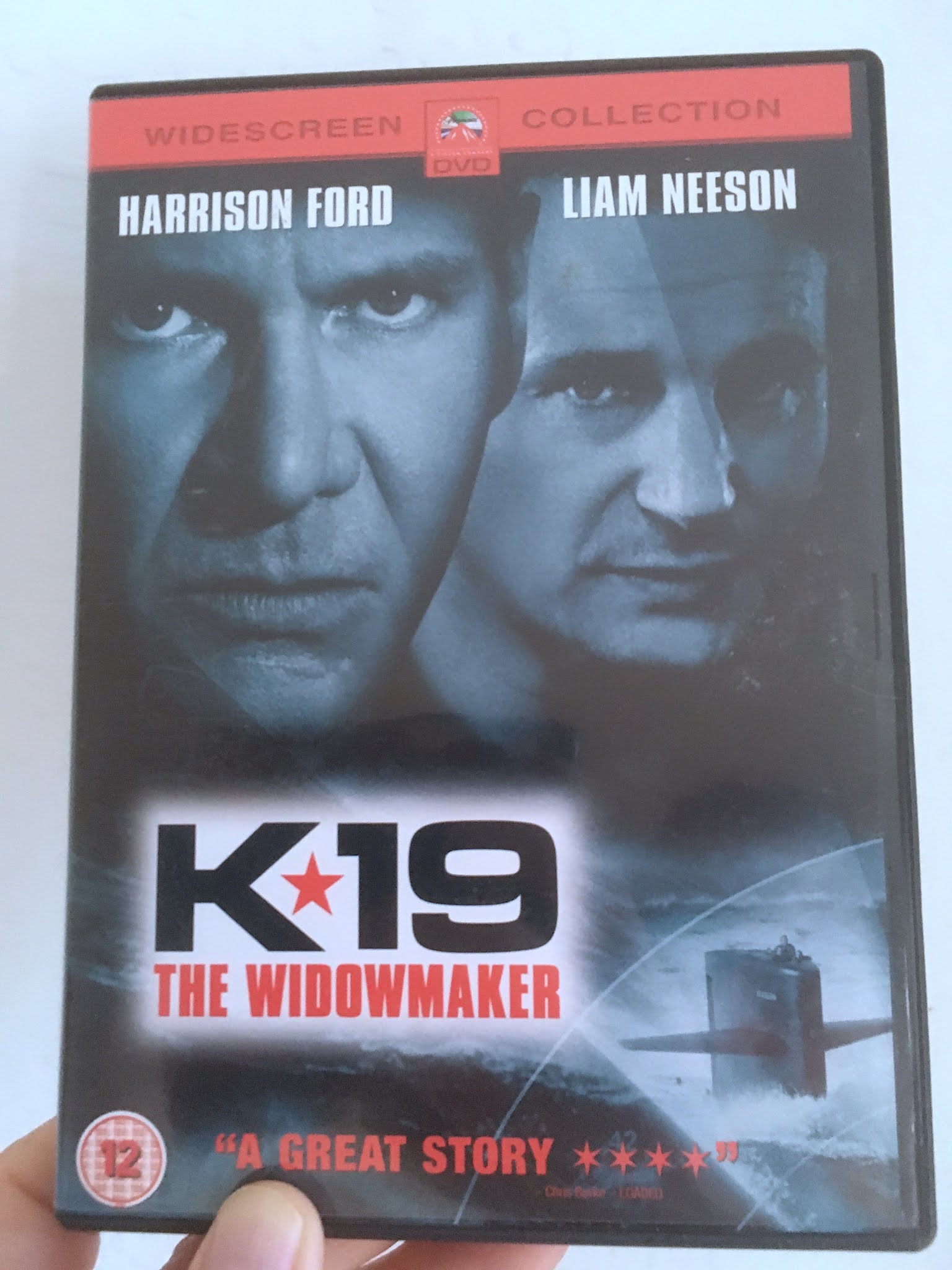
K-19: The Widowmaker (2002)

It’s 1961 and the Soviet Union sends a new nuclear submarine on a test mission. Mikhail Polenin (Liam Neeson) has been demoted from the role of captain and replaced by Alexei Vostrikov (Harrison Ford), who seems unreasonable and needlessly reckless, so tensions are running high from the outset. When a reactor coolant pipe bursts, the sub is in danger of blowing up – and destroying everything around it, including a US destroyer – risking dangerous military escalation and potentially World War III. 

As the drama unfolds and the crisis rapidly accelerates within the claustrophobic interiors of the craft, the two captains have to navigate their own prickly relationship as well as the relationships they have with their men, who clearly favour Polenin’s way of doing things. 

It’s an intelligent film that continually surprises. There are disturbing scenes that change the dynamic from intense Cold War thriller to compassionate human drama. 

The two leads are excellent and exude charisma, even if their Russian accents sometimes come and go.

Non-Stop (2014)


Highly enjoyable thriller about a Federal Air Marshal (played by Liam Neeson) who finds himself on a flight with a hidden killer who threatens to murder a passenger every 20 minutes. But in an exciting twist, the killer manages to frame the Air Marshal so that it is he who is suspected of being the terrorist.

Neeson is easy to like as the heavy-drinking, down-on-his-luck Bill Marks. Julianne Moore, always worthwhile, is also appealing as the woman he sits next to and finds an unexpected connection with.

The action scenes are superbly handled by director Jaume Collet-Serra – fluid and real-looking, but with a bright, clean hyper-reality about them. I also like the way the phone texts are displayed on screen as words floating in the air. It’s imaginative and a lot more interesting and convenient than repeatedly showing close-ups of a mobile phone screen.

It’s not perfect. The criminal rationale, when explained, seems far-fetched. The title is generic and could apply to any thriller. And Neeson being chummy with the little girl veers on sentimental tough-guy-with-a-heart-of-gold cliché. But there’s still easily enough excitement and drama to keep you hooked to the end.